
Public commenters and teachers press Cambridge finance committee on pay for expanded learning time at Fletcher Maynard Academy
Get AI-powered insights, summaries, and transcripts
Sign Up Free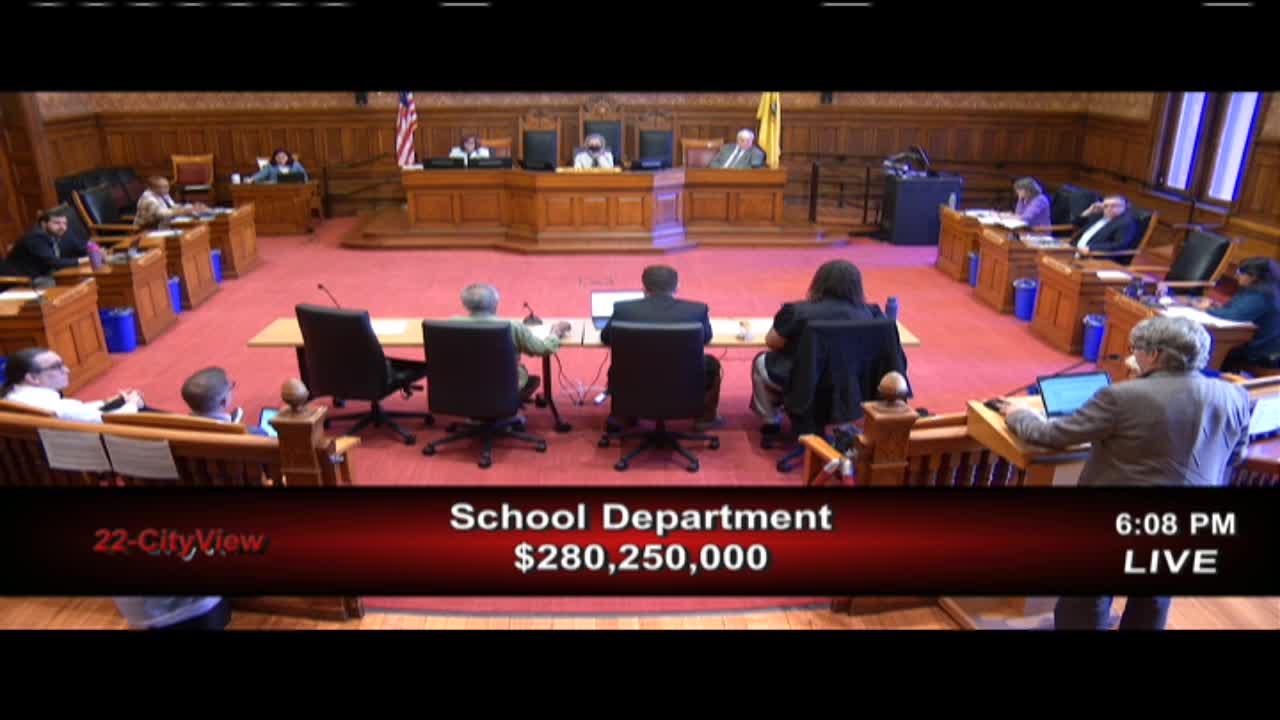
Summary
Cambridge City Council Finance Committee members heard public comment and an extended presentation on the Cambridge Public Schools proposed FY2026 budget — with multiple teachers and the Cambridge Education Association urging the committee not to forward the budget until the school committee guarantees fair, proportional pay for expanded learning time (ELT) at Fletcher Maynard Academy (FMA).
Cambridge City Council Finance Committee members heard public comment and an extended presentation on the Cambridge Public Schools proposed FY2026 budget — with multiple teachers and the Cambridge Education Association urging the committee not to forward the budget until the school committee guarantees fair, proportional pay for expanded learning time (ELT) at Fletcher Maynard Academy (FMA).
The most urgent issue raised during public comment was compensation for teachers required to work a longer school day at FMA. Dan Monahan, president of the Cambridge Education Association, told the committee he “asks you tonight to not approve the school department budget until you have heard assurances from the school committee that there’s adequate funding to pay teachers fairly for expanded learning time.” Several FMA teachers and staff reiterated that the proposed pay structure treats ELT as a flat stipend rather than proportional salary, which they said undervalues long‑tenured teachers and creates large pay differences between schools.
The concern centers on a district plan that extends some school days from about 6 hours 55 minutes to roughly 8 hours 25 minutes at ELT schools. Public commenters said the change amounts to a 16.14% increase in work time for many FMA staff and warned that a stipend-based approach would leave experienced teachers paid less than colleagues at other ELT schools.
Several teachers described personal impacts. Jeffrey Jardin, an inclusion specialist at FMA of 18 years, said the forced extension of his workday would require his family to move into Cambridge because his current 80‑mile daily commute would become unsustainable, and added, “Quite simply, FMA is worth it.” Other speakers said the difference in lifetime compensation between a flat stipend and proportional pay can be thousands of dollars for teachers at the top of the scale.
Interim Superintendent Murphy and Chief Financial Officer Ivy Washington presented the adopted FY2026 budget and the district’s process for developing it. Murphy said the administration and school committee had run an extensive public engagement process and defended the budget’s priorities, including investments in educator effectiveness, family engagement and curriculum alignment. He said the district identified roughly $500,000 as the incremental FY2026 increase tied to aligning ELT needs and acknowledged the district’s obligation to compensate educators fairly: “Educators, when they’re working more, need to be paid more and they need to be paid fairly.”
Washington gave a brief summary of federal grant exposure and said the district receives recurring entitlement grants (roughly $4.7 million) and federal support for school meals (about $2.6 million); together those federal pots total about $7.3 million and represent approximately 2.4% of the district’s budget. She also noted the district receives about $1 million a year in Medicaid reimbursement that flows to the city rather than the school operating budget.
Murphy addressed the salary structure that prompted teacher objections. He said earlier analyses led staff to propose a different configuration of tiered stipend versus flat stipend options because, under some scenarios, a flat stipend would yield higher total pay for FMA teachers given their positions on the contractual salary scale. He said the administration’s most recent proposal (conveyed in the days before the hearing) reverted to a tiered approach in response to objections, and he urged that detailed bargaining remain at the negotiating table while acknowledging the public concern.
Committee members asked detailed questions about chronic absenteeism, family engagement, tutoring and program evaluation. Multiple councilors pressed the administration to tie professional learning dollars and curriculum alignment to measurable results and to use the district’s accountability office to evaluate program effectiveness. Murphy said the newly structured accountability function will coordinate program and personnel oversight and urged patience for multiyear results while reiterating the district’s commitment to measurable improvement.
After questions and discussion the Finance Committee voted to forward the adopted FY2026 school budget to the full City Council with a favorable recommendation. The roll call recorded seven yes votes and two absences (Councilor Razin and Councilor Toner), and the motion carried.
Why this matters: The outcome affects both the timing of budget approval and ongoing collective bargaining over ELT compensation. Teachers at FMA and the CEA argued that inadequate pay for extended work risks staff attrition and harms continuity for high‑need students. School leaders said the budget does include investment to support ELT and that bargaining is the appropriate venue to finalize pay terms.
The Finance Committee’s favorable recommendation moves the adopted FY2026 school budget to the full City Council for final action; the ELT compensation dispute remains subject to collective bargaining and further school committee discussion.
Votes at a glance: Finance Committee vote to forward the FY2026 school budget to full City Council with a favorable recommendation — outcome: approved (7–0–2 recorded; Councilor Razin and Councilor Toner absent).