Get Full Government Meeting Transcripts, Videos, & Alerts Forever!
Get email alerts on the Zoning Setbacks topic
No spam. Unsubscribe anytime.
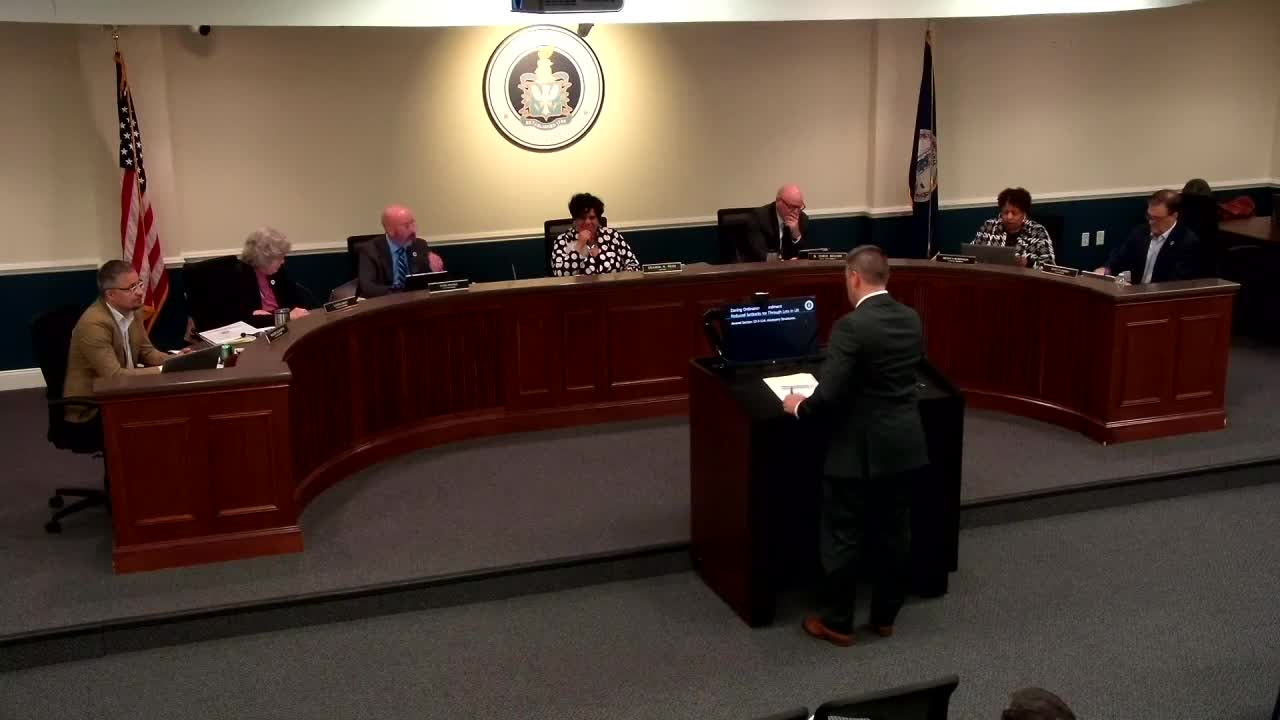
Harrisonburg council approves 5-foot setback for accessory buildings on through lots in UR district
Summary
Harrisonburg City Council on Tuesday voted 5–0 to reduce the minimum setback for accessory buildings on through lots in the city’s Urban Residential (UR) zoning district to 5 feet, reversing a staff recommendation for a 10-foot compromise.
HARRISONBURG, Va. — Harrisonburg City Council on Tuesday approved an amendment to the city zoning ordinance that reduces the required setback for accessory buildings on through lots in the Urban Residential (UR) district to 5 feet.
Adam Fletcher, director of community development, told council the amendment would change subsection d of section 10.3.1.14 of the zoning ordinance to allow accessory structures on through lots (parcels with public street frontage on two sides) to be placed closer to the public right-of-way than current rules allow. Fletcher said the change would be narrowly targeted, affecting roughly 49 parcels in and adjacent to downtown.
The amendment followed disagreement between the applicant and staff over how close accessory structures should be allowed to sit. The applicant had proposed a 5-foot setback; staff recommended increasing that to 10 feet to reduce potential conflicts with sight distance, driveway maneuverability and utilities. Fletcher said the UR district’s standard principal-building setback is 25 feet, so a 10-foot allowance would still provide a 15-foot reduction from that baseline.
Quentin Callahan, attorney for the applicants Chance and Miranda Ebersold, told council the goal was to resolve a Board of Zoning Appeals case through a narrowly tailored ordinance change. Callahan said, “Of the 49 affected parcels, 26 parcels already have accessory buildings within 10 feet of the rear property line. And of those 26, 22 have accessory buildings within 5 feet of the rear property line.” He argued the change would allow some existing nonconforming accessory buildings to become conforming and give property owners more usable yard space.
Council members questioned whether the smaller setback would create safety problems for drivers backing out onto narrow rear streets. One council member said the difference “between seeing around the corner of your car” could be critical and favored the staff-recommended 10-foot setback. Staff responded that 10 feet is often the preferred zone for utilities and makes future right-of-way widening and street improvements less complicated and less costly to the city.
Council first voted on a motion to adopt staff’s recommended 10-foot setback. That motion failed on a 2–3 roll call vote (two yes, three no). Council then voted on an amended motion to adopt the applicant’s requested 5-foot setback. The second motion passed unanimously, 5–0.
Votes at a glance - Motion to adopt 10-foot setback (staff recommendation): failed, 2 yes, 3 no. - Motion to adopt 5-foot setback (applicant proposal): approved, 5–0.
What it changes - Where it applies: UR (Urban Residential) district only, and only on through lots (about 49 parcels identified by staff). - Setback change: accessory structures on through lots may be located 5 feet from the public street/property line (previously required to meet principal-building setbacks). - Scope/limits: the city’s 30% coverage rule for rear yards was not changed by this ordinance and remains in effect; council and staff emphasized that the amendment is narrowly tailored to the UR district.
Why it matters The change affects properties near downtown that have narrow rear yards and a history of setback variances. The council and staff framed the decision as balancing property owners’ ability to use their lots with public-safety and public-works concerns about sight lines, future street widening and utility placement.
Next steps City staff will update the zoning ordinance text and publish the ordinance amendment. The change will apply only to the UR district through-lot parcels identified by staff; property owners seeking immediate relief still may pursue appeals or variances through the Board of Zoning Appeals if desired.
Speakers in the record included Adam Fletcher (director of community development), Quentin Callahan (attorney for the applicants), city staff and members of the council. Planning Commission had recommended the staff modification (10 feet) but the council ultimately approved the applicant’s 5-foot language.