Get Full Government Meeting Transcripts, Videos, & Alerts Forever!
Get email alerts on the Emergency Services District topic
No spam. Unsubscribe anytime.
Prosper council votes to consent to inclusion of town ETJ in proposed Collin County Emergency Services District
Summary
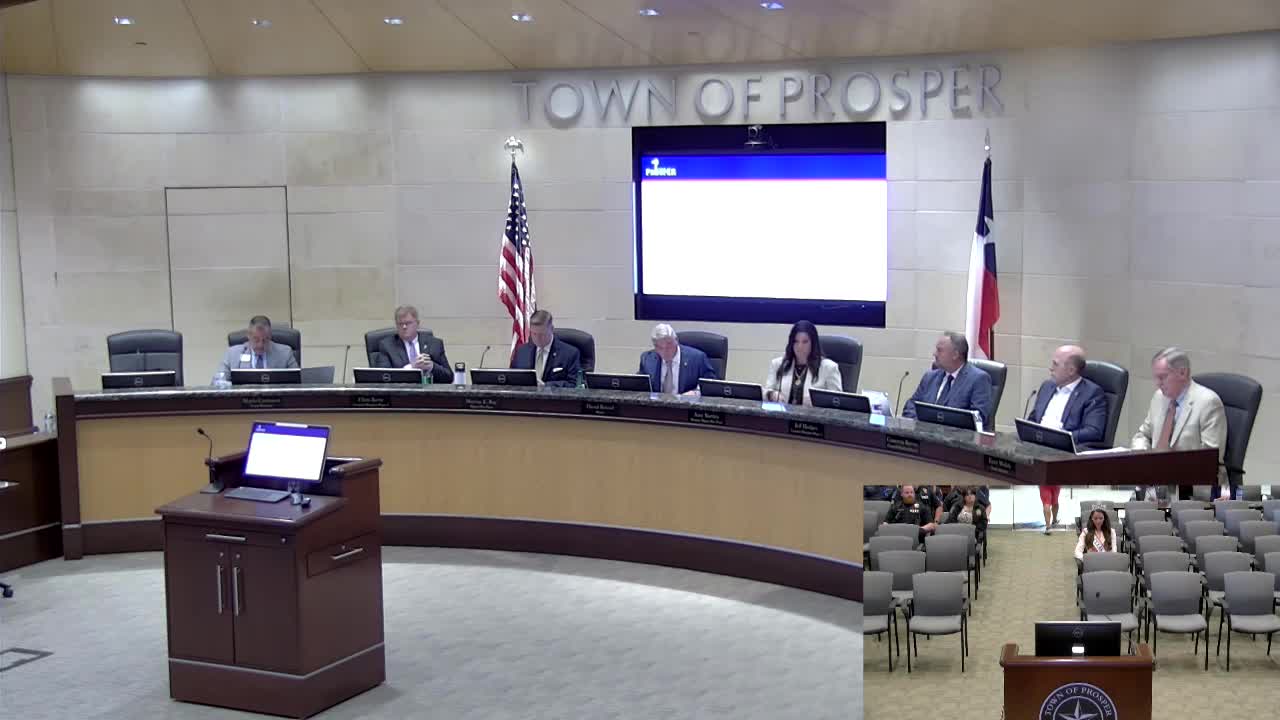
The Prosper Town Council on May 13 voted unanimously to consent to including the town’s extraterritorial-jurisdiction parcels in a proposed Collin County Emergency Services District No. 1, clearing the way for ETJ residents to vote on a county property-tax measure to fund fire and EMS services.
The Prosper Town Council on May 13 voted unanimously to consent to including the town’s extraterritorial jurisdiction (ETJ) parcels in a proposed Collin County Emergency Services District No. 1, a county-driven plan that would allow a property-tax levy to raise money for fire and emergency medical services in unincorporated areas.
Council action came after a presentation from Chief Blassingame, who described the countywide funding shortfall that prompted the ESD proposal and urged council members to consent so residents in the town’s ETJ could vote on the measure this fall. “For over 15 years, the county has allocated approximately $1,000,000 annually to support fire departments handling calls outside their municipal boundaries,” Chief Blassingame said, adding that the funding level has not kept pace with rising equipment and personnel costs.
The ESD process requires municipal consent before the county may include a city’s ETJ in the ESD boundary; if a municipality does not respond within 60 days it becomes non-consent and ETJ residents would be ineligible to vote on the county ESD measure. Chief Blassingame said the county petition to form ESD No. 1 was accepted by the Collin County Commissioners Court in late February, and that commissioners will set the tax rate and ballot language if the ESD advances to voters.
Why it matters: the measure would alter who can levy a tax and who votes on it for properties currently in Prosper’s ETJ. If approved by voters in November and the town had not consented, Collin County could not be required to provide funded fire or EMS service for those ETJ parcels; any local municipality choosing to respond could do so without county funding.
Details presented to the council: Chief Blassingame and staff provided estimates discussed at county briefings. Possible property-tax levies discussed for the ESD included examples at 0.03, 0.075 and 0.10 dollars per $100 of taxable value. Chief Blassingame said, as presented by county staff, a 7.5-cent levy was the most likely rate discussed so far and that, using the county’s preliminary calculations, that rate would generate roughly $3,849 for the town’s five ETJ parcels; a 10-cent levy could produce an estimated $5,241. The chief also said that for the town’s five unincorporated parcels the county provided about $260 this past year under the previous ad hoc funding approach.
Town Manager Mario confirmed the county’s current proposal was expected to be a property-tax measure only. “The proposal that’s being carried forward for November is purely a property tax, not for a sales tax,” Mario said, adding that a sales tax option would still require a separate voter approval inside the ESD if it were ever proposed.
Council members asked about local operational and ethical implications. Chief Blassingame said department leaders were concerned about a so-called “gap year” because, even if voters approve the ESD in November, tax collections and distribution would not begin until the following February and would not be available for at least another budget cycle. He also said fire departments were reluctant to refuse life-safety responses in ETJ areas even if municipalities had opted out, calling that a difficult ethical choice for first responders.
Council discussion touched on potential downsides, including the possibility that ETJ parcels could change use in the future (for example to commercial or multi-family) and generate disproportionate calls for service on departments whose primary funding comes from Prosper taxpayers. Several council members said they preferred a mechanism that produced funding rather than continuing the status quo in which the county’s per-year allocation to towns had not increased while costs rose.
After discussion the councilmember Jeff Hodges moved to approve a resolution consenting to inclusion of the Town of Prosper’s ETJ in Collin County ESD No. 1; Cameron Reeves seconded. The motion passed unanimously.
Votes at a glance
- Consent agenda (items 10–13): motion to approve by Councilmember Jeff Hodges; second by Councilmember Marcus Ray; motion passed unanimously. - Resolution to consent to inclusion of the Town’s ETJ in Collin County Emergency Services District No. 1: motion to approve by Councilmember Jeff Hodges; second by Councilmember Cameron Reeves; motion passed unanimously. - Appointments from executive session: motion to appoint Amy Bartley as Mayor Pro Tem and Chris M. Kern as Deputy Mayor Pro Tem; motion passed unanimously.
What the resolution does — and does not — do: the council’s consent does not itself create the ESD or set a tax rate. Consent allows the county to include Prosper’s ETJ parcels in the ESD boundary and lets the residents of those ETJ parcels vote on the ESD proposal in November. If Prosper had not consented, property owners in those ETJ areas would not be eligible to vote on the county ESD measure and, if the ESD passed, county-funded services for those areas could be restricted.
Council members said they would monitor the county process for board composition, administrative fees and how revenues would be distributed to local providers; those decisions would be made later by the county and by the ESD board if the ESD is approved by voters.
Next steps: the county will continue its petition process and, if the commissioners court proceeds, the measure would appear on the November ballot with tax-rate and distribution details worked out in later public meetings and by any future ESD board.