Boerne presents community 'Boerne Listens' mobility survey: residents prioritize roundabouts, signal timing and road repairs
Loading...
Summary
City staff presented results from the Boerne Listens mobility survey (about 1,600 responses). The top community priorities people identified included intersection improvements (roundabouts), signal timing, downtown pedestrian safety and road maintenance; staff described current traffic‑counting, signal management and pavement‑condition work.
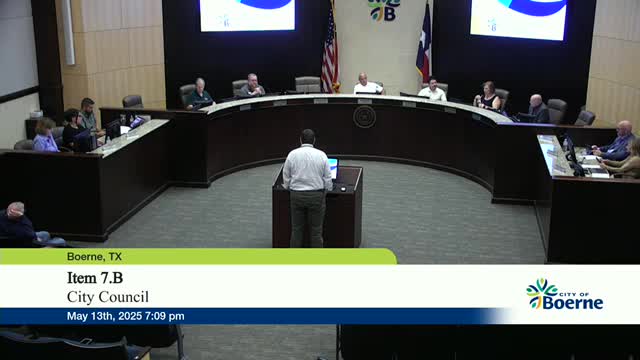
City staff presented the results of the city’s “Boerne Listens” community survey on mobility at the May 13 meeting, summarizing responses from roughly 1,600 completed surveys. The outreach asked residents and nonresidents to rank mobility priorities and suggest specific improvements.
Key findings from staff summary - Participation: Staff said the survey gathered just under 1,600 completed responses; approximately 75% of respondents were city residents and 25% were greater‑Boerne community residents. - Top priorities: Respondents most frequently cited (1) intersection improvements and roundabouts, (2) traffic‑signal timing and turn‑lane timing, (3) downtown pedestrian safety and crosswalks, and (4) maintenance and repair of local streets (potholes and pavement condition). - District‑level examples: Staff read representative comments from each council district; examples included requests to install planned roundabouts (District 1), optimize signal timing and increase turn‑lane allowances (District 2), reduce downtown jaywalking and consider parking restrictions on Main Street (District 3), and add a traffic signal at Slope and Oak Park (District 4).
Technical context provided by Public Works - Road network: Public Works Director Jeff said the city maintains about “83 miles of roadway” (measured in lane miles for maintenance calculations) and described the department’s pavement‑condition index work and preventative maintenance programs (chip seal, slurry seal, patching, and reconstruction). - Signals and counts: Staff described how traffic signals and corridors are timed (TxDOT maintains several downtown corridors and can change timing remotely) and that the city and TxDOT maintain traffic‑count data to support warranted decisions on stop signs, signals or other treatments. - Safety and design: Staff explained modern roundabouts reduce conflict points compared with four‑leg intersections and highlighted ongoing ADA ramp improvements and a bundled sidewalk grant application submitted to the MPO for multiple sidewalk projects.
What residents can expect - Staff will continue to use the survey results to prioritize projects in the capital improvement plan and to support grant applications. Several projects (sidewalk bundles, pavement maintenance programs and signal timing coordination) are already in planning or design pipelines.
No formal council action was taken; the presentation was informational. Staff invited questions and will use the results as input to budgeting and grant applications.