Get Full Government Meeting Transcripts, Videos, & Alerts Forever!
Get email alerts on the Inverse Condemnation Flooding topic
No spam. Unsubscribe anytime.
Judge denies state’s motion to dismiss inverse-condemnation claims arising from 2020 Edenville Dam failure
Summary
On May 12, 2025, a Michigan Court of Claims judge denied the state agencies’ motion for summary disposition in Krieger v. Michigan Department of Environment, Great Lakes and Energy, finding factual disputes — including expert testimony and documentary evidence — that warrant further proceedings; an oral motion for a stay was also denied.
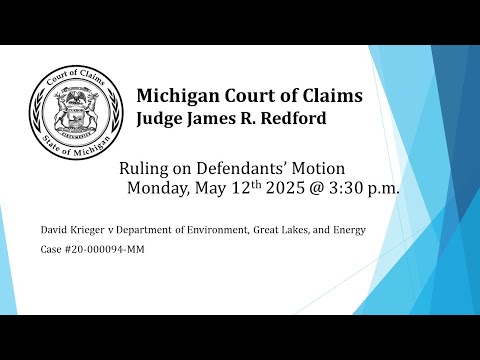
LANSING, Mich. — On May 12, 2025, Michigan Court of Claims Judge James Robert Redford denied the defendants’ motion for summary disposition under MCR 2.116(C)(10) in Krieger et al. v. Michigan Department of Environment, Great Lakes and Energy (EGLE) et al., a suit tied to the May 20, 2020 failure of the Edenville Dam that flooded downstream properties.
The ruling, made from the bench and memorialized in an order filed the same day, denied the state agencies’ motion “without prejudice,” the judge said, and preserved the plaintiffs’ inverse-condemnation claims for further development. The court also denied an oral request by defense counsel for a stay pending appeal.
The court’s denial rests not on a finding that the plaintiffs will prevail at trial but on the presence of genuine factual disputes in the record that must be resolved at trial rather than on a pretrial motion. Redford said the record — including expert testimony, the Federal Energy Regulatory Commission (FERC) licensing order, and an engineering report prepared by Spicer Group for the 4 Lakes Task Force — contains material questions that preclude resolving the case under the summary-disposition standard.
Background and why it matters
The litigation arises from the collapse of the Edenville Dam on May 20, 2020. Plaintiffs allege state agencies’ actions and omissions — including communications about and regulation of water levels and denials of requests for winter drawdowns — contributed to conditions that caused or worsened the failure and resultant property damage. The lone remaining cause of action at issue in the Court of Claims is inverse condemnation, a constitutional claim seeking compensation when government action substantially causes a loss in property value or other taking without formal eminent-domain proceedings.
What the judge relied on
Redford reviewed extensive briefing and exhibits — he noted the parties’ filings and attachments totaled roughly 2,651 pages — and said limited expert discovery remained incomplete when the parties last appeared for oral argument on May 5, 2025. He emphasized that, under Michigan summary-judgment law, a court must view evidence and all reasonable inferences in the light most favorable to the nonmoving party and may not resolve credibility disputes on a c(10) motion.
Redford cited several items in the record as raising factual questions: the FERC order revoking license authority for the project and faulting the operator’s long-standing failure to increase spillway capacity; a Spicer Group engineering report for the 4 Lakes Task Force that identified deficiencies and concluded existing spillways could not pass a half probable-maximum flood without additional auxiliary spillway capacity; and expert deposition testimony offered by plaintiffs.
Plaintiffs’ expert W. Sturdivant, whose testimony the judge described as a basis for denying the motion, was quoted in deposition as saying he “considered the normal pool … to be dangerously high given that the dam was not capable of passing the flows that it was supposed to.” Retired dam-safety inspector Pawlowski testified that a drawdown is intended to “reduce the risk of threat of the dam failing,” the judge recounted.
Defense arguments and court response
Defense counsel argued that permitting or licensing decisions alone are insufficient to show an affirmative governmental action that amounts to a taking, and that the physical cause of the Edenville failure was soil liquefaction rather than water level. Redford acknowledged those arguments but concluded that the plaintiffs had presented more than only a permit issuance claim and that the record contains evidence from which a reasonable factfinder could infer actionable government conduct or causation — issues that must be resolved at trial.
Procedural posture and next steps
Redford signed an order titled “Order denying defendant’s motion for summary disposition under MCR 2.116(C)(10),” dated May 12, 2025, and explicitly described it as not final on all issues. He noted that additional argument may not be necessary at a later hearing but scheduled oral argument on remaining summary disposition issues for Sept. 15, 2025, if the case remains pending. Defense counsel made an oral request for a stay pending appeal, which Redford denied and said he would memorialize in a short order.
The denial without prejudice leaves the plaintiffs’ inverse-condemnation claim in the case; the parties may pursue interlocutory review or a full trial depending on subsequent filings and appellate decisions.
Quote highlights
“The defendant’s motion for summary disposition under MCR 2.116(C)(10) is denied without prejudice today,” Judge Redford said from the bench.
Plaintiffs’ expert W. Sturdivant testified in deposition that he “considered the normal pool … to be dangerously high given that the dam was not capable of passing the flows that it was supposed to.”
Retired dam-safety inspector Pawlowski testified that the purpose of a drawdown is to “reduce the risk of threat of the dam failing.”
Ending
The court’s ruling preserves the parties’ ability to develop disputed factual issues at trial, including further expert discovery and credibility determinations. The order is limited to the defendants’ motion for summary disposition and does not resolve final liability or damages. If either side seeks appellate review, the transcript and the court’s written order will be part of the record for any further proceedings.