Get Full Government Meeting Transcripts, Videos, & Alerts Forever!
Get email alerts on the Signs And Right Of Way topic
No spam. Unsubscribe anytime.
Ordinance committee forwards amended sign code allowing limited weekend right‑of‑way signs, bans them in El Pueblo Viejo
Summary
The Santa Barbara City Ordinance Committee on May 13 voted 2‑1 to send proposed amendments to Chapter 22.7 of the municipal code to the full City Council for introduction and adoption, including a new, limited allowance for temporary private signs in the public right of way outside the El Pueblo Viejo Landmark District.
The Santa Barbara City Ordinance Committee on May 13 voted 2‑1 to send proposed amendments to Chapter 22.7 of the municipal code to the full City Council for introduction and adoption, including a new, limited allowance for temporary private signs in the public right of way outside the El Pueblo Viejo Landmark District.
Assistant City Attorney John Damas told the committee the draft is intended to be content‑neutral to meet recent U.S. Supreme Court precedent and to give staff enforceable tools. "This will allow temporary private off‑site signs to be placed in the right of way so long as they meet the following criteria," Damas said during the presentation, and then outlined size, placement and timing limits.
Under the committee‑recommended draft, allowed private temporary signs must be placed in a parkway portion of the right of way (the area that is neither roadway nor sidewalk), be free‑standing (not attached to utility poles), and meet size limits set out in the draft. Staff described the time limit as a 42‑hour weekend window beginning at 6 a.m. Saturday and ending by 9 p.m. Sunday. The draft sets a maximum height of 42 inches above ground and a maximum face area stated in the presentation as no greater than 6 (as described in the draft ordinance). The ordinance would also allow staff to immediately remove and store violating signs for 90 days.
The ordinance would retain a current, content‑based allowance for real‑estate open‑house signs as an existing carve‑out until this broader, content‑neutral approach is adopted. Staff explained the rewrite’s primary legal goal is to eliminate content‑based regulation of signs following Reed v. Town of Gilbert (U.S. Supreme Court, 2014) and related case law. Damas said the draft includes exemptions and clarified definitions to avoid content‑based distinctions and to limit enforcement to objective measures — size, location and duration.
A key element of the draft is a complete prohibition of private right‑of‑way signs inside the El Pueblo Viejo (EPV) Landmark District. Staff said the EPV district generally lacks parkway space and has very high pedestrian traffic, creating safety and access concerns for people with disabilities.
Committee members and public commenters focused on enforcement and accessibility. Multiple speakers, including Jaime Limone and Ken Sorgman of the Sign Committee, and Elizabeth Sorgman of the Access Advisory Committee, urged clearer enforcement and urged tools to prevent signs from blocking sidewalks or interfering with people who are blind or use mobility devices. "There is absolutely no enforcement," Elizabeth Sorgman said, adding that committee members observed illegal signs on sidewalks before the meeting. Members of the Downtown Santa Barbara Improvement Association recommended standardized sign templates and a coordinated wayfinding program as alternatives to many sandwich‑board signs.
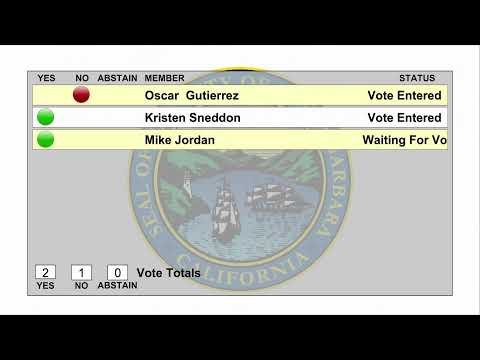
Councilmember Gutierrez said he would not support sending the ordinance to full council at this time, citing concern about additional burdens on businesses and the current economic climate. Councilmember Jordan, who moved the committee motion to forward the draft to council, and Chair Sneddon, who seconded it, said the draft provides an enforceable, content‑neutral standard that staff can apply immediately and that enforcement under the current code has been ineffective. "We can just pull those signs," Jordan said of the new removal authority described by staff.
The committee instructed staff to incorporate several changes before the item goes to full council, including removing a numeric limit on the number of flags on a single flagpole, clarifying that small paper notices (for example, an 8½×11 flyer) will not be the focus of enforcement, and substituting a reference to the El Pueblo Viejo Landmark District design standards (chapter 30.57) rather than naming a specific architectural style in the ordinance language.
Votes at a glance: Motion to forward proposed amendments to Chapter 22.7 to City Council for introduction and adoption, with the edits requested by committee members — Mover: Councilmember Jordan; Second: Chair Sneddon. Vote: Yes — Councilmember Jordan; Yes — Chair Sneddon; No — Councilmember Gutierrez. Outcome: approved by committee, 2‑1.
The committee also directed staff to continue working with downtown stakeholders, the Realtors association and the Access Advisory Committee on implementation and enforcement details and to return the ordinance to the City Council with the committee’s requested edits.