Get Full Government Meeting Transcripts, Videos, & Alerts Forever!
Get email alerts on the Property Taxation topic
No spam. Unsubscribe anytime.
Kenai Peninsula Borough BOE staff outline SB 179 changes: long-form appraisals, farm deferments and certification rules
Summary
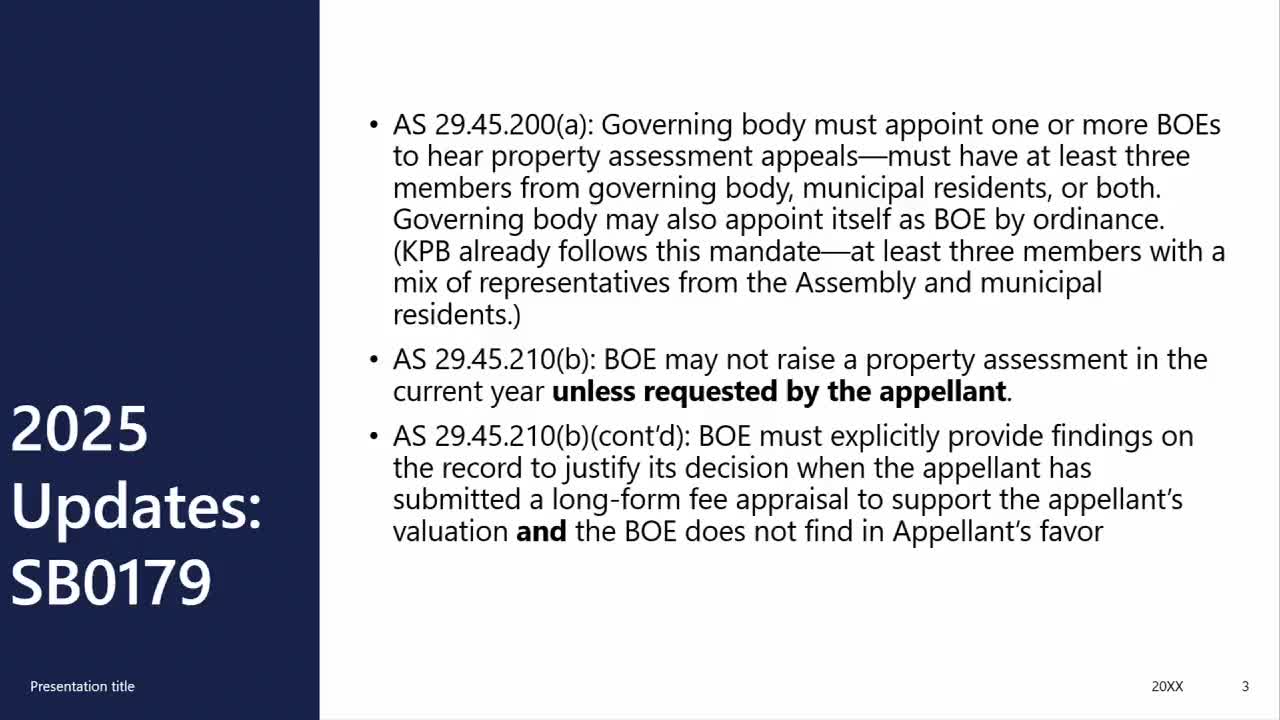
Deputy borough attorney and the borough assessor briefed the Board of Equalization on changes from Senate Bill 179, including a prohibition on raising assessments over a long-form fee appraisal unless requested, new farm-deferment eligibility and a state certification requirement for assessors.
Deputy borough attorney Walker Steinhage and Borough Assessor Adena Wilcox told the Kenai Peninsula Borough Board of Equalization on May 13 that changes from Senate Bill 179 (effective Jan. 1) alter how the board handles appeals that include long-form fee appraisals, and revise the farm-deferment program and assessor certification rules.
Steinhage told the board the key legal change is that the board may not raise a property assessment in the current year when an appellant submits a long-form fee appraisal unless the appellant specifically requests an increase. "The BOE may not raise a property assessment in the current year unless requested by the appellant," he said, and added that the board must place explicit findings on the record when it rejects an appellant's long-form appraisal.
Wilcox said the borough is already largely compliant with the statute but highlighted other changes in SB 179. The farm-deferment program’s income threshold now is $2,500, she said, and structures used for farm activity are now eligible for deferment. Because the State of Alaska had not yet issued implementing guidelines, Wilcox said the Kenai Peninsula Borough established an interim policy for 2025: deferring 90% of the land value for active farm acreage and deferring 90% of the value of structures used for qualifying farm purposes. She said the borough had run that approach by the state assessor and commissioner and had received no contrary instruction.
Wilcox also described documentation requirements and deadlines. Applicants must apply annually, must provide a federal Schedule F for individual operators (she said that is challenging for corporations that do not file Schedule F), and the owner must sign where the land is leased. Wilcox cautioned that the statute limits eligibility to operations for animal or human consumption; she said that, under that criterion, "flower farmers on the Kenai Peninsula Borough are not going to qualify this year." She told the board the borough will remain ‘‘lenient’’ in the first year of implementation but expects appeals related to corporate operations and documentation to arise.
On long-form appraisals, Wilcox said the office’s policy has been to accept a current fee appraisal submitted for a sale: "If they supply a current fee appraisal that was used for a sale, no questions asked, I'm going to accept that." Steinhage described a case in which the assessor’s office found an omitted structure during review; the office settled the matter for one year and planned to re-evaluate the next year rather than raising the appellant’s current-year assessment over the submitted fee appraisal.
Wilcox also summarized assessor certification changes included in the legislative package: assessors must be at least Level 3 certified with the Alaska Association of Assessing Officers (or work under a Level 3 or the state assessor). She said the borough’s assessor and managers meet the requirement and the department funds certification training in its budget.
The presentation closed with board questions about how discovered improvements during inspections should be handled and when appeals may be late-filed; Wilcox said late-filed appeals are possible and would be handled separately when and if they are submitted.