Get Full Government Meeting Transcripts, Videos, & Alerts Forever!
Get email alerts on the Health Finance topic
No spam. Unsubscribe anytime.
House passes broad health-finance bill after hours of debate on hospitals, childcare, EMS and reproductive services
Summary
The Minnesota House approved House File 2435 on May 13, 2025, a sprawling health and human services finance bill that includes hospital-directed payments, pharmacy and EMS funding, child welfare and early learning investments, and contested changes to reproductive health grants and dental administration. The final vote was 95-38.
House File 2435, the health and human services finance bill, passed the Minnesota House on May 13, 2025, after several hours of debate and multiple roll-call votes. The final vote was 95 yeas to 38 nays.
The bill's primary sponsors described it as a broad package of measures intended to stabilize hospitals, expand telehealth and pharmacy supports, and maintain public-health infrastructure. "The health finance bill before you today is focused on delivering better health care access and meeting some of the most pressing needs of our state," said Representative John Bierman, the bill author and chair from Dakota County.
Why this matters: HF2435 bundles many programs that affect daily health services — from payments that aim to shore up hospital finances to funding that touches early-childhood care, child-protection information systems and emergency medical services (EMS). Lawmakers said the package attempts to balance near‑term budget constraints with targeted investments; opponents warned some provisions will not go far enough or will reallocate funds in ways they said would harm specific providers and clients.
Most important facts
- Hospital-directed payment program: The bill establishes a federal-state directed payment model for hospitals intended to increase medical assistance (MA) rates without raising additional state general-fund dollars. Representative Nadeau and others framed the provision as a means to stabilize hospitals with negative operating margins.
- Pharmacy and PBM changes: HF2435 includes a provision to move to a single state pharmacy benefits manager (PBM) for MA and a short-term dispensing payment add-on intended to assist community pharmacies while the PBM transition is implemented.
- EMS and rural supports: The bill continues and expands several EMS provisions and includes funding mechanisms targeted to rural ambulance operations and unreimbursed costs; sponsors cited earlier pilot grants and a new EMS division at state government to coordinate that work.
- Children and families investments: The bill funds the SSIS modernization effort (the Statewide Social Services Information System) — legislators referenced roughly $40 million to modernize SSIS — and a one-time early-learning scholarship increase of roughly $5.85 million, among other children-and-families measures.
- Child-protection and maltreatment statute fix: An amendment (a11) led by Representative Pinto that closes gaps in the maltreatment statute for reports of abuse that occur outside a child's county of residence was adopted by roll call (75 yeas, 58 nays).
- Dental administration debate: The bill retains a plan to move to a single dental administrator (Delta Dental was mentioned as the selected vendor by DHS) if managed care performance on dental utilization benchmarks does not improve. Representative Liebling proposed an amendment (a13) to accelerate that change and redirect savings into provider rates; the amendment failed on a roll call (32 ayes, 92 nays).
Contested items and debate highlights
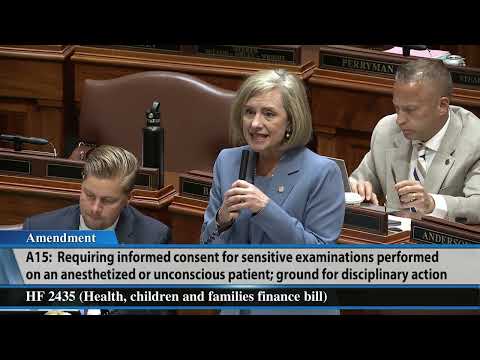
- Consent for sensitive exams under anesthesia: Representative Kelly Robins' amendment (a15) — requiring consent before a sensitive exam is performed while a patient is anesthetized — was offered and adopted by voice vote; supporters said it protects patient autonomy, and sponsors noted bipartisan committee support.
- Reproductive health grants and alternative pregnancy resources: A contentious floor amendment and related motions (led by Representative Zalesnikar and discussions by Representative Lesnar Carr, Purcell and others) would have restored or increased funding for pregnancy resource centers and maternity homes. Multiple attempts to amend or increase funding were closely divided; a major amendment failed on a 67–67 tie (not adopted). Representative Purcell’s attempt to add $4 million to the reproductive health services grants failed at roll call when the amendment-to-amendment did not pass (67–67 tie in an earlier procedural vote) and the underlying amendment later failed.
- Childcare compensation “equity” bonus: Representative Coulter proposed an amendment (a8) to preserve a 10% geographic/equity bonus for Great Start compensation supports targeted to providers serving high-need communities; Representative West argued its removal would extend program dollars to more providers overall. The amendment failed on a 67–67 tie.
- Minnesota care/MinnesotaCare funding: Multiple members noted that MinnesotaCare (the state-subsidized program) funding was not included in this bill’s framework and said it remains a separate, unresolved budget issue to be addressed before the session ends.
Formal actions and outcomes
- Adopted: amendment to close out-of-county maltreatment gap (a11) — adopted, roll call 75–58. - Not adopted: Zalesnikar/Lesnar Carr amendment to restore/expand pregnancy resource and maternity home funding (a9 or related votes) — not adopted, roll call 67–67 (tie). - Not adopted: childcare equity bonus preservation (a8) — not adopted, roll call 67–67 (tie). - Not adopted: Liebling single-dental-administrator acceleration (a13) — not adopted, roll call 32–92. - Final passage: House File 2435, as amended — passed, roll call 95–38.
Discussion vs. decisions
Legislators repeatedly distinguished discussion points from formal actions. Multiple amendments were debated at length and either withdrawn, adopted by voice, or resolved by roll call. Several speakers, including Representative West (children and families), Representative Backer (cochair), and Representative Bierman (author), emphasized that the bill was the product of committee work and represented compromises across many policy areas. Other members and advocacy groups pressed for restorations or changes they said were necessary for front-line providers (childcare centers, community clinics, rural hospitals, and EMS).
What comes next
The House approved the bill and sent it to the Senate; lawmakers said outstanding questions — notably funding for MinnesotaCare and some program-specific implementation details (single PBM and the dental-administration transition) — will be negotiated in conference. Several members said they expect continued work on mental-health rates, dental access reforms, and rural EMS implementation details in the coming weeks.
Speakers who spoke on this topic on the floor include Representative John Bierman (bill author, Dakota County), Representative Matt Backer (cochair, Traverse), Representative Erin West (children and families chair, Anoka), Representative Katiza Wooten (Hennepin), Representative Kelly Robins (author of a15), Representative Paul Nadeau (Hennepin), Representative Zalesnikar (St. Louis), Representative Purcell (Rice), Representative Cathy Coulter (Hennepin), Representative Cheryl Liebling (Olmsted), Representative Drew Hewitt (Hennepin), Representative Ben Baker (Kandiyohi), and Representative Fredricka Pinto (Ramsey). Direct quotes in this article are from those speakers as recorded in the floor transcript.
Ending note
Supporters described HF2435 as a multi-pronged attempt to protect hospitals, pharmacies and emergency services while preserving vital early‑learning and child-protection programs; opponents highlighted cuts, contested reallocations and items they said deserved standalone debate. With the House passage, the bill moves to interchamber conference where negotiators must reconcile remaining differences with the Senate version.