Get Full Government Meeting Transcripts, Videos, & Alerts Forever!
Get email alerts on the Police Technology topic
No spam. Unsubscribe anytime.
Council hears $5.9 million Axon proposal to replace cameras, tasers and add AI tools; council gives consensus to advance review
Summary
Axon presented a consolidated 10‑year package for body cameras, in‑car cameras, TASER 10 devices, virtual‑reality training and AI tools to the Wyoming City Council on May 12, 2005. The vendor estimated the 10‑year cost at $5,914,012.48 and the council gave staff consensus to return the item for formal consideration.
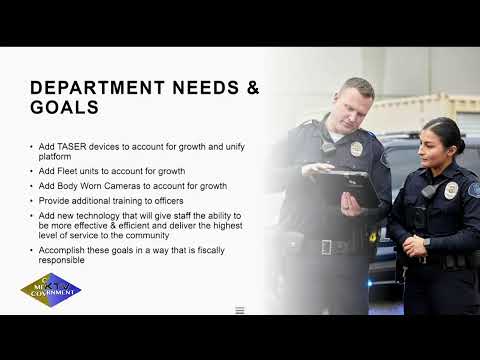
Axon representative Kyle Heitz and City of Wyoming public safety leaders presented a proposal at the May 12, 2005 council work session to consolidate and upgrade the city’s body‑worn cameras, in‑car cameras, tasers and related software, including new artificial‑intelligence tools for transcription and report drafting.
The vendor proposal
Kyle Heitz, sales representative for Axon, said the package would include 103 body‑worn cameras, 100 TASER 10 certification packages, 33 in‑car cameras, virtual‑reality training and the company’s AI “Air Plan.” The total cost for a new 10‑year agreement, as presented, is $5,914,012.48. Axon’s proposal includes promotional incentives and negotiated savings the presenter described as totaling $1,872,960 in discounts. Heitz said Axon is offering future AI releases at no additional cost as part of the AI plan for early adopters.
Council and staff context
Police leadership told council the department is midway through a current 10‑year contract that began in 2020 and that a roughly $500,000 invoice was scheduled under the existing contract in 2025. The department presented the Axon package as an option to consolidate multiple addenda and to obtain new hardware and software now while the vendor’s AI pricing is in an early‑adopter phase. The chief and Axon staff emphasized potential operational benefits including faster report drafting, transcription and redaction tools, supervisor auditing tools, an integrated license‑plate reader (mobile ALPR) and virtual‑reality training.
Time savings and estimated workload impact
Axon’s representative presented vendor testing and third‑party testimonials saying the AI report‑writing tool (Draft 1) can save officers “50 to 60%” of report writing time in trials. Using the department’s 2024 figure of just under 39,000 calls for service, Axon estimated the technology could save an estimated 15,000 hours across the department annually if report writing time fell by half. Axon and staff cautioned that those labor savings are operational (more officer time in fieldwork) rather than direct budgetary cash savings.
Cost comparison and timing
The proposal included a vendor cost analysis comparing (a) extending the current contract through 2030 and adopting new technology later versus (b) adopting the new Axon 10‑year package now. Axon’s presenter said that using a 7% assumed annual increase, the comparable cost if the city delayed adoption until 2030 would be higher (Axon estimated $6,962,437.45 for the alternative scenario) and that doing the consolidated purchase in 2025 with the vendor incentives could reduce the modeled 10‑year outlay by about $1,048,425 versus waiting and renewing later.
Data, security and FOIA
Axon stated that footage and transcripts would be hosted on Microsoft Azure GovCloud (FedRAMP and CJIS certified). The vendor said agencies retain ownership of their data; footage and derived transcripts are subject to FOIA requests and the city’s records division would retain control of redaction and release decisions. Council members discussed the substantial FOIA workload the police records team already handles and asked about redaction and search tools the package would provide.
Training, hardware refresh and implementation
Axon said training and professional services to implement the system are included in the package and that the company would certify internal instructors for the TASER 10 and provide on‑site assistance at rollout. The TASER 10 devices require new certification training; Axon said it will provide master‑instructor training so the department can then certify its own instructors.
Council direction and next steps
Council did not take a formal vote at the work session. Staff sought and the council expressed consensus to move the proposal forward for formal council consideration and directed staff to provide additional requested information prior to a council meeting. Council members asked staff for a revised invoice schedule and additional detail on (a) training hours per officer, (b) speech‑to‑text range and performance in noisy environments, (c) FOIA/redaction workflows, and (d) alternative vendor comparisons. Axon noted the vendor’s early‑adopter incentives expire June 30, and staff said a final council action would be needed before that date to secure the incentives.
Quotations
- “I don't think there's an officer in the area that would wanna work on the street today without a body cam,” Chief (name not specified) said, explaining why the department views the equipment as essential.
- “In 2023, we set out to introduce our moonshot, which ultimately to, reduce gun related deaths between police and the public by 50 percent over the next 10 years,” Kyle Heitz said of Axon’s long‑term objectives for the technology.
Ending
Staff will return the proposal to a regular council meeting with the additional technical and budget detail requested by council. Council members signaled general support to pursue further review but took no binding action at the work session.