Get Full Government Meeting Transcripts, Videos, & Alerts Forever!
Get email alerts on the Transit Budget And Policy topic
No spam. Unsubscribe anytime.
Committee discusses transit budget, asks for Metro Connect cost and ridership data; fare recovery at 10%
Summary
Commissioners debated whether to pause or reduce first‑and‑last‑mile services (Metro Connect) amid a looming budget 'cliff,' asked staff for detailed cost per user and return‑on‑investment data, and received agency figures showing weekday boardings up 2% since the Better Bus Network and a 10% fare recovery rate.
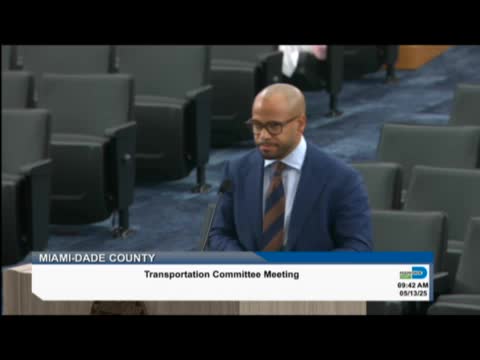
Miami‑Dade County commissioners on the Transportation Committee spent an extended portion of the meeting debating transit priorities as the county prepares for a difficult budget cycle. Commissioners raised the prospect of pausing or reducing first‑and‑last‑mile programs, requested agency data on costs and ridership, and sought a clearer definition of the county’s “core transportation services.”
Vice Chairwoman Regalado said she did not support raising fares amid current economic conditions and proposed pausing some first‑and‑last‑mile programs such as Metro Connect for two years to preserve core transit services. “I do not think that raising our rates is the solution to our problem,” Regalado said. “I am a big proponent of first and last mile... however... I don't think that we receive the return on investment that is needed.” She asked attorneys to draft an item and asked staff to present Metro Connect cost and ridership figures at the committee’s next meeting.
Sean Adjacent, deputy director and chief of transit operations, provided ridership context: “Our overall ridership since BBN is up 2%. … That's about 3,000 extra people per day are riding Metrobus since we've done the network.” He also said the overall system is about 7% above pre‑COVID ridership when normalized for the free‑fare period.
Melvin Castagena, chief financial officer for the department, reported a fare recovery of roughly 10%: “Currently, our fare recovery is 10%. That means that transit is subsidized by 90% per rider,” he said.
Commissioners pressed for more detailed accounting: cost per user of Metro Connect, how many riders use first‑and‑last‑mile services versus those who use Metro Connect to fill gaps created by the Better Bus network, and comparisons with other regions. Commissioners also discussed coordination with municipal trolleys and the Transportation Planning Organization (TPO) report on municipal connectivity, which members said they had not yet received.
No formal motions to change fares or cancel programs were adopted at the meeting. The committee directed staff to provide detailed Metro Connect cost and usage data, a definition of county core transportation services tied to federal requirements, and comparative ridership/subsidy information for peer jurisdictions ahead of upcoming budget discussions.