Get Full Government Meeting Transcripts, Videos, & Alerts Forever!
Get email alerts on the Property Taxes topic
No spam. Unsubscribe anytime.
Torrington approves two‑year phase‑in of 2024 grand list revaluation
Summary
At a May 12 special joint meeting, the Torrington City Council and Board of Finance voted to phase in the Oct. 1, 2024 grand list over two years, a move city staff said will shift some tax burden from residential owners to businesses in the first year and reduce a state motor‑vehicle transition grant.
Torrington’s City Council and Board of Finance voted on May 12, 2025, to phase in the Oct. 1, 2024 grand list revaluation over two years following extended discussion and multiple failed motions on other options. The motion for a two‑year phase‑in passed on a roll‑call vote after the council and finance members returned to the question late in the meeting.
The decision matters because a phase‑in spreads the impact of higher assessed values over multiple years. City staff and members debated whether to implement no phase‑in, a two‑year phasing, or longer options. Supporters said two years gives taxpayers time to adjust; opponents argued it shifts burden to businesses and complicates budgeting. The assessor must notify the state Office of Policy and Management (OPM) of the legislative body’s choice and submit related reports by the city’s June 1 deadline.
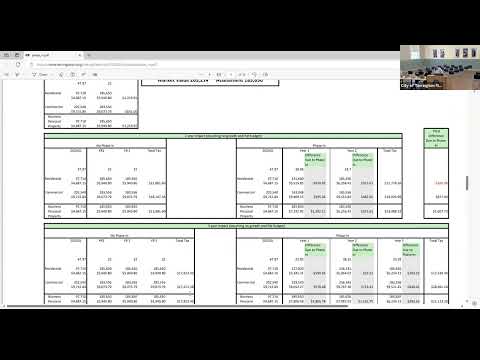
City staff presented two spreadsheet models showing effects on a median residential home and on a higher‑value home. Stacy from the assessor’s office said the models assume no growth in the grand list and no change in the budget and that the analysis applied the mill rates being discussed to the reassessed values. “The whole point of a revaluation ... is because over 5 years, we know the market changes,” Stacy said, describing why the state requires periodic revaluation.
Staff and elected members flagged several tradeoffs. In the assessor’s two‑year example, the average residential taxpayer would see a modest reduction in the first year (the assessor’s model showed an average residential change of about negative $420 in year one for the sample property), but businesses—particularly business personal property—would see larger increases in that first year. The assessor’s presentation said Torrington has roughly 1,700 businesses and about 1,000 commercial and industrial properties; because residential property represents a larger share of the grand list, phasing can shift a disproportionate share of the increase onto businesses and business personal property in early years.
Finance staff explained that the state’s motor‑vehicle transition grant is sensitive to changes in the mill rate. Erica (finance staff) said Torrington’s motor‑vehicle transition grant under the prior grand list was about $5,486,665; in the two‑year example, the first‑year transition grant would fall to about $1,916,206, reducing one revenue source the city had been using to offset tax shifts.
Multiple council and board members expressed concern about messaging and the practical effect on taxpayers. Some members urged a full, one‑year implementation—“rip the Band‑Aid,” as one council member put it—so the city would return to normal budgeting and avoid repeated annual notices and appeals. Others argued a two‑year phase would allow households with fixed incomes or tight budgets to prepare and would make Torrington a more attractive tax environment for prospective businesses by allowing the city to target a lower mill rate after the phase‑in.
Board of Finance members also raised operational issues. The assessor warned that implementing a phase‑in requires maintaining two databases during the phase‑in period, additional annual notices to taxpayers, and substantial additional work by assessor staff to prepare appeals and reports. The assessor said the city risks state penalties if required June 1 reports are not filed.
After discussion the body took several procedural votes. An initial motion to adopt a two‑year phase failed on roll call; a later motion for a three‑year phase failed; a motion for immediate full implementation (no phase) also failed. A final motion by Councilman Kevin Earl (seconded by Councilwoman Spino) to adopt a two‑year phase‑in passed on roll call. The mayor directed staff to proceed with the paperwork required by OPM and to provide the board of finance and council with the detailed mill‑rate and budget spreadsheets used in the analysis.
The council and board emphasized that the two‑year decision does not set a final mill rate; that will be set in subsequent budget proceedings. Staff noted the phase‑in decision changes how revenues and spending scenarios are modeled and that the council will have to address remaining budget gaps, potential use of fund balance (the current modeling assumes using about $3.9 million of fund balance in the scenario presented), and uncertainty tied to state and federal revenue decisions.
The meeting concluded with the mayor asking the assessor to complete the required state submissions on the chosen phase‑in and with elected officials urging clear public messaging about what the phase‑in means for rate increases and timing.