Get Full Government Meeting Transcripts, Videos, & Alerts Forever!
Get email alerts on the Education Dei topic
No spam. Unsubscribe anytime.
Council hearing scrutinizes university DEI rollbacks after Penn removes public DEI material
Summary
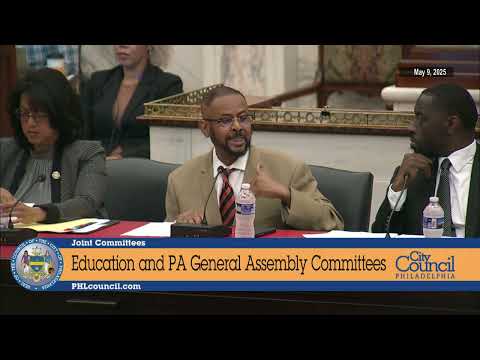
Philadelphia City Council’s Committee on Education convened a public hearing May 9 to examine how recent federal guidance and executive orders on diversity, equity and inclusion are affecting Philadelphia’s tax‑exempt higher education institutions, focusing attention on the University of Pennsylvania’s recent removal of prominent DEI content from its websites.
Philadelphia City Council’s Committee on Education convened a public hearing May 9 to examine how recent federal guidance and executive orders on diversity, equity and inclusion are affecting Philadelphia’s tax‑exempt higher education institutions, focusing attention on the University of Pennsylvania’s recent removal of prominent DEI content from its websites.
The hearing, called by Councilmember Curtis Jones and sponsored by a city resolution (No. 250185) authorizing an investigation of federal DEI rollbacks, drew state lawmakers, legal scholars, higher‑education diversity officers and union representatives. Councilmember Jones opened by saying the city must decide whether its anchor institutions “stand 10 toes down to their commitment to this city.”
Why it matters: witnesses said visible institutional commitments and dedicated staff matter for students’ sense of belonging and for compliance with civil‑rights obligations. Legal experts told the committee that common DEI practices remain lawful and that universities that remove public facing DEI language may be “over‑complying” with a nonbinding federal letter. Union and campus witnesses said the changes have real consequences for workers and students who rely on protections and on programs that broaden access.
State Sen. Anthony Williams, one of several state officials who attended, described a meeting with Penn leadership in February and said the university’s changes appeared driven by monetary concerns rather than legal necessity. “This is not a moral position,” Williams said of Penn’s actions; “This is not a legally law driven position. This is a money position. That's all that is.”
Legal witnesses pressed that point. Jonathan Feingold, associate professor at Boston University School of Law, testified that many common DEI practices remain legally defensible following the Supreme Court’s admissions rulings and that university preemptive removal of DEI language is not required by court decisions or by the February Department of Education communication widely cited by administrators. Professor Stacy Hawkins of Rutgers Law School said removal of DEI offices, titles and website language can undermine mechanisms that prevent and correct discrimination, and thereby could impede institutions’ obligations under federal and state anti‑discrimination law.
Paulette Granberry Russell, president and CEO of the National Association of Diversity Officers in Higher Education, told the committee that the recent wave of state laws and federal directives has already led to closed offices and staff layoffs at some campuses and that “pulling back, especially out of fear rather than necessity, weakens the entire mission of higher education.”
University of Pennsylvania: the university did not send an official to testify in person. Maria Candris, chief of staff to Councilmember Gautier, read into the record written testimony attributed to Jeffrey Cooper, Penn’s vice president for government and community affairs. The written statement described Penn’s historical commitments and said the university is “defending the vital work of our faculty, staff, and students” while it evaluates programs “to ensure that they are both consistent with the new federal government guidance and executive orders, federal, state, and local law, and our values.” The committee repeatedly requested follow‑up information from Penn, including a ZIP‑code breakdown by which Philadelphia neighborhoods students admitted to Penn reside and lists of local employees and neighborhood programs.
Campus and labor testimony: library workers, graduate student organizers and faculty groups described concrete consequences they attribute to Penn’s changes. Yvonne Harris, president of AFSCME Local 590 and a 44‑year Penn employee, detailed library outreach and fellowship programs the union supports and said unions have helped secure benefits and hiring practices that expanded opportunities. Graduate student bargaining committee members described stalled contract talks; one graduate student organizer said Penn negotiators cited federal directives as a reason for resisting enforceable anti‑discrimination provisions in a first union contract.
Public commenters representing faculty and campus unions said some Penn administrators instructed staff to “change the words” rather than defend the underlying commitments. Justin Mullican of AAUP Penn said “it is not possible to conduct research or teaching on racism, gender, or LGBTQ+ topics when those terms, concepts, and issues are deemed unspeakable.” Graduate student speaker Clancy Murray told the committee that Penn had quietly removed gender identity from a discrimination policy and urged council to push the university to restore protections.
Committee requests and next steps: Councilmember Jones asked universities, including Penn, to provide a ZIP‑code breakdown of admitted students, a list of employees from Philadelphia ZIP codes and details on school adoption or dual‑enrollment programs that benefit neighborhood students. The committee recessed the hearing to the call of the chair; no formal vote or policy action occurred at the session.
The hearing captured a sharp divide between universities’ public messaging and the concerns of local officials, legal scholars and campus workers. For now, the committee’s work will move to document requests and follow‑up with campus leaders and state officials.