Get Full Government Meeting Transcripts, Videos, & Alerts Forever!
Get email alerts on the Planning Site Plan Review topic
No spam. Unsubscribe anytime.
Leesburg staff proposes six-point plan to speed and simplify site plan review; council asks for measurable targets
Summary
Community Development presented findings from interviews with 12 developers (390 comments) and recommended a six-point improvement plan addressing regulatory updates, culture/behavior change, organizational staffing and expedited review; council members asked for quantitative baselines and expected impacts before final adoption.
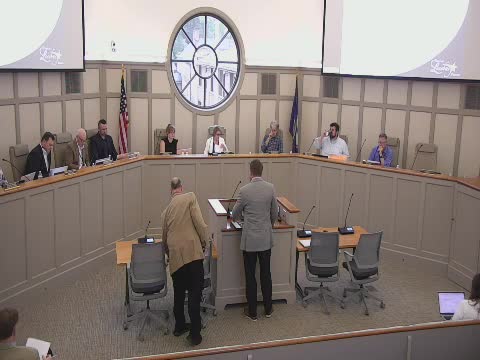
James David, Community Development Director, presented a summary of feedback and a six-point improvement plan for Leesburg's site plan review and approval process at the May 12 work session.
David said staff conducted off-site interviews with 12 developers and engineers and recorded about 390 comments, which were synthesized into 25 themes and eight summary statements. "Out of all the people interviewed, they all expressed that your town staff is intelligent and your town staff is experienced and your town staff is knowledgeable about Leesburg," David said. He then listed top concerns including updates needed to the Design Construction Standards Manual (DCSM) and zoning ordinance, excessive review comments that seek "perfection rather than solutions," and the need for greater certainty in early stages of projects.
David presented a six-point response plan: update regulatory documents (DCSM and zoning ordinance), behavior/culture changes to shorten comment letters and focus on compliance, collaboration and concurrency to avoid overly linear review steps, organizational strategy including staffing adjustments and possible ombudsman role, improved intake checklists to raise quality at submission, and an expedited-review program ("2 submissions plus 1 signature") for higher-quality initial submittals or qualifying projects.
David provided three recent site-plan timelines as examples: a Valvoline at Compass Creek took just over a year from application to site plan approval; a county government pump-station decommissioning took three months; and an infill project at the former Black Walnut Brewery took eight months. He noted those figures exclude pre-application meetings, which can make a project feel longer.
Bill Ackman, Chief Engineer, explained the technical review focus areas — stormwater, transportation (VDOT alignment), grading, erosion/sediment control, landscaping, utilities and floodplains — and said existing DCSM language was written for greenfield/suburban development and needs updates for urban infill and historic-district contexts.
Councilmembers asked for implementation details and metrics. Councilmember Wilkes asked which metrics staff will use; David said each of the six items will have its own success measures (for example, fewer DCSM modification requests, shorter comment letters, reduced time from application to approval) and staff will develop baselines and targets as micro‑teams further study each item. Wilkes and others urged that staff return with quantifiable expected impacts tied to each proposal.
Several councilmembers also discussed ESI (Engineers and Surveyors Institute) peer review, pre-application meeting improvements, and whether expedited review could be scaled with current staffing. Staff said DCSM and zoning rewrite work is underway, the SLDR (Subdivision Land Development Regulations) rewrite was proposed but not funded in FY26, and implementing expedited or staffing-intensive improvements may require additional budgeted resources. David said the six-point plan will be placed on the consent agenda for the council meeting the next day for conceptual approval and that staff will return with more detailed analyses and proposed metrics.