Get Full Government Meeting Transcripts, Videos, & Alerts Forever!
Get email alerts on the Wage Theft Investigations topic
No spam. Unsubscribe anytime.
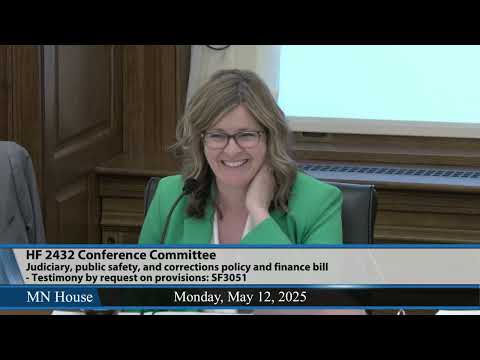
Conference committee considers giving county attorneys administrative subpoena authority for wage‑theft probes
Summary
The conference committee took testimony on Senate File 1909, a proposal to authorize county attorneys to issue administrative subpoenas for employer financial and payroll records in wage‑theft probes.
A conference committee on the Legislature’s omnibus bills heard testimony on language in Senate File 1909 that would authorize county attorneys to issue administrative subpoenas for employer financial and payroll records in wage‑theft investigations.
Joel Hansen, director of government affairs for Associated Builders and Contractors, told the committee the proposal would expand existing authority used in other financial‑crime investigations and asked for clearer drafting. Hansen said the draft (article 6, r 1, lines 103.16–105.2) uses phrases such as “other person” and “other records that in any way relate to wages or other income” that he said are undefined and risk overbreadth; he also noted the change would move some investigations from the search‑warrant standard to an administrative subpoena standard that does not require probable cause in the same way a warrant does.
Richard Kajewski, government affairs director for the North Central States Regional Council of Carpenters, urged the committee to consider the expansion because wage‑theft cases often take years to assemble and victims continue to suffer while enforcement proceeds. “These cases take far too long to resolve, and it’s at the expense of more and more victims,” Kajewski said, describing frequent on‑site complaints and the time needed to collect affidavits, payroll records and video evidence.
Drew Evans, superintendent of the Minnesota Bureau of Criminal Apprehension, described wage‑theft work as often “very much record driven.” Evans said administrative subpoena authority can let investigators “quickly sift through the information provided to determine whether or not we do believe a crime is occurring” and may allow investigators to clear nonprosecutable complaints faster. He emphasized, however, that the BCA was not advancing the policy change itself in committee testimony and that multiple state agencies (Department of Labor and Industry, Commerce, BCA) share responsibilities for civil and criminal aspects of wage violations.
Committee members probed whether an administrative subpoena would produce records a court‑issued search warrant could not. Counsel and nonpartisan staff said the draft limits administrative subpoenas to records “relevant to an ongoing, legitimate law‑enforcement investigation,” and noted the statute currently attaches a probable‑cause specification only for welfare fraud and identity‑theft administrative subpoenas. Several senators suggested targeted drafting to avoid overly broad authority: tightening definitions (for example, clarifying “other person”), specifying categories of records, or permitting administrative subpoenas only after preliminary factual corroboration.
Those testifying listed records that commonly support wage‑theft cases: payroll registers, bank and credit‑card records, workers’‑compensation filings, contracts and transactional documents. Kajewski and other witnesses described cases in which employer records and video evidence were necessary to document systemic underpayment or misclassification.
Members indicated interest in narrow, workable drafting that would speed investigations but preserve constitutional protections and due process. The committee did not adopt final language during the meeting and agreed to further consultation among stakeholders and counsel.