Get Full Government Meeting Transcripts, Videos, & Alerts Forever!
Get email alerts on the Collision Data Release topic
No spam. Unsubscribe anytime.
Conference committee hears bill to let accident parties obtain unredacted crash videos
Summary
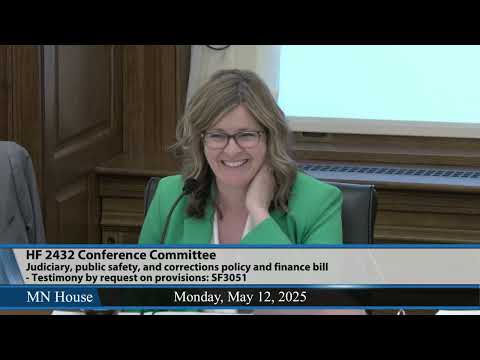
A Minnesota conference committee on the Legislature’s omnibus bills heard testimony on Senate File 3051, which would permit certain crash‑related body‑worn and dash‑camera footage to be released unredacted to parties entitled to an accident report.
A Minnesota conference committee on the Legislature’s 2025 omnibus bills on Monday took testimony on language in Senate File 3051 that would allow certain crash‑related body‑worn and dash‑camera footage to be released unredacted to people entitled to an accident report.
Proponents said the change would reduce redundant redaction work and speed the exchange of evidence; law enforcement raised privacy and operational concerns. Joel Carlson, representing the Minnesota Association for Justice, told the committee the measure aims “quite frankly [to be] a cost savings to local government” by avoiding repeated redactions that are ultimately undone by court orders.
Carlson said the proposal is limited. The draft language (article 11, r 12, section beginning lines 169.27–170.22) requires a written request and an accompanying accident report and applies only to the persons statutorily entitled to an accident report — the people involved in the crash, their insurers, counsel, or next of kin. He said the bill preserves exceptions for active investigations and other legal privacy protections and would restrict use of the footage to “that claim or as court evidence.” Carlson cited a 2015 state decision he described as Burks v. Metropolitan Council as the legal background for his view that subjects are entitled to the data.
Colonel Christina Bogojevic, colonel of the Minnesota State Patrol, told the committee the patrol has concerns about workload and privacy. “Many times those videos show people at their worst times, the worst time in their life,” she said, noting current data‑classification rules require redaction when subjects do not consent. She said even if the patrol could permissively release footage, staff would still have to review video for exceptions (juveniles, undercover officers, CJIS data and similar) and that the draft lacks an explicit liability clause for improper downstream dissemination.
Nonpartisan staff reported a preliminary fiscal note from the Department of Public Safety estimating an initial cost of about $4,000,000 and roughly $3,304,000 annually thereafter for workload associated with the proposal, which drew questions from committee members about the assumptions behind that figure.
Committee members debated two related issues: (1) whether releasing footage pre‑litigation saves net work or merely shifts when the review occurs, and (2) how strongly the bill should limit recipients’ use of the footage. Senator Lutz and other members described the tradeoff between avoiding redundant redaction work and protecting privacy, and suggested the bill could be narrowed to a litigation‑focused exception or to permit counsel to view footage without receiving copies.
Supporters said the proposal does not create a new right to access data; rather, it seeks to streamline a process that often ends, they said, with an unredacted court order after judicial balancing under the Government Data Practices Act (chapter 13). Law‑enforcement witnesses agreed courts can order disclosure under discovery, but emphasized the operational challenge of reviewing large volumes of video. The colonel estimated a typical basic traffic crash generates about 30 minutes of body‑camera review time per trooper and said injury or fatal crashes multiply that workload by the number of officers on scene.
The committee noted the bill was introduced in the House as House File 2938 and was not heard there before the conference deadlines; members agreed to continue work on drafting clarifications, including whether viewing rights (without copies) or stronger downstream protections and liability language could address privacy and operational concerns.
Committee staff and testifiers said they would continue to discuss refinements in the days before the end of session.