Get Full Government Meeting Transcripts, Videos, & Alerts Forever!
Get email alerts on the Restorative Justice Evidence Privilege topic
No spam. Unsubscribe anytime.
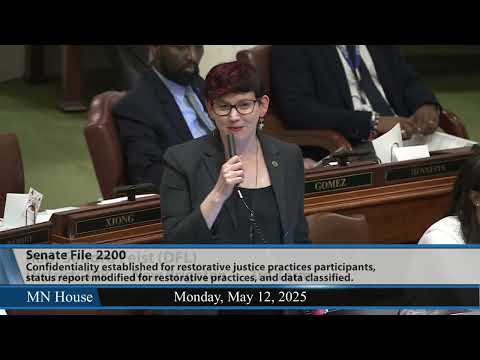
Minn. House passes bill making restorative-practice statements inadmissible in court
Summary
The Minnesota House approved Senate File 2200 on a 98-36 vote, shielding statements made in restorative-practice settings from admission as evidence and creating a statutory confidentiality privilege similar to alternative dispute resolution.
The Minnesota House passed Senate File 2200 on third reading, approving a measure that makes statements made in restorative-practice settings inadmissible as evidence on a 98-36 vote during a floor session. The bill had passed the Senate unanimously before coming to the House.
Supporters said the bill responds to survivors' calls for more options for accountability and healing. Representative Feist said the measure "has been championed by survivors of assault seeking expanded accountability and healing for other survivors," and described the change as creating "a legally safe space for dialogue" similar to privileges that already exist for alternative dispute resolution.
Representative Hudson, speaking in support, described the bill's origin as "coming directly from real people, not lobbyists," and said although he personally did not fully embrace restorative processes, he had heard from survivors that the option can provide closure when the criminal justice system does not. "This is provides another option to be able to find that type of a closure," Hudson said, while acknowledging concerns that restorative processes could divert cases from criminal prosecution.
Representative Schwartz also spoke for the bill, saying it "strengthens confidentiality for participants in restorative justice practices" and that prosecutors and law enforcement "will still investigate" and pursue criminal cases where appropriate. "For those cases where victims choose a restorative path, they deserve the safety to speak freely without fear of retribution or public exposure," Schwartz said.
The bill would make statements made during voluntary restorative-practice sessions inadmissible in court, establishing a privilege analogous to that used in alternative dispute resolution settings. Supporters named several survivor-advocacy organizations backing the bill, including Violence Free Minnesota, Minnesota Alliance on Crime, CADA, and the advocacy group Break the Silent; survivor and advocate Sarah Super was thanked on the House floor for her work on the measure.
After discussion closed, the clerk called the roll for members voting remotely and others; named votes recorded in the transcript include Finke (aye), Hussein (aye), and Sensor Murrah (aye). The clerk reported "There being 98 yays and 36 nays, the bill is passed and its title agreed to." The clerk also noted there were no amendments at the desk prior to the third reading.
The discussion on the House floor distinguished between the bill's statutory change (making restorative-practice statements inadmissible) and existing criminal processes; speakers repeatedly stated the measure does not replace prosecution or investigation. The transcript indicates supporters view the bill as expanding options for survivor-centered accountability while some members raised reservations about potential diversion from criminal accountability and signaled that legislative fixes could follow if problems arise.
The bill summary presented on the floor described the change as an evidence rule adjustment rather than a new criminal procedure; the House action recorded in the transcript is a formal passage with the bill's title agreed to.