Get Full Government Meeting Transcripts, Videos, & Alerts Forever!
Get email alerts on the Budget topic
No spam. Unsubscribe anytime.
McKinney ISD leaders warn of multi-year budget shortfalls; attendance, special education and tax compression cited
Summary
Assistant superintendent for business operations and the district CFO presented an update outlining a multi-year budget deficit driven by stagnant state funding, lower attendance, rising special education costs and mandated security expenses; the board discussed projections and possible mitigations.
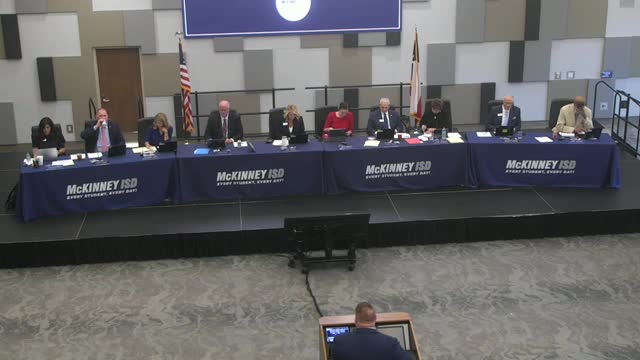
At the May 12 McKinney Independent School District board meeting, Assistant Superintendent for Business Operations Dennis Womack and Chief Financial Officer Marlene Harbison presented a multi-part budget update describing an operating deficit driven by several structural factors.
Womack told the board that school funding in Texas is largely driven by average daily attendance and that the district's drop in attendance since the pandemic has a material revenue effect: "For every percentage point of average daily attendance that we can increase is about $3,000,000 to the overall revenue to the district," he said. He and CFO Marlene Harbison walked trustees through recent and projected impacts on fund balance and tax-rate compression the district is using for budget planning.
Harbison said the district's certified property value estimate from Collin Central Appraisal District was roughly $31.4 billion, a roughly 10.75% increase year over year, and that current planning assumes a maximum compressed maintenance-and-operations (M&O) rate near 0.708 and an interest-and-sinking (I&S) rate near 0.37 for a combined rate near 1.078. She summarized where the district ended the prior year and the estimated hits to fund balance: the 2023-24 fiscal year showed about an $8 million impact to fund balance, leaving roughly $104 million; current-year estimated hits are around $17 million leaving a projected $87 million; and under current assumptions the 2025-26 projection shows an approximate $7 million hit.
Both presenters told trustees that the district faces rising costs without corresponding state funding increases and that several elements drive the deficit: a rise in special education counts and associated costs, increased operating expenses and double-digit inflation, and newly mandated campus armed security (the district's program costs about $2.2 million annually while state reimbursements for the program total about $700,000). Womack said special education and staffing increases accounted for roughly $21.4 million in additional expenditures over the past three years and reminded the board that many costs are estimates until the Legislature resolves proposals this spring.
The board asked questions about potential new funding streams and legislative changes. Harbison said pending state legislative activity could alter the district's revenue picture, but cautioned that additional funding typically carries "strings" (restrictions) and that the final shape depends on whether the House or Senate proposals prevail. She said the district's planning did not assume additional homestead exemption changes or final legislative decisions; the numbers shown were conservative projections based on current law.
Womack and Harbison also reviewed local actions the district has taken to reduce the budget gap: elimination of vacant positions, reorganizations, reductions in force earlier in the spring, administering conservative budget reductions and pursuing revenue opportunities such as open enrollment programs. Womack emphasized the district is prioritizing programs but that choices to reduce offerings have real consequences for students.
No formal vote was taken during the presentation; the item was an informational budget update to guide trustees' decisions during the upcoming fiscal planning cycle.