Get Full Government Meeting Transcripts, Videos, & Alerts Forever!
Get email alerts on the Aviation Heliport Pud topic
No spam. Unsubscribe anytime.
Planning Commission declines to recommend PUD amendment and CUP to permit heliport at Snake River Canyon Ranch
Summary
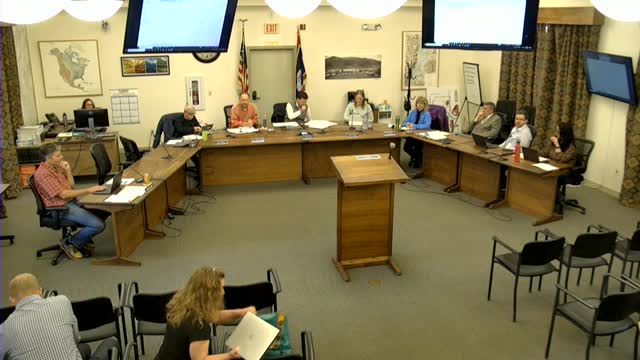
The Teton County Planning Commission on May 12, 2025, voted unanimously not to recommend approval of a PUD amendment and a conditional use permit that would allow a heliport at Lot 3‑2 (Johnny Counts Lodge) in the Snake River Canyon Ranch Resort.
The Teton County Planning Commission on May 12, 2025, voted unanimously not to recommend approval of a planned unit development (PUD) amendment (PUD‑20205‑1) and the companion conditional use permit (CUP‑20204‑4) that would add aviation (a heliport) as an allowed use at Lot 3‑2 (Johnny Counts Lodge) within the Snake River Canyon Ranch Resort master plan.
Staff Presentation and Recommendation Planning staff (Hamilton Smith, Planning Building Services) walked commissioners through background, the resort’s subarea structure, and the specific tests for amending a PUD and issuing a conditional use permit. Smith told the commission that the proposed amendment would add aviation to the Subarea 2 use table as a site‑specific allowance for Lot 3‑2 and that the applicant later limited the request to that lot in response to community comment. Smith said staff’s analysis focused on the PUD and Article 4 findings (consistency with comprehensive plan, purpose and intent of the resort master plan, and the character element for the river‑bottom subarea) and concluded staff was not able to make required findings. Smith said staff therefore recommended denial of the PUD amendment and of the CUP.
Key staff concerns described in the report and at the meeting included: potential impacts to the Astoria Hot Springs passive public park and wildlife habitat; the intended character and 97–100 acre public park set‑aside integral to the resort master plan; the difficulty of monitoring or enforcing limits on the distribution of flights between two heliport locations; and hazards related to overhead power lines near the proposed landing area. Smith stated that permitting a second operational landing site would effectively permit a second fully usable helipad with “a doubling of the area of occupancy” and airspace impact at low elevations where wildlife and avifauna may be sensitive.
Applicant and Support Hal Hutchinson (HH Land Strategies), representing High Mountain Heli and owner Jake Laskin, and Mr. Laskin presented the application and argued the proposed landing zone on Lot 3‑2 would reduce noise and congestion near Astoria Hot Springs, would not increase the operator’s overall permitted flight volume, and would provide redundancy and operational flexibility (special events, group trips, avalanche mitigation staging). Hutchinson said the application was revised after neighborhood meetings to limit aviation allowance to Lot 3‑2 only, and that the Snake River Sporting Club Homeowners Association later voted to support the Lot 3‑2 location. Hutchinson noted the U.S. Forest Service had stated in a letter (04/28/2025) that, “we do not anticipate any additional adverse or long term impacts to crucial wildlife habitats” if the additional landing site provided redundancies without an increase in traffic.
Applicant testimony emphasized these points: the proposed pad is roughly a quarter‑mile from the existing pad and farther from the hot springs and park; flight paths from the proposed site would be oriented away from most of the park; the small pad would be used primarily during the established heli‑ski season (Dec. 15–Apr. 15) and for private/group operations rather than year‑round commercial tours; and High Mountain Heli’s historic volume is controlled through Forest Service permitting.
Public comments and agency input were mixed. The Astoria Parks Conservancy and other conservation groups submitted letters raising concerns about effects on the hot springs park and wildlife; the Forest Service, the conservation district and some agencies provided technical comments but did not uniformly oppose the application. Lower Valley Energy (local utility) requested coordination for markings on lines near the proposed pad; staff noted overhead conductors within approximately 35 feet of the proposed location and cited Article 6 aviation siting standards that caution against siting helipads near power lines.
Commission Deliberation and Vote Commissioners questioned enforceability of flight distribution between pads, the meaning of LDR language that allows transferable “historic volume” for named helicopter operators, and whether granting a site‑specific aviation allowance would be consistent with the resort’s character and the public park covenant. Commissioners and the county attorney discussed options including a text amendment, an interpretation by the planning director, or continuation to request additional clarification; several commissioners said they would be open to a future approach that would extinguish the existing easement and transfer operations to a single new pad, but that was not the application before the commission.
On separate motions, the commission voted unanimously not to recommend approval of the PUD amendment and not to recommend approval of the conditional use permit. The planning director’s written recommendation to deny the PUD amendment and CUP was reflected in the staff report and formed the basis for the commission’s action.
Next steps The Planning Commission’s non‑recommendation will be transmitted to the Board of County Commissioners as the commission’s formal recommendation on the PUD amendment and CUP. The applicant may choose to pursue alternatives, including a formal LDR interpretation, a text amendment to clarify the transferability of historic aviation rights, modification of the proposal (for example, extinguishing the existing landing easement as part of a transfer), or an appeal to the Board of County Commissioners.