Get Full Government Meeting Transcripts, Videos, & Alerts Forever!
Get email alerts on the Uav Drone Policy topic
No spam. Unsubscribe anytime.
Conference committee weighs expanded police drone use, lawmakers spar over warrant and missing-person language
Summary
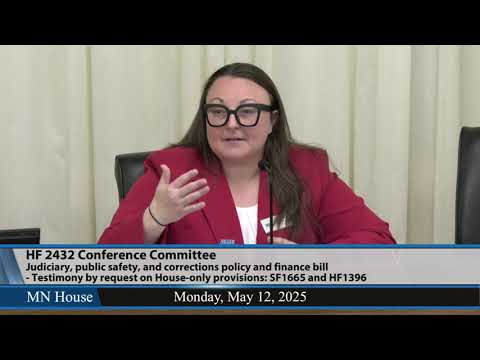
A Minnesota conference committee heard testimony on competing House and Senate language to broaden law-enforcement use of unmanned aerial vehicles (UAVs), focusing on whether drones may be used without a warrant for fleeing suspects and in missing-person searches.
A Minnesota legislative conference committee considering judiciary and public-safety budget language heard testimony on competing House and Senate provisions that would expand law-enforcement use of unmanned aerial vehicles, commonly called drones. The provisions appeared as additions to House File 1396 and Senate File 1665 and are being considered as part of House File 2432.
House counsel Jeff Diebold summarized the differences, saying the proposals diverge on four main points: whether a drone may be used to "document" evidence or to "preserve and protect" it; the standard for using drones to track fleeing suspects (probable cause in the House language versus a lower reasonable-belief/suspicion standard in the Senate draft); limits on using drones over private property with occupant consent; and whether drones may be used to search for missing people only in "active" searches that involve risk of death or bodily harm (House) or more broadly "to facilitate the search" (Senate).
The Minnesota Chiefs of Police Association, represented by Jeff Potts, executive director, supported the House wording that the drone can "document evidence that is in imminent risk of destruction," arguing that "a drone can't really preserve and protect, however, it can document." Potts also backed the Senate amendment offered as A32 to allow drone use when officers reasonably believe a crime was committed and a person is fleeing or might flee, and he supported the Senate language allowing drones to "facilitate the search for a missing person."
Scott Habel, sheriff of Renville County testifying for the Minnesota Sheriff's Association, agreed the House wording on documenting evidence is preferable to language about "preserving and protecting." He also supported the A32 amendment's reasonable-belief standard for pursuits and said he preferred the Senate's broader missing-person phrasing because the House provisionwhich requires an "active" search involving risk of death or bodily harmcould create uncertainty about when a drone may be launched. Habel described rural examples, saying that whether a child in a cornfield is at risk "depends" and that parents "deserve every piece of equipment available" to search for a missing child regardless of whether the risk of bodily harm is immediately clear.
Drew Evans, superintendent of the Minnesota Bureau of Criminal Apprehension, told the committee the BCA shared the law-enforcement groups' preferences and noted that many of the contested uses are exceptions to the warrant requirement the parties are trying to narrow. Evans said the Senate position or the A32 amendment would be the BCA's preference to aid violent-crime investigations and reduce risk to officers and suspects by enabling perimeter-setting with UAVs.
Alicia Gransey, a staff attorney at the ACLU of Minnesota, testified in favor of the House language requiring probable cause and a warrant exception only when someone actually is fleeing, warning that broader standards risk "eating" the warrant requirement. Gransey emphasized the constitutional warrant protections and said the House language was crafted to "conform to the protections that all Minnesotans have under the constitution." She also explained the inclusion of the word "active" in the House missing-person provision, saying it is intended to distinguish emergency searches from older or archival missing-person investigations.
Committee members pressed both sides on practical and legal trade-offs. Senator Latz questioned whether the warrant process is feasible during a short pursuit, saying, "In the time it takes to get a warrant to put up a drone, they're long gone," and argued that drones can enable safer perimeter tactics in rapidly evolving pursuits. Other members asked whether the broader emergency language elsewhere in the bill might already cover missing-person searches, and law-enforcement witnesses said adding explicit missing-person language provides clarity for field use.
No formal action or vote on the statutory language was taken at the hearing. Chair members released the testifiers and recessed the committee to the call of the chair, noting other testifiers could not be heard that day.
The committee will reconvene to continue testimony and to reconcile the House and Senate positions on the UAV provisions, including the probable-cause versus reasonable-belief standard for pursuits and whether missing-person searches should require an "active" emergent risk of death or bodily harm or be allowed more broadly to "facilitate" searches.