Get Full Government Meeting Transcripts, Videos, & Alerts Forever!
Get email alerts on the Veterans Services Cvso Funding topic
No spam. Unsubscribe anytime.
Lawmakers hear calls to boost county veteran service officers and crack down on for‑profit claims firms
Summary
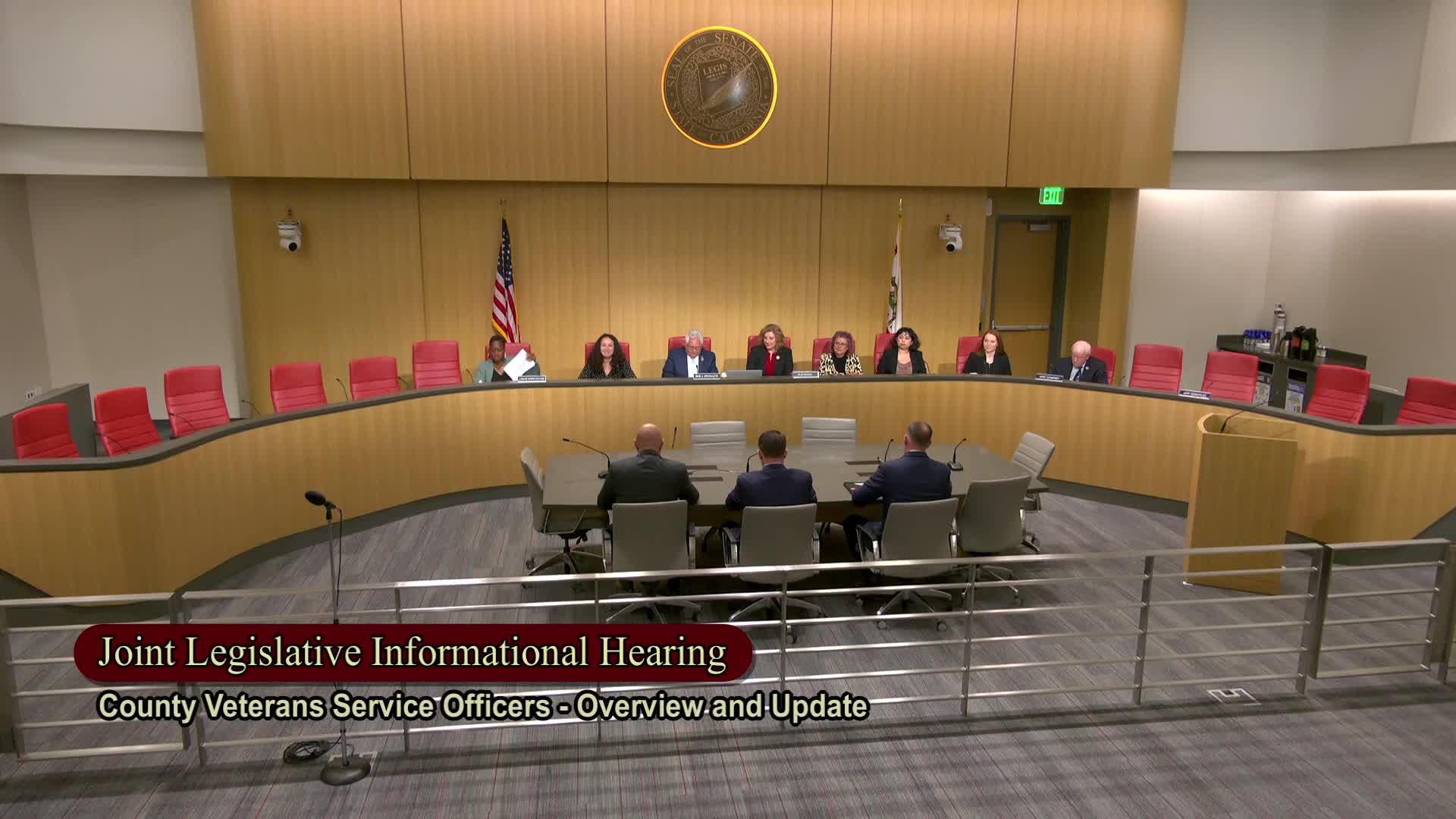
County veteran service officers and state officials told a joint informational hearing of the California State Senate and Assembly committees on Military and Veterans Affairs in Sacramento that California underinvests in local veteran services and needs stronger protections to stop for‑profit claim consultants from exploiting veterans.
County veteran service officers and state officials told a joint informational hearing of the California State Senate and Assembly committees on Military and Veterans Affairs in Sacramento that California underinvests in local veteran services and needs stronger protections to stop for‑profit claim consultants from exploiting veterans.
David West, president of the California Association of County Veterans Service Officers and a county veterans service officer, told the panel that CVSOs are often the first point of contact for veterans and their families and that the offices build long‑term relationships while filing claims, connecting veterans to housing, health care and other benefits. "We are here to connect every one of California's veterans and their families to the benefits and services they earned," West said.
The witnesses said state subvention for CVSOs is small compared with the scale of the work. West and other CVSO witnesses cited the current State General Fund allocation of $11,000,000 for CVSO subvention, the Medi‑Cal Cost Avoidance Program at about $838,000, and the Veterans Services Office Fund at about $554,000. West said California has roughly 1,400,000 veterans and that the $11,000,000 allocation amounts to about $7.86 per veteran per year. "This is a call to recognize the disproportionate underinvestment in the system that serves the vast majority of California's veterans," he said.
Los Angeles County Director of Military and Veteran Affairs Jim Zenner described a broader local model that combines county funding, peer navigators and cross‑agency teams to reach veterans across a large and dispersed population. "Access to veteran services and benefits should not depend on where a veteran lives," Zenner said, describing LA County's "no wrong door" approach and a veteran peer access network that deploys trained veteran peers in the community.
San Luis Obispo County Veterans Service Officer Morgan Boyd said his smaller county has increased claims and benefits secured while facing reductions in state subvention. Boyd said his office helped secure $12,350,000 in new benefits last year for a county with roughly 14,000 veterans and noted San Luis Obispo leads the state in veteran suicides per capita. "Pride doesn't pay for accredited staff, reduce case loads, or support the expansion of outreach programs," Boyd said.
CalVet Deputy Secretary Roberto Herrera described the department's role in accreditation and training for CVSOs and said CalVet operates district offices that review claims and represent veterans in appeals. "To become accredited, CVSOs and their veteran service representatives must complete the CalVet Veterans Service Representative Academy," Herrera said, summarizing phased training, supervised on‑the‑job requirements and an examination process that supports quality claims development.
Several witnesses warned that for‑profit, unaccredited companies — commonly called "claim sharks" — market aggressively to veterans, charge large contingency fees and often provide little follow‑up or advocacy. Steve Johnson, Placer County veterans service officer, described cases in which veterans who paid fees to private companies still needed local advocacy to get favorable VA decisions or to secure back pay. "The word advocate cannot be overstated," Johnson said. Deborah Johnson of the Veterans of Foreign Wars (Department of California) urged state action such as banning contingency fees for unaccredited agents, creating a public register of accredited advisors, launching awareness campaigns, strengthening penalties for misleading conduct and working with digital platforms to curb deceptive ads.
Catherine Kuminski, director of studies at the Center for a New American Security, summarized national research showing county veterans service offices generally increase the success rate of claims compared with unaided filers and argued that investment in local offices yields measurable returns in benefits secured.
Why it matters: witnesses told the committees that increased state funding, standard accreditation and public education would reduce veteran reliance on predatory consultants, speed access to benefits and keep federal benefit dollars in California. Several speakers framed the request as an investment: state subvention increases, they said, have coincided with higher filings, improved approval rates and larger amounts of federal benefits returned to veterans.
What lawmakers heard and next steps: testimony outlined a series of legislative and administrative remedies: increase the CVSO subvention (witnesses described a budget ask in the hearing materials), fund statewide mentorship and fellowship programs to expand accredited staff, coordinate CalVet outreach and district‑office review for cleaner claims, run public service messaging to steer veterans to accredited representatives, and pass state law to limit fee‑taking by unaccredited agents. No formal votes or committee actions were recorded at the hearing.
The hearing also surfaced county‑level program examples and data: LA County reported reductions in veteran homelessness and the use of peer navigators to reach veterans in nontraditional settings; Placer and San Luis Obispo counties described direct outreach, jail and reentry work, and suicide‑prevention reviews. CalVet said California CVSOs filed 12% of VA claims in a recent year while the state accounts for about 8% of the national veteran population, a statistic witnesses used to underscore the offices' productivity.
Moving forward: witnesses urged clearer consumer protections and better state funding. "With your support, we can assure that every veteran in the state receives timely, accurate, and dignified access to the benefits they have earned," David West said. Lawmakers on the panels indicated interest in drafting or reintroducing state legislation and in partnering with CalVet on public communications to warn veterans about unscrupulous firms.
Ending: Panel members closed by thanking witnesses and veterans in the audience. Committee chairs said they will consider legislative options and further briefings to refine funding requests and consumer‑protection measures.