Get Full Government Meeting Transcripts, Videos, & Alerts Forever!
Get email alerts on the East Side Governance topic
No spam. Unsubscribe anytime.
Committee backs cultural-council model to oversee East Side CBA funds
Summary
A City Council committee voted to pursue a cultural-council-style independent nonprofit to administer East Side Community Benefits Agreement funds, after public comment calling for legacy East Side representation and staff briefings on funding and oversight.
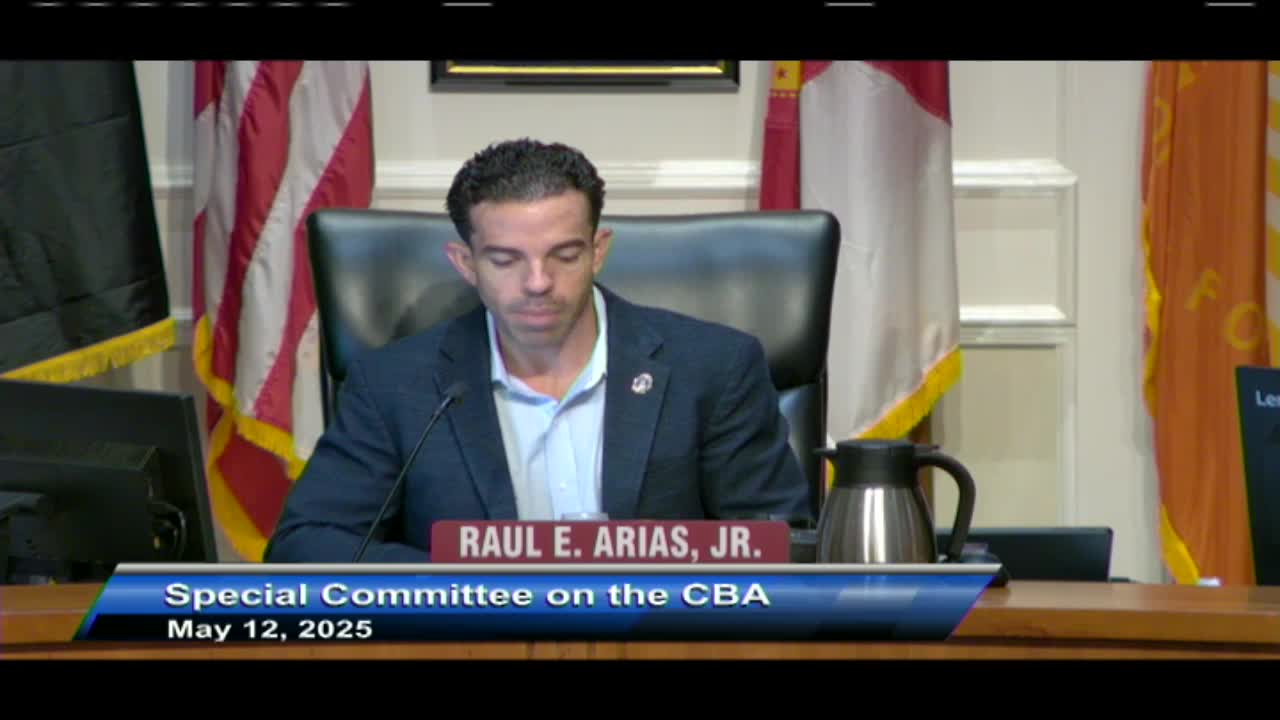
A City Council CBA committee voted May 12 to move forward with a cultural-council model for distributing Community Benefits Agreement (CBA) funds targeted to Jacksonville’s East Side.
The committee’s action follows a staff summary that the supplemental CBA includes about $40 million earmarked for East Side projects to be delivered on a roughly seven-year timetable; the committee also heard public comments pressing for legacy East Side representation, stronger checks and balances, and local control of funds. The vote was taken by voice; committee members indicated support and the chair declared the motion passed.
The move is intended to create an independent 501(c)(3)-style entity that would receive annual appropriations from the city and administer grants or contracts for affordable housing, workforce development and other East Side initiatives. Philip Peterson, council staff, summarized the funding background and said the original Jaguars-related CBA included roughly $118 million from the team and a matched city contribution for parks and other elements; the supplemental CBA specifically programs $40 million for East Side work, with an expectation that some of that will be funded over a seven-year period. Peterson said roughly $5.99 million of that had already been counted in the 2024–25 budget, reducing the remaining East Side obligation to about $34 million under some scenarios.
Community speakers urged local oversight and tangible results. Eric Paul McNeil, an East Side resident, described a proposal to modernize a community computer center and said he had encountered resistance from staff and contractors when trying to work inside the system. Latavia Harris, a fourth-generation East Side resident, urged “massive checks and balances” and asked who is being paid and whether workers are actually performing work in the neighborhood. Jackie Lattimore, who described long experience running a business on the East Side, listed neighborhood organizations that have worked in the area and urged collaboration among them.
Travis Williams, representing the Together Eastside Coalition, told the committee the coalition had held nearly 15 community meetings and logged nearly 1,000 volunteer hours; he said the coalition favors the Cultural Council model because it combines community input with audit and reporting requirements and can be specified in ordinance. Williams also said Nelson Mullins (a local law firm) has provided pro bono legal support to the coalition and is prepared to assist in drafting bylaws and proposed ordinance language.
Mary Stifopoulos, Office of General Counsel, described two common city approaches: (1) an independent 501(c)(3) similar to the Cultural Council, which receives city appropriations and runs its own grant process with some council-appointed seats; and (2) an internal, city-managed grants process like the Public Service Grants (PSG) system, which is administered within city government and where the council and mayor appoint board members. Stifopoulos warned that independent nonprofit boards and their appointees are subject to government ethics rules that can restrict board members from receiving grant dollars they seek to administer.
Committee members discussed board size and composition. Suggestions ranged from a compact board of seven to a larger nine- or 15-member model similar to the Cultural Council. Several committee members and public commenters urged prioritizing “legacy” East Side residents and long-standing stakeholders for neighborhood seats; others said geographic representation from the community’s five neighborhoods should be considered. The chair asked staff to return proposed ordinance language and to incorporate any draft materials Nelson Mullins submits for review.
Staffing and administrative costs were also discussed. Peterson noted the Cultural Services Grants Council is limited to 13.5% of city allocations for administrative costs and asked whether East Side administrative costs should come from the $4 million-per-year allocation or be treated separately. Whitney Meyer, speaking for the Jaguars, said she had no objection to administrative costs being drawn from the East Side allocation.
The committee asked OGC to review the supplemental CBA for any needed clarifying amendments and asked staff to prepare a one-page summary of funding and the various buckets of city obligations. Committee members and community representatives agreed to follow up with draft ordinance language and bylaws; staff said the city will not send appropriations to an independent entity until it is legally formed and the council has settled guardrails in code or ordinance.
Ending: The committee passed the motion to pursue a Cultural Council–style structure and asked staff and OGC to return draft language and a staffing/funding clarification at a future meeting. The committee indicated it will take final action on board composition and related ordinance language at a future meeting once draft materials are available.