Get Full Government Meeting Transcripts, Videos, & Alerts Forever!
Get email alerts on the Infrastructure Drainage Grants topic
No spam. Unsubscribe anytime.
San Patricio County hears timeline, permitting and easement hurdles for $25 million GLO mitigation package
Summary
County grant manager and Lankford Community Management Services updated the Commissioners Court on two active GLO mitigation grants and a new $25 million method-of-distribution (MOD) award, outlining environmental, right-of-way and permitting steps that could delay bidding and construction.
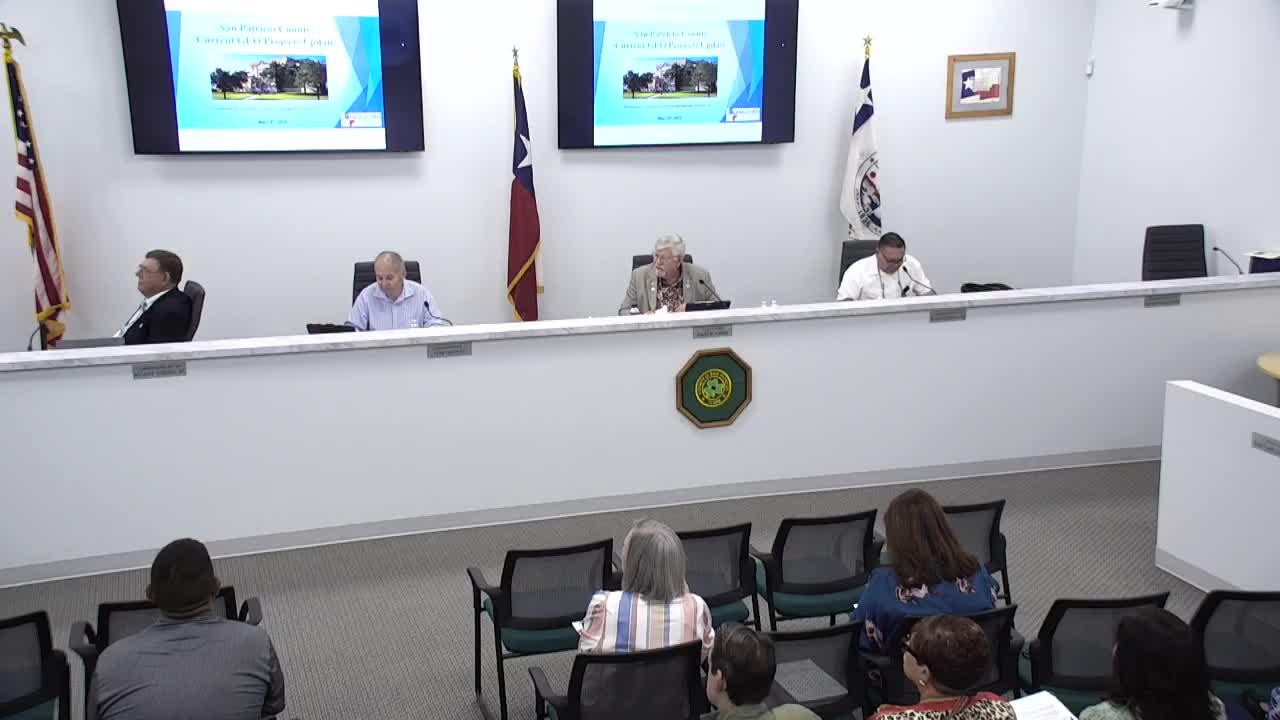
San Patricio County Commissioners Court on the record received a presentation on the county’s two active Texas General Land Office (GLO) mitigation grants and a new $25 million CDBG‑MIT method‑of‑distribution (MOD) award, and heard that right‑of‑entry, wetlands and flood‑plain permitting pose schedule risk.
Lankford Community Management Services consultant Jessica Day Down told the court the county has two active mitigation projects — channel improvements on two identified sites — and that the MOD contract covers about a dozen additional drainage, road and water‑system projects totaling roughly $25.9 million. Day Down said the currently active mitigation grant has an expiration tied to a prior extension and that GLO has refused additional extensions for that contract; the MOD award carries its own timeline and allows limited extensions.
Why it matters: the projects are intended to reduce flooding and repair drainage and infrastructure across the county, including work in Taft, Lake City, Ingleside and other communities. Delays in acquisition, environmental review or permits could push construction well beyond the county’s preferred schedule.
Day Down and Alyssa Bickford of Lankford said the county is now in the acquisition and environmental review phases on the active mitigation grants and in the early environmental review and engineering procurement phases for the MOD contract. They described several recurring issues that consume time: obtaining right‑of‑entry or easements from long‑distance or difficult‑to‑locate landowners; coordination with the U.S. Army Corps of Engineers (USACE) on nationwide permits when work may affect wetlands or river crossings; historical‑resources review and tribal consultation; and flood‑plain permitting and Texas Commission on Environmental Quality (TCEQ) coordination for water and wastewater work.
“Given where we are, we would need to be ready to bid this month,” Day Down said of the active mitigation work, then added the county is not ready to bid because survey access and right‑of‑entry packets remain outstanding. She asked the court to help contact property owners so survey and easement work can proceed.
County grant manager Melanie Cooper told the court Lankford’s team and her office have sent packets to landowners three times and held two public meetings; she said a small number of parcels show title records with no identifiable owners, which may require eminent‑domain procedures and legal services. Cooper asked the court to approve procurement of legal services for eminent domain where necessary.
On the new MOD award, Day Down described a set of projects that include a water‑tower mixing and heating system replacement in Odum, a $6 million Peter Swell project (noted as likely requiring USACE coordination and possibly an archeological study), pavement and drainage improvements, and other site‑specific ditching, culvert and bulkhead repairs. She said most projects qualified as low‑to‑moderate income (LMI) projects under GLO rules; approximately 15% of the MOD award was designated as “urgent need.”
Engineering procurement and contract award: the court considered awarding a single countywide engineering contract to perform project information, development and design for the MOD projects. Melanie Cooper reported the scoring committee ranked the top firms and the court voted to award RFP 2020‑5‑2 to Heff Engineering (motion carried). Cooper said one contract will reduce administrative burden on county staff; several commissioners raised concerns that using two firms might speed delivery but complicate audits and contract administration.
Administrative costs and contract amendment: the court considered Amendment No. 2 to the existing grant administration contract with Lankford for the MOD program, which would increase administrative fees up to the 6% maximum allowed by the grant. Several commissioners asked whether Lankford could reduce its administrative rate by 1 percentage point; Lankford said they would relay the request to their principal. The court voted to withdraw the pending motion and table the amendment while staff follows up on the administrative‑fee question.
Signatures, civil‑rights policies and related start‑up documents: the court approved a resolution designating authorized signatories for construction and financial documents required to begin reimbursement activity under the MOD contract, and approved county civil‑rights policies required by GLO. Cooper said those startup documents are required for reimbursement eligibility and for contract execution. The court added Commissioner Zagorski as an authorized signatory to the list.
Next steps and timing: Lankford advised the court it has one year from contract execution to complete environmental reviews for the MOD work and will attempt to parcel out design and environmental work to allow bidding on cleared projects while design continues on others. Day Down said early coordination with USACE, TxDOT and TCEQ will be important and that the county should expect some projects to require extensive permitting and potentially archaeological surveys.
Commissioners repeatedly asked staff to push for landowner cooperation on right‑of‑entry packets and easements to avoid more time‑consuming acquisition steps. Lankford and county staff said they will continue outreach, complete environmental pre‑screening and proceed with procurement steps already underway.