Get Full Government Meeting Transcripts, Videos, & Alerts Forever!
Get email alerts on the Oversight Operations topic
No spam. Unsubscribe anytime.
DPA recommends technology upgrades, expanded data tools and health monitoring for San Francisco jails
Summary
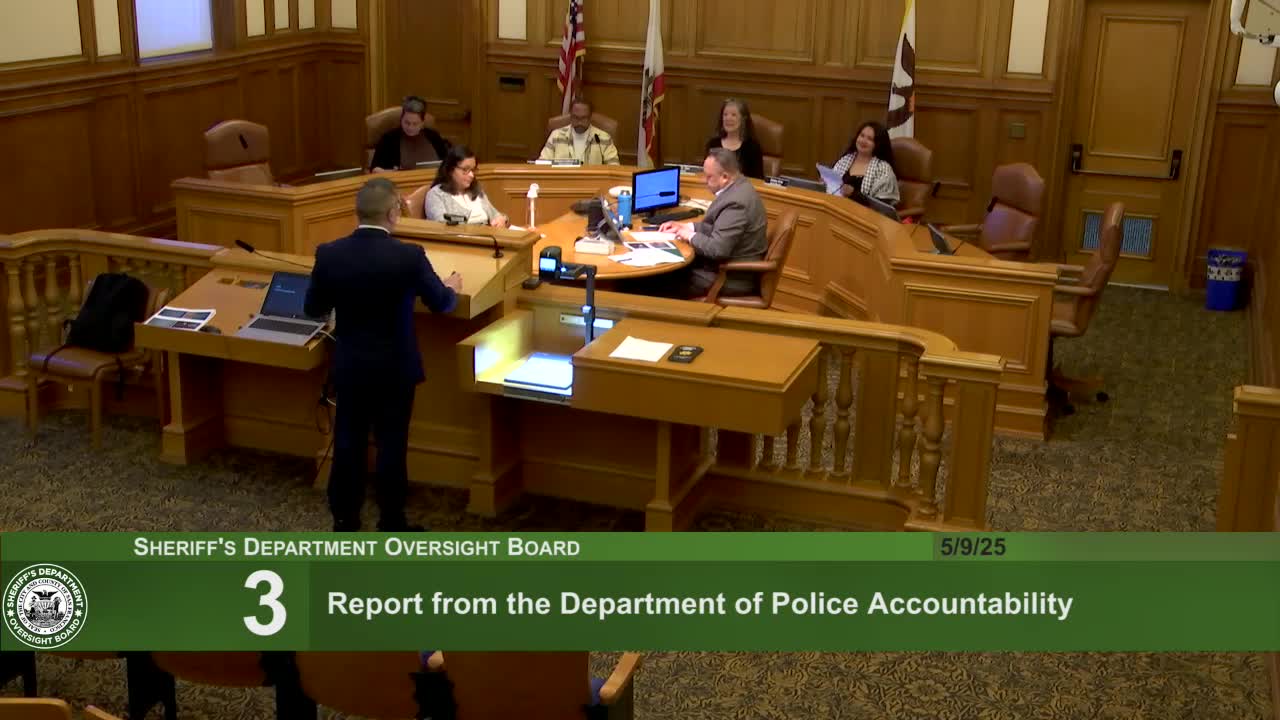
Marshall Kine of the Department of Police Accountability outlined investigative findings and a prioritized set of recommendations for the Sheriff’s Office, including digital use-of-force logging, upgraded surveillance, wearable or room sensors for at-risk people, body-worn camera rollout and expanded data dashboards.
Marshall Kine, chief attorney at the Department of Police Accountability (DPA), presented the DPA’s first-quarter investigative findings and prioritized recommendations to the Sheriff’s Department Oversight Board.
Kine summarized the DPA’s current investigative role under a series of agreements with the Sheriff’s Office and emphasized that DPA jurisdiction—per the letter-of-agreement—covers sworn sheriff deputies in categories including use of force, weapons, certain misconduct allegations and in-custody deaths. “We only recommend investigative findings. We do not recommend discipline. We do not have any subpoena power to conduct hearing, and all of our access is granted, by the sheriff's office as an agent of or investigative arm for, the administrative investigations,” Kine said.
The DPA’s prioritized recommendations included modernizing record-keeping with an integrated case-management system; replacing or upgrading aging surveillance cameras (Kine cited failures that resulted in lost footage and said current retention is limited to about six months); implementing a centrally stored digital use-of-force log (the DPA and Sheriff’s Office are piloting an electronic system called BlueTeam); increasing body-worn camera coverage and clarifying body-worn camera policy language; and exploring wearable or ceiling-mounted wireless monitors to track vital signs for people at high medical risk in custody.
Kine described the health-monitoring idea as a pilot candidate: either wrist/ankle wearable trackers that monitor respiration and heart rate or non-contact wall/ceiling sensors. He said those systems include dashboards that can alert staff to anomalies and could reduce response time in acute medical events.
On process and capacity, the DPA reported a year-over-year rise in caseload and said staff feel “taxed” by the investigative volume. Kine said the DPA has assisted in standing up the Office of the Sheriff’s Inspector General, migrated case files toward cloud storage, built a customized case-management database and is working with the Nucleus vendor to put DPA complaint forms on jail tablets so incarcerated people can file grievances digitally.
Kine also reviewed historical context: the DPA’s investigatory role grew from memoranda of understanding after public scandals and ballot measures, and California legislation and local charter language were cited as the law- and policy-level background for oversight. He noted that Inspector General Terry Wiley resigned earlier in 2025 and described transitional arrangements in which the DPA has provided investigative and administrative support while the OIG position is filled.
Board members asked for follow-up detail: whether the DPA could share a draft jail orientation video before it is finalized; how the resignation of the inaugural inspector general has affected operations; and whether tablet privacy and cybersecurity vulnerabilities had been resolved. Kine said the vendor vulnerabilities had been addressed, the DPA is testing cloud-based file migration and data dashboards, and the DPA would seek sheriff staff review of the orientation draft.
Ending: Kine recommended piloting prioritized technology and administrative changes in 2025, and the board asked staff to pursue additional data on jail demographics, tablet capabilities and integration with broader city IT systems to reduce duplicated entry and improve investigative efficiency.