Get Full Government Meeting Transcripts, Videos, & Alerts Forever!
Get email alerts on the State Jobs Labor Budget topic
No spam. Unsubscribe anytime.
Minnesota House passes jobs, labor and economic development budget after votes on vocational rehab, wells and subminimum wages
Summary
The Minnesota House approved Senate File 1832, the biennial jobs, labor and economic development budget, 115-19 after extended debate and several roll-call votes on amendments including a well‑contracting shift and failed proposals to end subminimum wages for people with disabilities and to remove a noncompete exemption.
The Minnesota House on Friday passed Senate File 1832, the two‑year budget for jobs, labor and economic development, approving the bill as amended by a 115‑19 roll‑call vote after hours of debate over funding choices, vocational rehabilitation services, well‑contracting jurisdiction and labor policy changes.
Representative Pinto, a member from Ramsey, told the chamber the package had to absorb “a $50,000,000 cut in both biennia” and noted the bill includes both cuts and targeted policy and investment changes. Representative Baker, the bill’s other lead, said the bill funds agencies overseen by the committee while seeking “more accountability and more follow through” on workforce programs.
The bill advanced with several amendments that changed program funding and policy language. An authors’ amendment (A15) that the chairs described as adjusting grant language and shifting money to expand a small‑business competitive grant program was adopted by voice vote. That amendment also preserved state administration for a film tax credit program and restored related Explore Minnesota funding mentioned during debate.
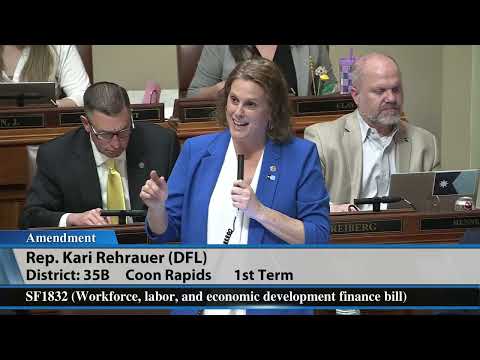
Lawmakers approved an amendment (A18) that redirected funding to vocational rehabilitation services and the Individual Placement and Support (IPS) program, which proponents described as an evidence‑based approach that helps people with serious mental illness obtain integrated employment. Representative Rae Rauer, speaking in favor, said IPS provides “a full range of employment services and supports to assist people with serious mental illnesses achieve integrated employment” and cited a reported success rate above 61 percent.
A contested amendment on well contracting (A14) passed on a recorded roll call, 69 ayes to 64 nays. Representative Baker described the change as intended to resolve overlapping jurisdiction between the Minnesota Department of Health (MDH) and the Department of Labor and Industry (DLI) over certain well plan reviews, saying DLI plan review turnaround had sometimes been slower and that the plumbing board was meeting to examine the issue. Representative Pinto urged caution, noting the plumbing board was scheduled to meet and that the amendment could create an implementation gap if not coordinated with the board’s work. The amendment’s supporters argued it would reduce delays for contractors in Greater Minnesota.
One of the most closely watched policy proposals offered as an amendment (A1) would have ended the use of subminimum wages under 14(c) federal certificates for people with disabilities by Jan. 1, 2027. Representative Hanson J, the amendment’s sponsor, framed the change as a dignity and anti‑poverty measure, saying, “Minimum wage is the most basic labor protection,” and noting testimony that about 3,000 Minnesotans were earning well under state minimum wage under existing certificates. After extended floor debate that split members along differing views about provider capacity and the pace of transition, the amendment failed on a roll call, 65 ayes to 67 nays.
Debate over a separate amendment (A12) that would have removed a partial exemption to Minnesota’s 2023 ban on most noncompete agreements also resulted in a tie vote (67‑67) and the amendment did not pass. Representative Greenman, who offered A12, argued that banning noncompetes supports worker mobility and innovation; opponents including Representative Niska and Representative Baker warned that broad restrictions could harm research‑heavy employers and risk moving high‑value jobs out of Minnesota. Speakers on both sides cited examples and studies in support of their positions.
Other floor action included the unanimous or voice‑vote adoption of a whistleblower protections amendment (A3) that sponsors said should remain part of the bill going to conference. One amendment to expand youth skills partnerships with construction employers (A5) was introduced and debated but ultimately withdrawn by its sponsor for further work.
Lawmakers and committee chairs also pointed to non‑budget language in the bill: measures to bolster enforcement against worker misclassification and to require better measurement of the scope and fiscal impact of misclassification, and modest enforcement staffing for those purposes. Committee and floor remarks referenced coordination with state agencies including the Department of Employment and Economic Development and DLI, and noted the bill’s intent to protect workers and honest employers from unfair competition by bad actors.
Votes at a glance - Senate File 1832 (jobs, labor and economic development budget): Passed as amended, final roll call 115 ayes, 19 nays. - Amendment A15 (authors’ amendment — competitive grants/small business program, film board/Explore Minnesota language): Adopted (voice vote). - Amendment A18 (funding shift to Vocational Rehabilitation Services/IPS): Adopted (voice/consent motion and subsequent roll activity indicated adoption). - Amendment A22 (technical amendment to A18): Adopted (voice vote). - Amendment A14 (well contracting — adjust plan‑review jurisdiction): Adopted by roll call, 69 ayes, 64 nays. - Amendment A3 (expand whistleblower protections for state employees): Adopted (voice vote; sponsors said it had earlier unanimous support in session). - Amendment A5 (youth skills/construction partnership): Withdrawn by sponsor for further work. - Amendment A1 (end subminimum wages under 14(c) by Jan. 1, 2027): Failed by roll call, 65 ayes, 67 nays. - Amendment A12 (delete partial repeal/exemption of noncompete ban): Failed, 67 ayes, 67 nays (tie).
Why it matters The bill sets the jobs and labor policy and spending priorities for the next two years. Supporters framed the package as a way to keep Minnesota competitive, fund core agencies and direct limited investments in workforce programs such as IPS and teacher apprenticeships. Opponents highlighted several concerns: the pace and scope of program changes, risks to specialized employment programs for people with disabilities, and potential competitiveness impacts for employers that argued the state must preserve tools to protect proprietary research.
What’s next Sponsors said they expect to continue negotiations with the Senate in conference committee on technical fixes and several contested policy areas, including noncompete language and how paid family and medical leave and other workforce mandates intersect with local collective bargaining. The bill will move to a conference process between the House and Senate before becoming law.
Sources and attribution Direct quotations and attributions are to speakers on the House floor as recorded in the official House transcript: Representative Pinto; Representative Baker; Representative Hanson J; Representative Rae Rauer; Representative Niska; Representative Greenman; Representative McDonald; Representative Robbins. Where specific roll‑call tallies are cited, those figures were recorded on the House floor as reported in the session transcript.