Get Full Government Meeting Transcripts, Videos, & Alerts Forever!
Get email alerts on the School Finance topic
No spam. Unsubscribe anytime.
Olentangy treasurer warns state proposal to sweep reserves could force annual levies
Summary
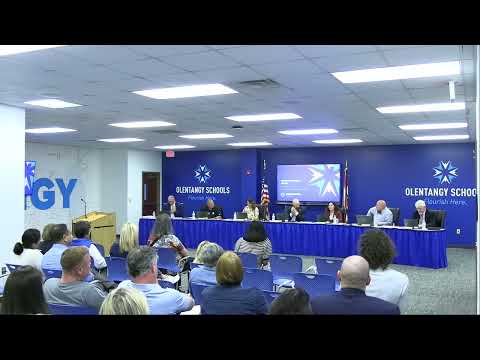
Mister Jenkins, the district treasurer, told the Olentangy Local School District Board of Education on May 8 that the district's five-year forecast shows steady enrollment-driven expense growth and that a recently proposed state law could sharply reduce the district's cash reserves.
Mister Jenkins, the district treasurer, told the Olentangy Local School District Board of Education on May 8 that the district's five-year forecast shows steady enrollment-driven expense growth and that a recently proposed state law could sharply reduce the district's cash reserves.
Jenkins presented highlights from the biannual five-year forecast, stressing that local property taxes remain the district's principal revenue source and that personnel costs (salaries and benefits) make up roughly 80% to 85% of expenses. "We have a plan for every dollar," Jenkins said, and then turned to a provision in the amended House bill that he and the board described as a clawback.
The proposal Jenkins discussed would add a section to the Ohio Revised Code (cited in the meeting as Ohio revised code 5705.316) that directs county auditors to reduce property tax rates when a public school district's general-fund carryover exceeds a percentage threshold. Jenkins summarized how it would work: "So dollar for dollar, what you're above that 30% threshold will be reduced in a subsequent tax bill," leaving the district with less cash in the next settlement cycle.
Why it matters: Jenkins said Olentangy currently carries roughly 53% to 54% in general-fund reserves (about six months of operating cash). Under the draft language discussed in the meeting the board could lose roughly $83 million in reserves above a 30% threshold, and the change could take effect as soon as the 2025 pay-2026 tax year. Jenkins warned that the result could be a much shorter levy cycle and more frequent ballot measures: "In the same cycle where some of these folks would get their tax bills reduced we would be strongly considering an operating levy in November of 25 or March or May of 20 26," he said.
Jenkins contrasted the governor's "as introduced" budget and the amended House bill. He said the House's proposed transitional funding approach would likely put more money into Olentangy's coffers than the governor's version (he estimated $18.7 million more under the House approach), but that the clawback provision is distinct and would still threaten local reserves.
Board members asked procedural and policy questions during the discussion. Doctor Dabrico asked whether the state would reduce mandates or administrative requirements to offset costs; Jenkins replied that while the state had provided some targeted subsidies (for example, for high-quality instructional materials and science-of-reading initiatives), it had not generally reduced administrative burdens.
What the district says it would do: Jenkins and other board members said the district will continue local advocacy. The superintendent and Jenkins planned to testify before the Ohio Senate Education Committee, and the district posted a "call to action" on its website asking residents to contact legislators. "We will be down to testify with the Senate Education Committee next week," Jenkins told the board.
Ending: Jenkins and board members framed the debate as one of local control and transparency. Jenkins warned that if the clawback becomes law, Olentangy would not look like the same district: "We will not, in my opinion, have the same Olentangy schools," he said, because the district's multi-year staffing and facilities plans assume the ability to carry reserves across settlement cycles.