Lifetime Citizen Portal Access — AI Briefings, Alerts & Unlimited Follows
UN event spotlights ICTP's role in expanding quantum science and training for developing countries
Loading...
Summary
A UN-hosted panel at the United Nations emphasized the Abdus Salam International Centre for Theoretical Physics’ six-decade role in training scientists from the global South and outlined new partnerships and initiatives to bring quantum science capacity to underrepresented regions.
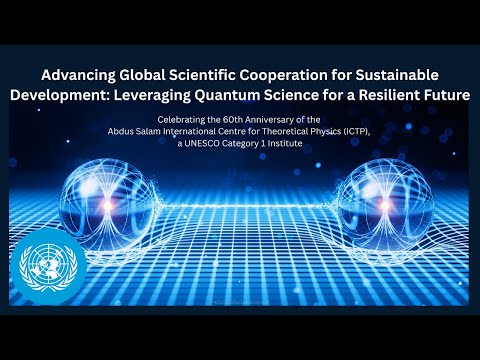
The United Nations and UNESCO on Oct. 26 convened a high-level event marking the 60th anniversary of the Abdus Salam International Centre for Theoretical Physics (ICTP) and underscoring ICTP’s role in expanding access to quantum science and related training.
The meeting opened with remarks highlighting ICTP’s founding mission to “democratize science.” Professor Duncan Haldane, 2016 Nobel laureate in physics and Sherman Fairchild Professor of Physics at Princeton University, quoted ICTP’s founder Abdus Salam: “scientific thought and its creation is the common and shared heritage of mankind,” and argued that basic science nurtures the local scientific cultures that underpin later technological advances.
The event’s nut graf: speakers from UNESCO, ICTP, the International Atomic Energy Agency (IAEA), philanthropy and academia described concrete steps — training, fellowships, international partnerships and philanthropic support — intended to broaden participation in quantum science, with a particular focus on scientists from developing countries and Africa.
Panelists laid out current activity and planned expansions. Dr. Aditi Brito, Assistant Director-General for Natural Sciences at UNESCO, said UNESCO is leading the International Year of Quantum Science and Technology and the International Decade of Sciences for Sustainable Development and framed those initiatives as vehicles to align advances in quantum science with the Sustainable Development Goals. Dr. Atish Dabokar, director of ICTP, described ICTP’s current scale and outreach: the center hosts roughly 400 scientists from about 100 countries at any one time, has welcomed nearly 200,000 participants to its programs over six decades, and each year supports approximately 600 visiting scientists — about 65% from developing countries and about 32% women, he said.
Private and philanthropic partners said they will continue to support training and research. Gregory Gabbadzate (senior vice president, mathematics and physical sciences, Simons Foundation) described philanthropy’s role as complementary to public funding, citing flexible research hubs (for example the Simons Foundation’s Flatiron Institute) and international collaborations as examples of philanthropic tools that can accelerate research and training. Fondazione Compagnia di San Paolo and the Simons Foundation were identified among donors and partners supporting ICTP facilities and programs.
Speakers emphasized that quantum science depends on foundational training. Haldane and Dabokar both stressed that “quantum science must come before quantum technology,” saying nations cannot leap directly to complex quantum technologies without a base of people trained in quantum mechanics. Dabokar outlined ICTP initiatives to expand “equal partnerships” and cited collaborations in Brazil, Rwanda, Mexico and China alongside agreements with foundations and corporations.
Panelists connected quantum capacity-building to concrete development outcomes. Professor Aysa Ward, chair of the African Mathematical Union’s Commission for Developing Countries, explained that mathematics underpins quantum algorithms, sensing and cryptography and that improved quantum-enabled climate modeling and optimization tools could benefit agriculture and disaster response in developing regions.
Former ICTP students gave first-person accounts of impact. Toye Rapapa, Minister of Education and Training of the Kingdom of Lesotho and an ICTP alumnus, recounted his path from undergraduate study to a Ph.D. and to national leadership, saying the center’s scholarships and junior associate programs helped him return to Lesotho with skills used in higher education, a national regulator and government. Raji Ashanafi Mamdouh, a former ICTP student now a Ph.D. candidate at MIT, described ICTP as enabling access to advanced coursework, mentorship and international networks vital for career progression.
IAEA engagement and joint programs were highlighted. Vivian Okeke, IAEA representative to the United Nations and director of the IAEA’s New York office, reviewed longstanding IAEA–ICTP collaboration, noting joint schools on nuclear security, a master’s program in medical physics that has graduated 172 students from 72 countries, and sandwich training programs that provide hands-on placements in Italian hospitals.
Speakers also raised policy and ethical considerations. Delegations and the “Group of Friends on Science for Action” urged frameworks for governance, open-science principles and attention to environmental considerations (for example, sourcing of materials used in quantum hardware).
The meeting closed with calls for multilateral investment in education, open access to training, and continued philanthropic-public partnerships to scale capacity in quantum science and its applications.
Ending: organizers and panelists said they expect ICTP and partners to continue expanding programs for scientists from underrepresented regions, and they highlighted forthcoming collaborations and facility investments intended to sustain that work.