Get email alerts on the Workers Compensation topic
No spam. Unsubscribe anytime.
Senate Labor Committee advances bipartisan workers' compensation bill adding rules for contractor‑controlled insurance programs
Summary
The Senate Labor Committee adopted an amendment and passed Senate File 3407, a bipartisan workers' compensation advisory council bill that makes technical changes across Chapter 176 and Chapter 79 and creates an approval process for owner‑ or contractor‑controlled insurance programs for large construction projects.
The Minnesota Senate Labor Committee on an unanimous voice vote adopted an amendment and passed Senate File 3407, a bipartisan bill from the workers' compensation advisory council that revises definitions and procedures in state workers' compensation law and establishes a new approval process for owner‑ or contractor‑controlled insurance programs for large construction projects.
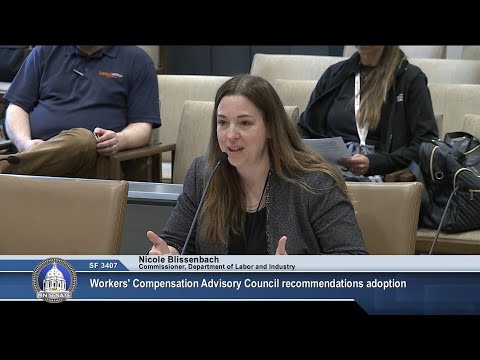
The bill, introduced and described to the committee by Nicole Lisonbee, Commissioner of the Minnesota Department of Labor and Industry, includes nine sections of technical and substantive changes. Lisonbee said the council "voted to advance ... both technical and substantive proposals to improve the workers compensation process and system for business and businesses and injured workers." She told the committee the advisory council — made up of equal numbers of labor and business representatives — met earlier and passed the proposal unanimously.
Why it matters: The measure affects how some large construction projects obtain workers' compensation coverage, adds requirements intended to prevent premium fraud, and clarifies who qualifies as an employee in certain direct care programs. Advocates for the bill said the changes standardize applications and reporting requirements that affect contractors, subcontractors and injured workers, and create a formal review by the Department of Commerce for certain multi‑employer insurance arrangements.
Key provisions described to the committee include: - Definitions and housekeeping changes across Chapter 176 and Chapter 79, including clarifications of who qualifies as an employee for purposes of workers' compensation in specified direct care programs, and amendments to definitions of corporate executive officers and filing provisions. - Section 6 increases the threshold above which workers' compensation benefits are assignable; the bill text presented to the committee makes that section effective for dates of injury on or after Oct. 1, 2025. - A new approval pathway for owner controlled or contractor controlled insurance programs (OCIPs/CCIPs). The Department of Commerce must approve or disapprove completed applications within 60 days and collect a $2,500 application fee. Eligibility criteria identified in the bill include that the project have an aggregate value exceeding $100,000,000 and generate $500,000 or more annually in workers' compensation premium. - Application and compliance requirements for approved programs: the insurer's name and rating plan; project location; contractor and subcontractor lists and classification codes; quarterly updates to Commerce during the program; insurer rate approval; limits on allowable deductibles (no less than $50,000 and no more than $1,000,000); and a prohibition on participants with insurance fraud convictions. - Prohibitions and reporting for so‑called "0 estimated exposure" policies (policies where an employer reports zero payroll/exposure): insurers must include attestations of accuracy in applications, and certain employer data and classification codes must be reported as public data. Employers with such policies must provide written notice and a copy of the policy to entities they contract with for construction or improvement services; recipients must retain those documents for three years. Contractors in an approved OCIP/CCIP are barred from using 0 estimated exposure policies, and project sponsors or general contractors must collect payroll at the time of premium audit and retain records for three years. The bill requires providing subcontractors a copy of the insurance policy covering their employees and informing employees how to file a workers' compensation claim.
Procedure and votes: The committee first adopted the amendment labeled in the hearing as A25‑0081 (the amendment as presented reflects the advisory council's agreement). The committee later voted to pass Senate File 3407. On the committee's roll or voice calls, members answered "aye" and the committee chair announced the motion passed. The advisory council's unanimous vote in support of the package was submitted to the committee in a letter signed by representatives of the chamber, the AFL and the Department of Labor and Industry.
Discussion and questions: Committee members praised the collaborative process. Senator Doornick said it was "nice to see that business and labor can work together" and encouraged a yes vote. Some senators asked procedural or out‑of‑scope questions during the hearing; for example, Senator Gruenhagen asked about rising unemployment insurance costs for a constituent business, and Chair McEwen redirected that matter to the Department of Employment and Economic Development because it is outside workers' compensation jurisdiction.
Next steps and implementation notes: The bill text presented sets the effective date of all sections except Section 6 as the day following final enactment; Section 6 applies to injuries occurring on or after Oct. 1, 2025. The bill assigns authority to the Department of Commerce to review OCIP/CCIP applications and to the Minnesota Workers' Compensation Insurers Association (MWCIA) for certain data sharing. The bill also repeals Minnesota Rules part 5220.284, described in testimony as previously codified into statute.
The committee record reflects multiple technical requirements that Commerce and insurers will need to operationalize should the bill become law (application forms, quarterly reporting, public reporting of certain employer data, record retention, and insurer rate approvals). Commissioner Lisonbee noted advisory council members and multiple agencies invested extensive staff time to reach the final language.
Ending: With the committee's passage, Senate File 3407 advances from the Senate Labor Committee; the bill's next procedural step will follow the Senate's rules for committee referrals and floor action. Committee members adjourned after the vote.
AI generated
The text on this page is AI generated. Summaries, highlights, analysis, and video transcripts are all produced from the original source material.
AI can make mistakes, so if you spot one, and we will fix it for everyone.
Note: the source content is unaltered by us. Any content source we link to, be it a video, an audio recording, or a document, is presented exactly as its publisher released it. That publisher is usually a government body, sometimes an individual official or another organisation.