Get Full Government Meeting Transcripts, Videos, & Alerts Forever!
Get email alerts on the Humanitarian Aid topic
No spam. Unsubscribe anytime.
UN warns Gaza aid blockade is worsening humanitarian crisis; declines to join Israeli ‘humanitarian foundation’ plan
Summary
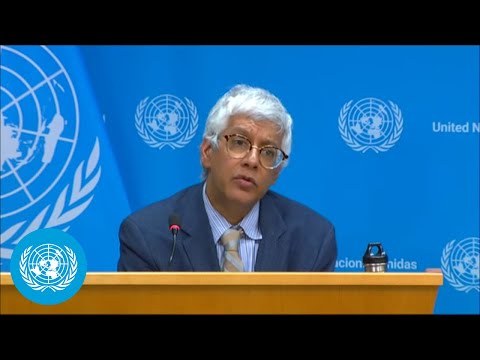
United Nations spokesperson Farhan briefed reporters on multiple urgent humanitarian crises on Friday, saying that humanitarian deliveries to Gaza must be allowed to reach everyone in need and warning that conditions there are worsening after nearly 10 weeks with little or no incoming aid.
United Nations spokesperson Farhan briefed reporters on multiple urgent humanitarian crises on Friday, saying that humanitarian deliveries to Gaza must be allowed to reach everyone in need and warning that conditions there are worsening after nearly 10 weeks with little or no incoming aid.
Farhan said, “After nearly 10 weeks with no aid or other supplies entering Gaza, the humanitarian crisis is worsening by the day. The cost of any further delay is irreversible.” He told reporters that UN partners report a sharp rise in acute malnutrition among children and that supplies inside Gaza have “mostly run out, while large quantities are waiting just outside.”
Why it matters: The spokesperson framed the briefing as a global humanitarian update but emphasized Gaza as the most acute emergency, describing damaged telecommunications and restricted fuel and movements that limit the ability of responders to operate. The UN’s stance on third‑party plans to deliver aid to Gaza drew direct questions from journalists; the spokesperson said the organization will not take part in any plan that compromises the humanitarian principles of humanity, impartiality, independence and neutrality.
Key Gaza details and UN position Farhan said UN teams are ready to scale up once access is granted. He reported that partners working on nutrition told the UN that “the proportion of children suffering from acute malnutrition has almost doubled” compared with February. He said fiber‑optic cables used by responders have been damaged for more than six weeks and that Israeli authorities have continued to deny coordination requests to permit repairs. He added that, while a UN team this week was allowed to retrieve some fuel from Rafah for the first time in weeks, those supplies are “a trickle compared to the immense needs,” and urged facilitation of humanitarian movement inside Gaza.
On questions about an Israeli proposal described in some reports as a “Gaza humanitarian foundation,” Farhan said the Office for the Coordination of Humanitarian Affairs (OCHA) and other humanitarian partners have been in dialogue with the United States and others about how aid reaches people in Gaza. He told reporters that what has been presented to the UN “appears designed to further control and restrict supplies down to the last calorie and the last grain of flour,” and he quoted the secretary‑general’s position: the UN will not engage in arrangements that do not uphold established humanitarian principles.
Global updates summarized Farhan summarized other urgent humanitarian situations: in Syria he cited more than 670,000 people displaced since November 2024 and noted explosive‑ordnance contamination and high civilian casualty counts since December 8, 2024. He said UN partners are delivering aid across Syria despite severe funding shortfalls and that the humanitarian appeal for January–June seeks $2 billion to support 8 million people but is only about 10 percent funded.
On the Democratic Republic of the Congo (DRC) he said the full response plan aims to assist 11 million people at a cost of $2.5 billion but has received roughly $233 million so far. He added that authorities in the DRC had declared a cholera outbreak affecting six provinces, with more than 18,000 reported cases and 364 deaths since January (figures cited by the spokesperson).
On Sudan and Darfur, Farhan said a UN humanitarian mission reached the town of Dawla via the Adré crossing from Chad to help people displaced from Zamzam Camp and that the World Food Programme has scaled up food assistance to hundreds of thousands of displaced people who fled Zamzam and El Fashir.
Wider regional needs and agency appeals Farhan relayed World Food Programme warnings that conflict, displacement and extreme weather are driving millions in West and Central Africa toward emergency hunger (IPC Phase 4), and that WFP plans to reach nearly 12 million people in the Sahel and West Africa this year; WFP had already reached about 3 million people with life‑saving assistance, he said. In Haiti he said a recent surge in armed violence in Lower Artibonite displaced more than 16,000 people and that UNICEF had deployed three mobile clinics reaching nearly 2,000 displaced people.
Refugee hosting and funding gaps The spokesperson warned of funding shortfalls for UN refugee operations in Costa Rica, saying Costa Rica hosted roughly 94,000 Nicaraguan asylum seekers and 9,216 recognized Nicaraguan refugees, and that a 41 percent cut in funding to the UN Refugee Agency (UNHCR) had forced suspension or cuts to services. He quoted UNHCR’s appeal for $40.4 million to sustain life‑saving work in Costa Rica.
UN Central Emergency Response Fund allocation Farhan said the emergency relief coordinator has released a $2,500,000 allocation from the UN Central Emergency Response Fund (CERF) to support the response to the arrival of more than 60,000 refugees in Uganda from the Democratic Republic of the Congo. He said the allocation will help scale up the response to cholera and other urgent needs.
Questions from journalists and UN responses During a question period, journalists asked about water access in Gaza, a reported Israeli operation in Nablus, and whether the secretary‑general’s upcoming UN 80 remarks would include operational details. Farhan replied that the UN has reported regularly on the West Bank and that the secretary‑general’s Monday remarks on UN 80 would update the General Assembly on the vision and work done so far.
What’s next Farhan said the UN will continue to press for safe, unhindered and sustained access to conflict‑affected areas and for stepped‑up, flexible funding. He closed the briefing by thanking member states that had made full payments to the UN regular budget; he said Somalia and Israel had made full payments, bringing the number of fully paid member states to 103.
Sources: United Nations spokesperson briefing (transcript excerpt).