Get Full Government Meeting Transcripts, Videos, & Alerts Forever!
Get email alerts on the Emergency Response Dispatch topic
No spam. Unsubscribe anytime.
Marathon County review finds EMS response times stable; panel discusses dispatch upgrades and text-to-911 testing
Summary
Sheriff's office staff told the Public Safety Committee that county EMS response times have been stable in recent years and outlined dispatch policies (4-minute acknowledgment, 8-minute en route), redundancy investments and NextGen 911 testing; the committee discussed countywide EMS options and funding complexities.
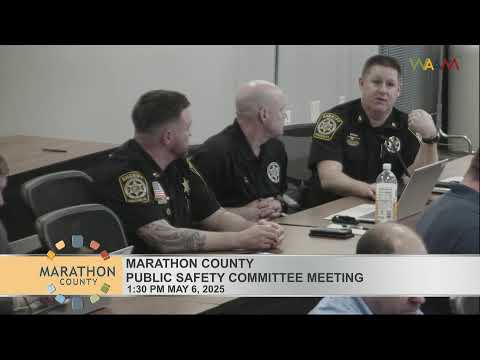
Marathon County emergency-response staff told the Public Safety Committee on May 6 that EMS response-time data has been broadly stable and described operational changes and technological upgrades intended to reduce delays.
Captain Berto and other sheriff's office staff said the dispatch protocol requires agencies to acknowledge a page within four minutes and to be en route within eight minutes from the time of the call; if a page is not acknowledged in four minutes, the system triggers a secondary mutual-aid dispatch so response does not wait another four minutes.
Staff told the committee that the metrics they provided to the committee reflect EMS data (not law-enforcement response times) and that the county dispatching data is captured in the CAD system and must be verified case-by-case. Captain Berto said EMS response times have been "pretty stable for the last several years," while Vice Chair Zhang and other members asked whether call volumes and response times have increased; staff said some local agencies report higher call volumes and that rural response times remain longer than metropolitan areas.
County staff and the sheriff's office described investments to improve dispatch reliability: additional communication specialist positions added in 2019 and 2020 (six positions were added to increase 24-hour coverage), the creation of a separate metro radio channel to distribute dispatcher workload, a redundant physical backup dispatch center (at the juvenile detention center) developed with ARPA funding, and a virtual backup arrangement with a neighboring county to allow cross‑dispatching if a center is compromised.
Staff also briefed the committee on NextGen 911 work (referred to in the meeting as the EsiNet/Azenet project) that will allow IP-based transfers of caller automatic location information across centers and will enable text-to-911. Captain Berto said he is testing text-to-911 with cellular carriers; AT&T completed a successful test recently and the county is scheduling tests with additional carriers. Committee members asked about whether increased fiber deployments have improved call reliability; staff said most incoming 911 calls are cellular and the impact varies.
The committee discussed whether to pursue a broader county role in EMS delivery. County administration said some counties operate countywide EMS directly or contract for consolidated services and that Wisconsin law includes a levy exception that provides fiscal flexibility if the county elects to take on EMS delivery. Officials cautioned that municipal preferences, volunteer fire-district structures and contractual arrangements complicate any move toward county-run EMS and that further study and policy direction from the county board would be needed.
Ending: Staff recommended further data-driven discussion if the board wants to explore countywide EMS; the committee received the update and requested any specific questions be directed to staff for follow-up.