Get Full Government Meeting Transcripts, Videos, & Alerts Forever!
Get email alerts on the Climate Coalition topic
No spam. Unsubscribe anytime.
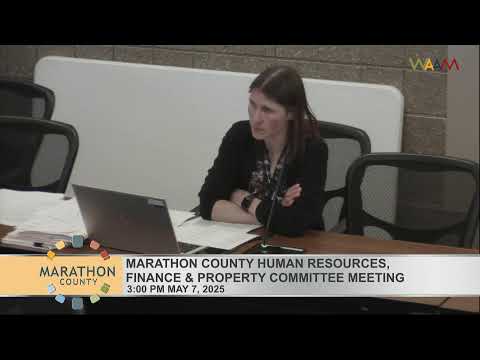
Marathon County committee declines immediate membership in Wisconsin Local Government Climate Coalition
Summary
The Human Resources, Finance & Property Committee heard a presentation from the Wisconsin Local Government Climate Coalition but voted not to forward a resolution to the full county board to join the coalition.
Supervisor Kroll introduced a resolution asking Marathon County to join the Wisconsin Local Government Climate Coalition and invited Allison Carlson, a coalition representative, to present the group’s mission and services.
Allison Carlson told the committee the coalition is a peer-to-peer resource for local governments focused on resilient infrastructure, clean energy, efficient buildings and climate-smart land use. She said membership is free, funded by charitable foundations (she named the Energy Foundation and the McKnight Foundation) and that the coalition provides trainings, a searchable sustainability resource database and occasional grant-seeking support.
Supporters on the committee said the coalition could help the county identify cost-saving opportunities in energy use and may help the county access grants and best practices. Supervisor Lemmer argued the county had previously tried to form an internal energy task force and that the coalition offered a lighter-weight way to advance the same work.
Several supervisors raised concerns about whether the coalition would act as an advocacy organization rather than a neutral resource. Carlson answered that the coalition “doesn’t try to push down” specific policy prescriptions and instead provides information and examples for local governments to use at their discretion. Other questions covered donor transparency (Carlson named the Energy Foundation and McKnight Foundation), meeting cadence, and whether membership would require regular attendance.
Administratively, the proposed resolution would designate the county administrator as the county’s representative and direct the administrator to appoint a board supervisor as a liaison when the board chose to do so. Several supervisors also asked for flexibility so attendance could be by a designee.
After discussion, Supervisor Lemmer moved to recommend the resolution to the full county board; Supervisor Hart seconded. Committee members debated whether joining would commit the county to advocacy or simply to a learning network. A roll-call vote followed; the motion failed and did not go forward to the county board.
The committee thanked Kroll and Carlson for the presentation and moved on to other agenda items.