Get Full Government Meeting Transcripts, Videos, & Alerts Forever!
Get email alerts on the No Fault Fee Schedules topic
No spam. Unsubscribe anytime.
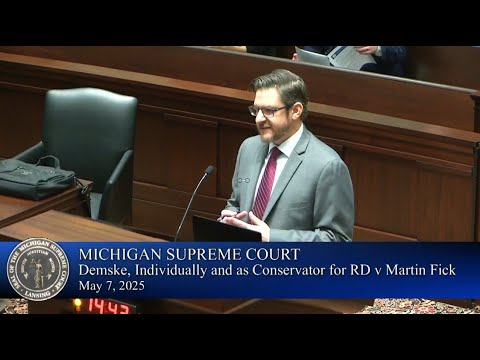
Supreme Court hears dispute over whether no-fault fee schedules apply to Demski injuries
Summary
At an oral argument, attorneys for Michelle Demski and State Farm disputed which statutory dates control whether newly enacted no-fault fee schedules limit personal injury protection (PIP) payments for injuries and treatments that occurred before insurers could issue amended policies.
At an oral argument before the Supreme Court, lawyers for Michelle Demski and for State Farm Automobile Insurance Company disputed which statutory dates govern whether newly enacted no-fault fee schedules limit personal injury protection (PIP) payments for injuries and medical treatment.
Keith Bank, counsel for the plaintiffs, argued that the key date is July 2, 2020, when insurers could first offer policies reflecting the legislature’s fee schedules, and therefore his clients — who were injured and received initial emergency treatment before that date — should remain entitled to unlimited PIP. "The key date is the 07/02/2020 date," Bank said. He told the court that because insurers had not yet received approval to change rates, policyholders who paid the pre-amendment premium received no benefit from the cost-saving provisions and should not be bound by the later fee schedules.
Paul Hudson, appearing for State Farm, countered that every relevant event in the case — the policy renewal, the accident and the medical treatments at issue — occurred after the June 2019 amendments to the No Fault Act. "The policy renewal, the accident itself, all of the medical treatments in this case happened after the June 2019 amendments," Hudson said. He argued that the plaintiff’s policy expressly incorporated the No Fault Act and its amendments and therefore the statutory phase-in dates and the fee schedules govern claims as written.
At several points during the argument, an unidentified justice questioned how the court should treat a statute that gives a multi-step phase-in. The justice asked, "Why wouldn't the law that's in place at the time of the accident, which included this future fee schedule, why wouldn't that apply?" Counsel for the plaintiffs responded that the statute’s practical effect was a one-year lead-in so insurers could obtain regulatory approval and inform consumers, and that until insurers could lawfully sell policies reflecting the fee schedules the pre-amendment contractual rights should control.
Bank emphasized three dates he said were important to the analysis: the June 1, 2019 effective date of the legislative amendments; July 2, 2020, which he described as the date insurers could begin to sell policies reflecting the changes; and July 1, 2021, when the fee schedules became applicable to care. He told the court, "If you judging by the the 2020 date, that's when State Farm could then offer a policy that contains incorporated the fee schedules." He argued that applying the fee schedules to injuries and care that occurred before insurers could offer such amended policies would leave policyholders "without the benefit of any bargain."
Hudson told the court the decision below correctly applied the statute and the court’s prior precedent in Andree. He said the Court of Appeals' interpretation aligns with the statutory phase-in and with the policy language that incorporated the statute. "It's consistent with the statute, it's consistent with the policy, it's consistent with this court's decision in Andree," Hudson said, adding that the court of appeals had noted there was no argument here that any vested contractual rights were impaired.
Bank also argued that the legislature’s purpose in phasing in fee schedules was to pass cost savings on to consumers, and he said the Demskys did not realize any premium savings when they renewed. "They say they paid the same premium," Bank said. He suggested that the lack of passed-through savings supported his view that claimants injured in the interim should remain entitled to unlimited PIP.
No final ruling was announced from the bench. The court concluded the argument and "the case will be submitted," according to the transcript.
The dispute centers on statutory interpretation: whether the operative legal test looks to the dates when amended policies could be sold and the fee schedules actually became applicable to care, or instead to the later-in-time events (policy renewal, accident and treatments) that, per the respondent, fall after the statutory amendments and thus bring the claim within the fee schedules as written.