Lifetime Citizen Portal Access — AI Briefings, Alerts & Unlimited Follows
Michigan Supreme Court hears argument on whether allowing child’s sexual abuse for drugs qualifies as ‘aggravated circumstance’ for termination
Loading...
Summary
At oral argument in Enri Barber Espinosa Meiners, counsel debated whether a parent who permits a child’s sexual abuse in exchange for drugs meets Michigan’s statutory definition of aggravated circumstances that permit termination of parental rights without reunification efforts. The court submitted the case for decision; no ruling was announced.
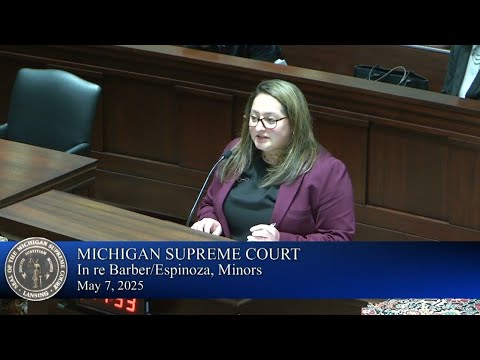
The Michigan Supreme Court heard oral argument over whether a parent who permits a child to be sexually abused in exchange for drugs meets the statutory definition of an “aggravated circumstance” that allows the state to seek termination of parental rights without providing reunification services.
The question centers on how to read the Child Protection Act alongside the juvenile code: whether the statutory phrase that a “parent abused the child” can be satisfied when the parent’s abuse consists of permitting or facilitating criminal sexual conduct committed by a third party, and whether that abuse must itself include criminal sexual conduct involving penetration as listed among the aggravated circumstances.
Nastasia Thomas, counsel for Lenoir County Health and Human Services, urged the court to apply the statutory definitions as written and to treat the respondent’s conduct as aggravated. "The facts of this case constitute child abuse by way of non-accidental physical or mental injury and sexual exploitation," Thomas said, and argued that the statutory definition of child abuse (MCL 722.622(g)) encompasses conduct in which a parent "allow[s], permit[s], encourage[s] or facilitate[s]" sexual exploitation. Thomas reserved two minutes for rebuttal and acknowledged she had yielded five minutes to the Office of the Attorney General.
Jennifer Rosen, assistant attorney general appearing as amicus for the attorney general, echoed that reading, telling the court that the department and the juvenile code work together to address situations in which "sexual exploitation is a form of child abuse" and that a parent who leaves a child with an abuser "in exchange for drugs makes her just as culpable as the abuser." Rosen framed the statutory exclusion of reasonable efforts as a protective measure: "The statutory exclusion of reasonable efforts for aggravating circumstances already contemplates the harm children would face by forcing reunification efforts for the parent," she said.
Vivek Sankaran, counsel for the appellee, urged the court to adopt a narrower reading and to affirm the Court of Appeals. Sankaran said the statutory scheme draws narrow exceptions to the reasonable-efforts requirement and that not every finding of abuse should operate as an automatic aggravated circumstance. "Not all findings of abuse are aggravated circumstances," he told the justices. Sankaran also argued the Court of Appeals analysis properly treated the phrase "the parent abused the child" as referring to abuse the parent personally committed, so that a separate finding is required that the parent's abuse included criminal sexual conduct as enumerated in the aggravated-circumstance statute.
Justices pressed both sides about how to harmonize the Child Protection Act and the juvenile code, with questions about whether adopting the county’s reading would nullify statutory reunification protections and whether any appellate remand would be needed to create the record for a decision. Counsel for Lenoir County and the attorney general responded that the trial court made findings they say are sufficient to affirm, while the appellee emphasized the trial record did not include the particular statutory findings the appellee contends are required.
The argument addressed several statutory provisions repeatedly: MCL 722.638(1) (aggravated-circumstances exception), the statutory definition of child abuse at MCL 722.622(g), and related juvenile-code provisions cited in the record (MCL 712A.19 et seq.). Participants noted that other states list trafficking and sexual exploitation explicitly as aggravated circumstances but that Michigan’s statutory text, as written, separates the existence of parental abuse from the specific enumerated aggravated forms.
Graphic testimony from the child, summarized by counsel during argument, was described as detailing forcible sexual acts involving penetration; counsel for Lenoir County characterized those facts as "the picture of an aggravated circumstance." Counsel and the court avoided repeating explicit detail from the record beyond what was necessary to frame the statutory dispute.
At the close of argument, the court took the case under submission. No decision was announced from the bench.
The case: Enri Barber Espinosa Meiners — petition for leave to appeal concerning termination of parental rights and whether aggravated circumstances existed that excuse reasonable-efforts reunification requirements under Michigan law.