Get Full Government Meeting Transcripts, Videos, & Alerts Forever!
Get email alerts on the Student Success topic
No spam. Unsubscribe anytime.
Board reviews life-management monitoring report as members flag finances, sleep and student risk-taking
Summary
The Issaquah School District board reviewed a monitoring report on life-management outcomes and asked staff to provide more school-level detail after hearing concerns about students’ financial literacy, sleep, and whether students feel safe to take academic risks without ridicule.
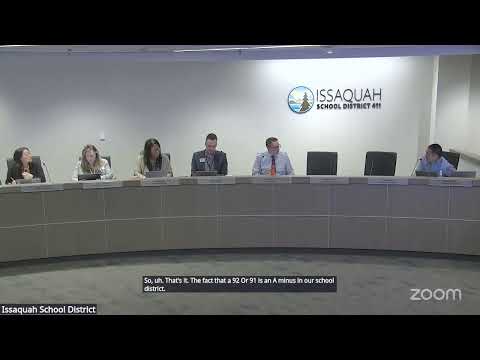
The Issaquah School District board reviewed its monitoring report on “life management and personal awareness” Wednesday and engaged in wide-ranging discussion about career planning, financial literacy, student well-being and survey-response rates.
District presentation: Assistant Superintendent Dr. Dana Bailey and staff presented data showing consistent course completion in health and physical education and expanded personal finance offerings (the district said it has reorganized personal finance into two semester-long classes to create more student access and scheduling flexibility). Staff noted strong use of credit recovery options and said college-matriculation statistics (from the National Student Clearinghouse) show many district students continue into and persist in postsecondary education.
Board and student concerns: Board members asked for more detail on course-taking patterns and asked for school-level breakdowns of several indicators (for example, physical-education grade distributions and engagement in electives). Directors pressed for better metrics about who is not participating in extracurriculars and whether schedules allow students to access desired courses. A director asked staff to capture senior exit questions that would better test financial readiness instead of general numeracy questions.
Students and staff also raised specific well-being concerns. Student representative Milo cited the 2023 Healthy Youth Survey results discussed at the meeting, saying that a large share of students report getting fewer than eight hours of sleep on school nights. Board members highlighted responses to a senior-exit question that asked whether students felt they could risk being wrong in class without ridicule; several directors said the proportion answering negatively was disturbing and said they want more qualitative follow-up to understand why students reported feeling marginalized.
Data quality and survey response rates: Staff told the board that several district surveys had low response rates in the last cycle (for example, one district soft-skills survey had a markedly lower response rate than prior years). Leaders said they will push for higher participation this fall and will consider alternative methods for getting alumni feedback rather than solely relying on low-response postgraduate surveys.
Next steps and requests: Board members asked staff to provide additional breakdowns (by building and by grade) of key indicators, to revise senior-exit and postgraduate survey wording to better capture financial readiness and to set up listening sessions with students to probe low-scoring items such as feeling safe to risk being wrong in class.
Why it matters: The monitoring report feeds the board’s governance-by-results work and helps measure whether district programs are leading to student outcomes in health, career readiness, and life skills. Directors said the data raised a mix of encouraging signals (credit recovery use, course provision) and areas that need deeper study (sleep patterns, financial readiness and student sense of belonging).