
District demographer projects enrollment decline to about 35,050 next year; birth-rate trends and zone boundaries cited
Get AI-powered insights, summaries, and transcripts
Subscribe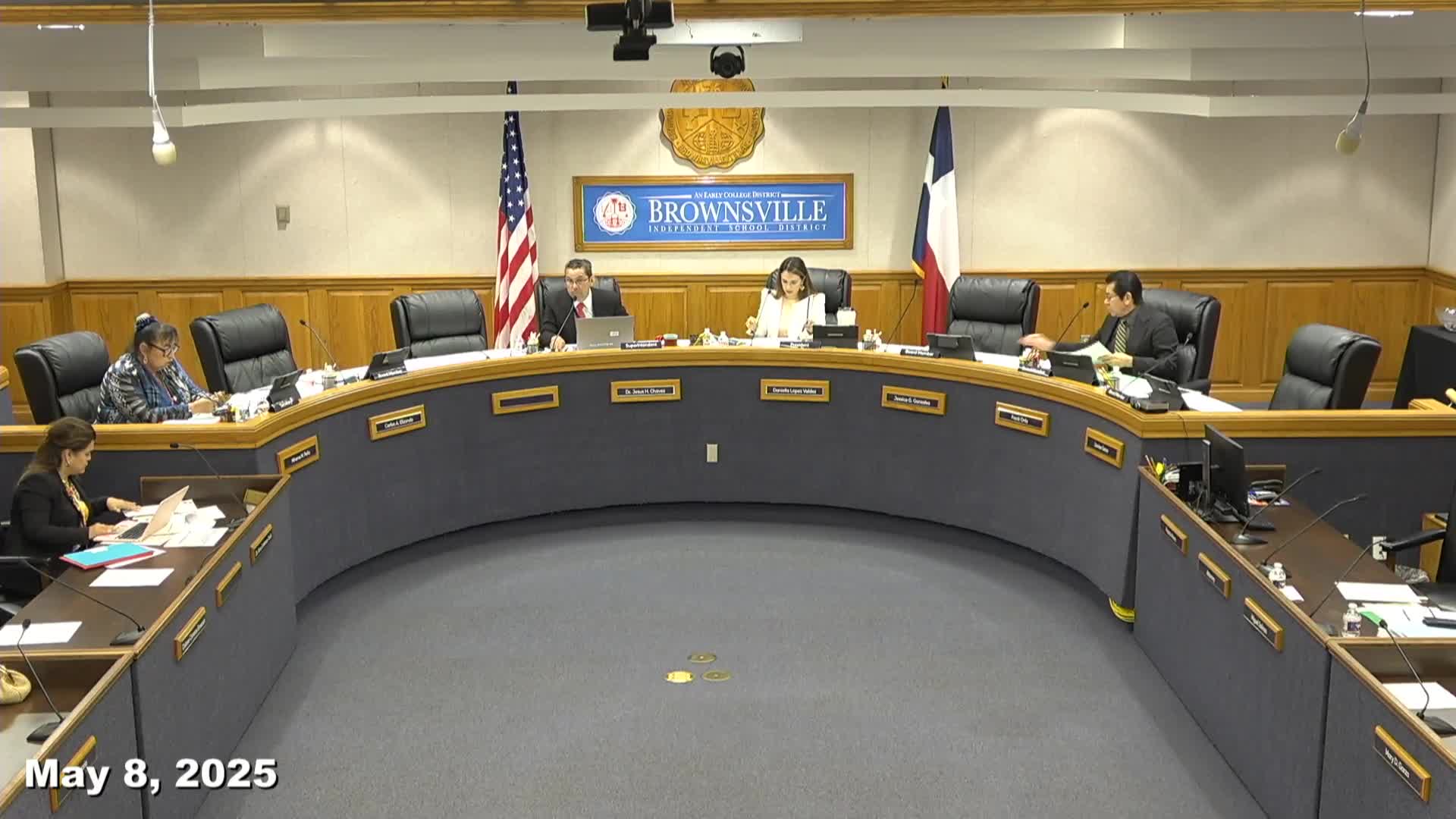
Summary
Brownsville ISD staff projected enrollment of about 35,050 students for 2026 and a longer-term decline driven mainly by lower birth cohorts and development outside district boundaries. Trustees and public speakers discussed recruiting, charter competition, and space/capacity implications.
Brownsville ISD demographer Dr. Lee Garcia presented the district’s enrollment projection model and told the board the district’s projected enrollment for the next school year is about 35,050 students, down from a PEIMS snapshot of 36,147 for the current year.
Why it matters: Declining enrollment reduces state funding tied to average daily attendance and can alter facility planning and staffing. Trustees and members of the public raised recruiting and retention strategies, questioned where students who left the district went, and asked staff to report which campuses have unused classroom capacity.
Garcia explained the methodology he uses for cohort‑survival projections: grade‑to‑grade “survival” percentages, birth-cohort counts provided by the city’s vital statistics office for early‑education cohorts, promotion/retention and graduation rates, and recorded withdrawals to non‑district providers. He emphasized that municipal boundaries and school-district boundaries differ: “the city has the latitude to go ahead and expand its boundaries. The school district, unfortunately, can only do that through legislative action,” Garcia said, noting BISD’s district lines largely date to 1915 with a later change in 1952.
Historic and current figures Garcia reviewed included a peak district enrollment of roughly 49,900 between about 2008 and 2015; a PEIMS snapshot enrollment of 36,147 for the current year and district capacity of about 54,003 (47 schools after consolidations) yielding a districtwide utilization near 66.5% for the current year and a projected 64.5% for next year. Garcia said the projection model uses historical birth cohorts and market-share calculations; for several recent cohorts the district’s market share of city births has declined (for example, a market share near 53% for the class of 2022 falling to about 47–50% for more recent birth cohorts across early grades).
Garcia called out specific grade‑level market‑share and birth‑cohort figures reported in the presentation (examples from the slides): a pre‑K‑4 market share of about 51.9%, kindergarten market share about 49.7%, and other grade‑by‑grade market shares that vary by cohort and school level. He said the district’s greatest losses tend to occur between fifth and sixth grade, where withdrawals to charter schools and other non‑district options are common, and added that many students who leave for charter programs return to BISD at the high‑school level, attracted by dual‑enrollment, AP and career/technical programs.
Trustees’ questions and staff responses Trustees and public speakers asked where the students who left the district went. Garcia said the data show many families decided to homeschool, moved out of state, returned to home countries, enrolled in online academies or enrolled in charter schools, and that campuses’ registration forms usually capture a withdrawal destination field that allows staff to track such movement.
Board members repeatedly raised recruitment and retention: Trustee Ortiz and others urged more active outreach to middle‑school families because the district’s largest losses have been at the fifth‑to‑sixth‑grade transition. Trustees asked staff to inventory unused classrooms at high schools and campus capacity by school so the board can assess whether the district should encourage out‑of‑zone enrollments or consider consolidation and facility investment. Superintendent Dr. Chavez and staff cautioned that accepting additional students can create space and program pressures (portables or new construction) and that larger construction projects would require bond funding.
Public comment echoed these themes. Patrick Hammes (BEST AFT) argued low utilization may require consolidation and sale of underused buildings; union speakers and trustees also recommended more proactive recruiting and marketing of BISD programs. Trustee and staff comments noted that bringing students into the district brings state funding but does not bring local tax revenue from homes that lie outside district boundaries.
Garcia’s accuracy record and projections Garcia told the board that BISD projections historically have been highly accurate before the pandemic—99%+ accuracy in several pre‑COVID years—and that projections were less accurate during the COVID years (down to about 87.2% in one model year) but returned to around 98.6% accuracy in the most recent full year he reported. For the five‑year outlook Garcia said the projections show continued decline but that losses slow over time; he offered a sample five‑year figure projecting roughly 30,820 students by about the 2029–30 school year under current assumptions.
Next steps Staff agreed to compile an inventory of classroom capacity at high schools and to return with more detailed recruiting and retention strategies, including middle‑school outreach and options such as virtual‑learning programs the board asked to explore.