Get Full Government Meeting Transcripts, Videos, & Alerts Forever!
Get email alerts on the Parks And Recreation topic
No spam. Unsubscribe anytime.
Taylor council receives wellness center feasibility study; committee urged to pursue bond timeline
Summary
Consultants presented a feasibility study for a proposed wellness and recreation center, recommending a phased base facility (64,800 sq ft) with a base project cost of about $55.3 million and a full build-out costing about $85 million. Council directed staff and councilmembers to begin committee work and received the report 5-0.
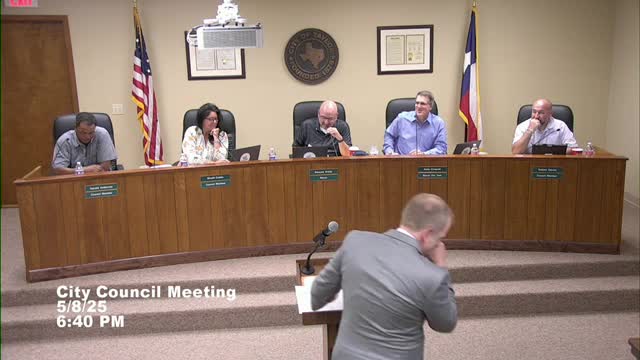
The Taylor City Council on May 8 received a final feasibility study for a proposed wellness and recreation center and directed preliminary work toward a public bond process and committee formation.
The study, prepared for the city by Barker Rinker Seacat (BRS) and funded by Samsung, recommends a base-phase facility of roughly 64,800 gross square feet with a total project cost estimated at about $55.3 million, and a full build-out scenario of roughly $85 million. The consultant presented a phased approach and operational pro forma that assumes a target cost-recovery range of 65–75 percent from fees and program revenue, with the balance subsidized by the city.
Mayor Dwayne Areola opened the presentation by stressing the planning purpose: "this is a feasibility study. This is a wish list so that future councils can decide how much money to spend, where to spend it, where to locate it," and BRS consultant Mick Massey described the process of combining program, budget and schedule in recommendations tailored to Taylor.
Key elements in the consultant recommendation include indoor aquatics (a recreation pool and a placeholder for a six-lane lap pool as a future phase), a gymnasium with additional cross courts, fitness and weight areas, an elevated indoor track, studios, classrooms, a senior lounge, child watch, multipurpose event/party rooms and outdoor amenities such as a spray ground. The study’s illustrative “base” program totaled about 64,800 sq ft; the maximum program cited in public input and steering-committee discussion reached about 111,800 sq ft.
BRS presented cost assumptions escalated to anticipated midpoints of construction. The base-phase construction cost with escalation was shown at about $41.0 million, with soft costs (design, contingencies, FF&E, permits) adding roughly $13.5 million for a total near $55.3 million. The full program estimate was presented at about $85 million.
On operations, the consultant gave a model of staffing and fees using 2029 as an opening-year baseline. Example pricing in the materials showed resident monthly rates in a mid-range cost-recovery scenario (about $24/month adult, $12 youth/senior) and warned that nonresident and secondary-market users could materially affect recovery assumptions.
The study identified two test-fit sites in city property analysis—Taylor Regional Park and Murphy Park—and suggested Murphy Park as a central, more walkable option while noting utility, parking and tree-preservation tradeoffs would require further site study and traffic analysis.
Councilmembers focused on timing and next steps. Several members said they preferred a May 2026 bond election if the city moves forward; city staff and the city attorney cautioned that a May 2026 ballot would require committee work and ballot language finalized months earlier (February is the practical deadline cited for a May election). Councilmembers Anderson and Garcia were given direction to begin forming a bond committee and to start deeper vetting. The formal motion before council was to receive the study as presented.
A motion to receive the feasibility update carried unanimously (5–0). The council stressed that the study expresses options and preliminary budgets rather than final commitments and noted that the city and potential partners (YMCA, Boys & Girls Club, school district) would need to negotiate roles if the project advances.
The presentation and council discussion make clear this is a planning stage: the report recommends a revealed public process and possible ballot question, but no funding or contract approvals were made at the May 8 meeting.