Get Full Government Meeting Transcripts, Videos, & Alerts Forever!
Get email alerts on the Budget And Appropriations topic
No spam. Unsubscribe anytime.
Housing conference committee reviews competing House and Senate funding targets and major appropriations
Summary
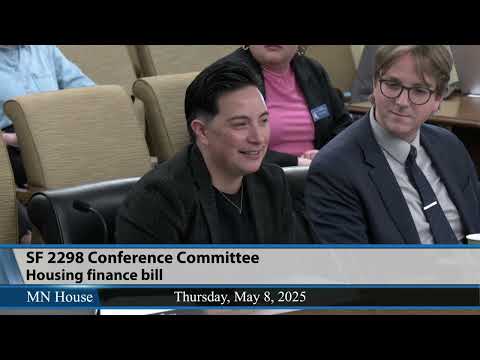
The Minnesota Legislature’s conference committee on the housing finance omnibus met to compare the House and Senate positions on funding and policy for affordable housing programs, with nonpartisan fiscal staff from both bodies walking members through a spreadsheet of line‑by‑line differences.
The Minnesota Legislature’s conference committee on the housing finance omnibus met to compare the House and Senate positions on funding and policy for affordable housing programs, with nonpartisan fiscal staff from both bodies walking members through a spreadsheet of line‑by‑line differences.
Senate fiscal staff Eric Olafson told the committee that “the senate position… was a net additional spend of 3,000,000 from the general fund” for the fiscal 2026–27 period and an additional $1,000,000 for fiscal 2028–29, numbers he said meet the Senate’s budget targets. House fiscal analyst Katrina Highmark summarized the House position as substantially larger, saying the House’s change items total about $75,450,000 for fiscal 2026–27 and $7,600,000 for fiscal 2028–29, meeting the House target of roughly $75 million in the 2026–27 biennium.
Why it matters: the two positions contain many identical policy provisions but differ primarily on spending levels, one‑time vs. ongoing funding, and certain bonding and debt‑service proposals. Those funding differences will determine which programs receive larger, one‑time boosts and which receive ongoing base increases.
Key program amounts and differences
- Family Homeless Prevention and Assistance Program (FHPAP): House staff said FHPAP would receive $30,150,000 in fiscal 2026 in the House position, with ongoing funding that produces a $30,600,000 line in fiscal 2026–27 and $900,000 in fiscal 2028–29. Senate staff described a smaller, one‑time bump of $10,150,000 in fiscal 2026 under the Senate position.
- Housing infrastructure bonds (HIVs) and debt service: The House position includes a proposal to allow Minnesota Housing to issue $100 million in housing infrastructure bonds and to appropriate money to pay debt service; staff said the debt‑service payment would start in fiscal 2028 (about $1,000,000 in fiscal 2028 rising to $5,600,000 in fiscal 2029 for a $7,600,000 two‑year impact). The Senate position does not include the same debt‑service appropriation in its side‑by‑side.
- Greater Minnesota housing infrastructure grants and other one‑time appropriations: the House proposed larger one‑time allocations (for example, $20,000,000 in fiscal 2026 for Greater Minnesota housing infrastructure grants versus the Senate’s $2,000,000 in a different phasing). The House also proposes larger one‑time workforce and challenge program appropriations.
- Cancellations and transfers: Senate staff identified a $10,000,000 one‑time cancellation in FY25 tied to the communities single‑family NOA (naturally occurring affordable housing) item, and a repeal of a transfer to the housing support account that the staff estimated would save $450,000 in FY25 and ongoing savings thereafter.
Contingent provisions and cross‑bill links
Olafson noted one contingent item outside the housing bill: an appropriation in the Senate Judiciary and Public Safety omnibus (House File 2432, first unofficial engrossment) that would apply a contingent proportional reduction to Minnesota Housing Finance Agency appropriations and a corresponding contingent appropriation of $66,500,000 to reimburse landlords during an eviction moratorium for tenants with Section 8 rental vouchers. Olafson said that provision is included in the side‑by‑side as a contingent article and flagged it for members’ attention.
Discussion and next steps
Chairs and members spent most of the hearing on the staff walkthrough and public testimony; no formal votes or motions were recorded in the transcript. Committee chairs said they need a global budget target before completing conference negotiations and expect to post future meetings at least 24 hours in advance when possible.
Speakers quoted in this article appear in the speakers section below. The full side‑by‑side spreadsheet and the line‑by‑line walk‑through served as the factual basis for the figures above.