Get Full Government Meeting Transcripts, Videos, & Alerts Forever!
Get email alerts on the Disaster Preparedness topic
No spam. Unsubscribe anytime.
OIG audit: California prisons not able to complete large‑scale evacuations within 72 hours, vehicle fleet and planning gaps identified
Summary
An OIG audit found most California prisons lack detailed external evacuation plans and would not be able to evacuate incarcerated people and staff within 72 hours. The report flagged inconsistent risk assessment tools across sites, limited transportation fleet availability, and aging buses that may be unreliable for large evacuations.
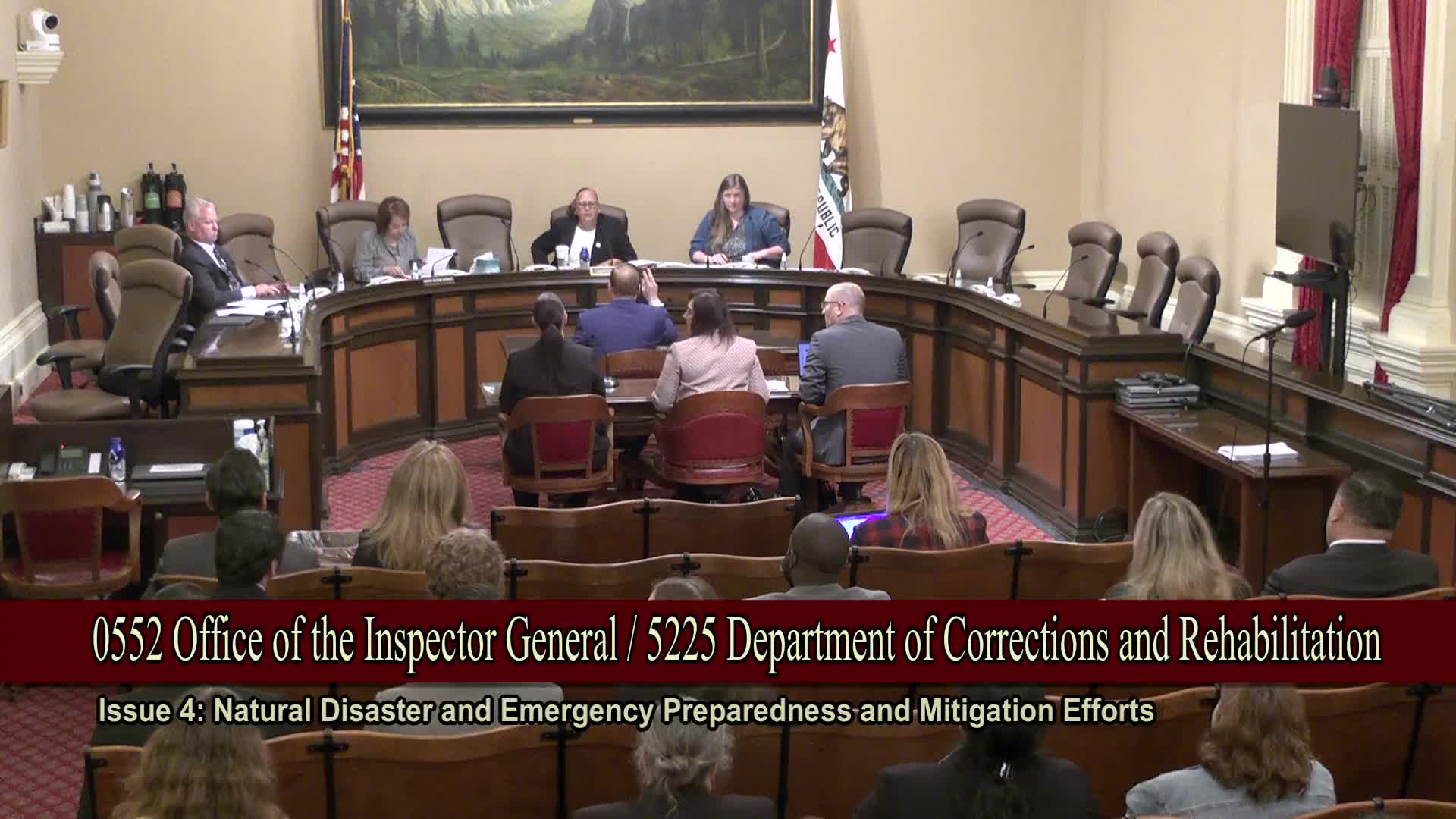
The Office of the Inspector General presented an audit to the Senate subcommittee finding that most California prisons lack site‑specific evacuation plans that would enable full external evacuations within a 72‑hour window.
The OIG reviewed emergency operations and planning documents for 30 prisons and conducted deeper reviews of three institutions. The audit concluded that while prisons maintain internal procedures to shelter in place or move people around inside facilities, none of the reviewed plans included detailed processes to evacuate people outside the gates to alternate secure housing within 72 hours.
Key findings
- Evacuation readiness: OIG concluded CDCR could not evacuate staff and incarcerated people at most prisons within a 72‑hour timeframe recommended by the U.S. Department of Homeland Security. - Transportation fleet: CDCR operates 30 buses (38 seats each) and approximately 93 fleet vehicles statewide; however, vehicle distribution is uneven and some buses have very high mileage (examples cited: 533,000; 676,000; five buses between 730,000 and 850,000 miles), exceeding typical 500,000‑mile service life for heavy buses and raising reliability concerns. - Overcrowding: As of Dec. 31, 2024, CDCR reported prisons operating at 122% of capacity, which complicates any large‑scale movement of people. - Risk assessment inconsistency: The audit found 3 different tools used across 30 prisons, and five facilities did not identify their assessment tool, producing inconsistent vulnerability ratings among nearby facilities.
The OIG cited a specific example in which two neighboring institutions rated flood vulnerability differently, creating planning inconsistencies even for nearby sites that could be jointly affected by the same event.
Department response and planning context
CDCR witnesses told the committee the department would rely on local, state and federal partners during large emergencies and noted existing capabilities such as 23 fire houses covering 29 institutions and mutual aid agreements with local fire agencies. CDCR also described an internal department operations center and the ability to shelter in place or conduct internal evacuations as appropriate.
Cal OES and CDCR told the committee they can and do coordinate with local law enforcement and state emergency management to secure transportation and logistics in large incidents, but both the audit and committee members emphasized the importance of site‑specific plans that do not assume outside resources will always be available.
Recommendations and next steps
The audit included 18 recommendations asking CDCR to improve consistency in risk assessment tools, strengthen substantive review of site emergency plans at headquarters, evaluate transportation readiness and fleet reliability, and plan for population reductions and closures where facilities are repeatedly shown to be vulnerable. The OIG said it will monitor implementation of those recommendations.
Discussion vs. decision
The subcommittee received the audit findings and asked CDCR and Cal OES to respond and provide follow‑up materials, including clarifications on plans, vehicle readiness and mutual aid status. No legislative action was taken at the hearing.
Ending
Members expressed concern that planning assumptions should not rely exclusively on mutual aid and that site‑specific evacuation planning, fleet readiness and consideration of population reductions in high‑risk locations require prompt attention. The OIG agreed to continue monitoring CDCR progress on recommendations.