Get Full Government Meeting Transcripts, Videos, & Alerts Forever!
Get email alerts on the Ggrf Spending topic
No spam. Unsubscribe anytime.
Senators and advocates spar over how to spend cap‑and‑trade proceeds: housing, transit, nature and agriculture vie for funds
Summary
Witnesses and public commenters offered competing proposals for allocating greenhouse‑gas reduction fund (GGRF) proceeds, with environmental justice groups seeking targeted continuous funding for frontline communities, others seeking infrastructure revolving funds, and agricultural and transit advocates asking for set‑asides for proven programs.
Lawmakers heard a wide range of competing recommendations for how to spend proceeds from California’s cap‑and‑trade auctions, with testimony divided across several broad priorities: community air protections, housing near transit, mass transit and rail, nature‑based solutions, and agricultural climate programs.
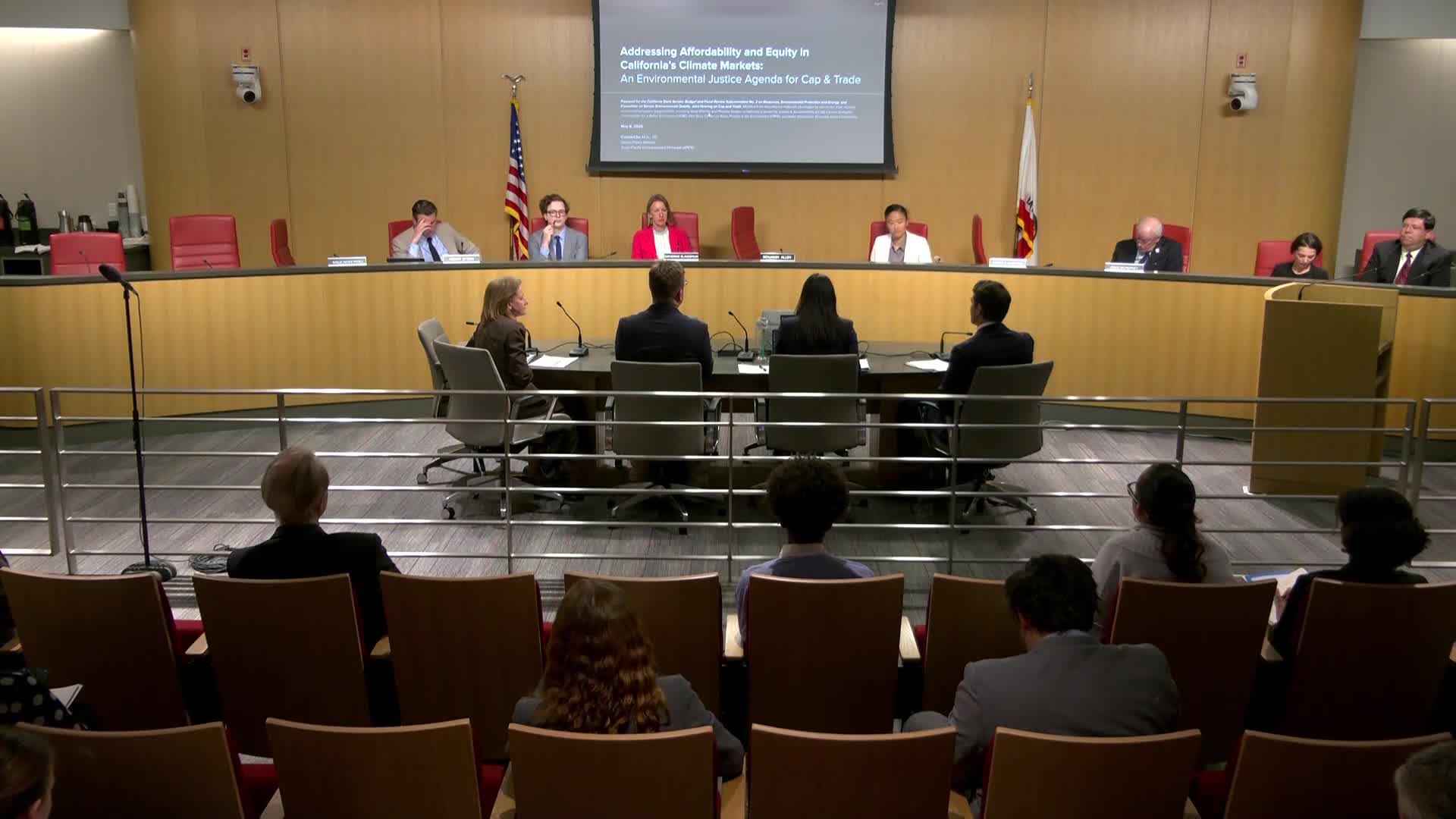
Advocates for environmental justice asked the legislature to ‘‘dramatically reduce or eliminate excessive free oil and gas allowances’’ and to prioritize direct investments in communities through the Greenhouse Gas Reduction Fund (GGRF). Connie Cho of the Asian Pacific Environmental Network told senators that groups representing frontline communities ‘‘are humbly asking the legislature to reform the cap and trade program for affordability and equity’’ and to redirect funds into programs that benefit low‑income and overburdened communities.
Housing and transit advocates asked for continued or expanded continuous appropriations for programs that combine land‑use, housing, and transit investments. Speakers representing affordable housing, regional planning and transit agencies urged the continuation of Affordable Housing and Sustainable Communities (AHSC) and the Transit and Intercity Rail Capital Program (TIRCP) and recommended that funds be protected because those programs drive mode shift and co‑benefits including reduced vehicle miles traveled and lower household costs.
Technical witnesses proposed different spending strategies. The Legislative Analyst’s Office advised memorializing key legislative priorities in statute and noted tradeoffs between program design choices (price collar, cap, allocation) and how allowance value is used. Net0 California recommended leveraging public funds through revolving infrastructure finance — for example, capitalizing a $5 billion clean‑energy revolving fund that, proponents said, could be rotated and leveraged to mobilize private capital and multiply deployment of clean infrastructure.
Agricultural groups and conservation organizations pressed for a steady stream of funding for climate smart agriculture, organic transition, food and processing upgrades, dairy methane projects and composting/organics infrastructure. Multiple speakers advocated for a continuous set‑aside in the range of 15% for agricultural climate solutions and reminded the committee that several agricultural programs have shown low dollars‑per‑ton costs for greenhouse‑gas reductions.
Several local air districts and environmental groups urged an increase in funding for AB 617 community air protection implementation; multiple speakers asked for continuous appropriations so districts could implement local emission reduction plans and accelerate projects that deliver immediate public‑health benefits.
Debate over program form: some environmental groups favored redirecting allowance value from free industry allowances to fund GGRF priorities and augment the California Climate Credit for utility customers; other stakeholders — including business and manufacturing representatives — argued for program stability and warned that overly prescriptive changes to design or allocations could raise costs and impair investor confidence.
Ending: No formal spending decisions were made at the hearing. Senators and witnesses agreed on the need for quicker clarity from CARB and the legislature to provide certainty to recipients and investors and to reduce revenue volatility for long‑lived projects.