Get Full Government Meeting Transcripts, Videos, & Alerts Forever!
Get email alerts on the Election Ballot Shortage topic
No spam. Unsubscribe anytime.
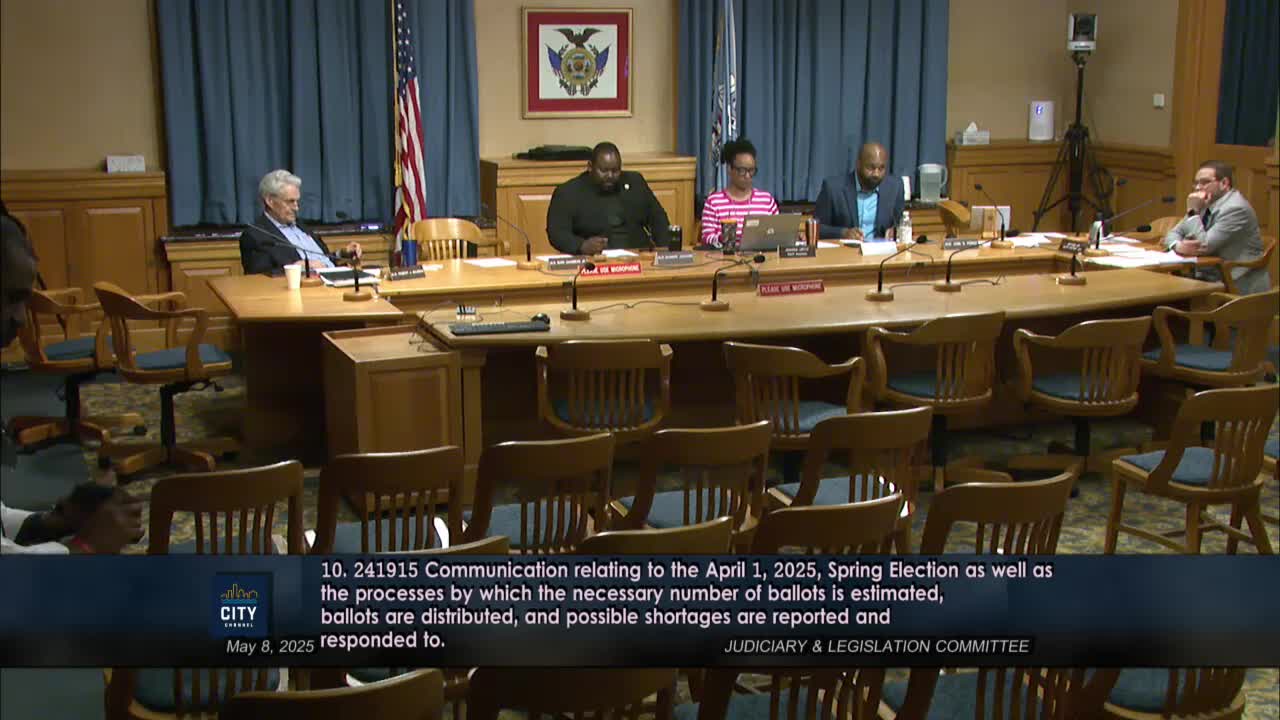
Election commission: April ballot shortages tied to historic turnout, logistics; commission vows tech, staffing and planning changes
Summary
City election officials told the Judiciary & Legislation Committee that concentrated high turnout and coordination issues produced temporary paper‑ballot shortages at some polling sites during the April 1 spring election, and the commission pledged new ordering and operations changes.
City election officials told the Milwaukee Common Council’s Judiciary & Legislation Committee that the April 1 spring election produced unusually high turnout and a concentrated, time‑of‑day surge in demand that drove temporary paper‑ballot shortages at a small number of polling sites.
"April election was a record‑breaking election," Pauline Gutierrez, executive director of the Milwaukee Election Commission, said. She and Deputy Director Marisha Harris said the office received unusually high call volumes to the commission's triage hotline — "nearly a thousand phone calls" — and documented ballot‑related problems at roughly 69 sites citywide, with about nine sites experiencing a period during which both regular and express vote ballots were depleted.
Why it matters: The shortage produced long lines at some polling places and raised concerns from council members about voter access, the commission’s logistics and whether some voters left without voting. Commission leaders said they will change ordering and operations procedures to reduce the chance of a recurrence.
What happened and how the commission responded
- Demand spike and logistics: Commission staff said an unusually strong campaign environment and heavy turnout — including a high‑interest Supreme Court contest — produced turnout roughly 10 points higher than the comparable 2023 spring election in many districts. The busiest demand period overlapped with afternoon and evening rush hour, which compounded courier travel times from the commission’s operations center in Bayview to several Northwest Side polling sites.
- Call center overload and coordination limits: The triage center was staffed by five hotline lines and four full‑time election staff plus an intern. Staff said the center took roughly 600 recorded hotline calls during the busiest hours and that additional calls likely came through other channels. The commission said the problem was not the absence of supplies but rather a coordination and dispatch bottleneck: couriers could not be tracked in real time and some had to return to the operations center to pick up printed ballots or express‑vote paper.
- Express vote and on‑site printing: Milwaukee is a first‑class city and maintains the ability to print ballots in‑house; staff reported they printed several thousand additional ballots in the run‑up to the election (roughly 5–6,000) but that in‑house print capacity is slow. Officials said they also dispatched additional express‑vote machines and paper where possible — and that faster adoption of express‑vote procedures by voters and poll workers would reduce paper demand on election day.
Planned changes
The commission announced several immediate actions:
- Move to a 1‑to‑1 order for spring general elections (order paper equal to the number of registered voters) and to refine that figure to reflect local voting‑age population where appropriate (for example, near college campuses). - Expand staffing and formalize an "election planning task force" to coordinate across departments and community partners before each election, not only before general elections. - Reconfigure the operations center/triage‑center interfaces and invest in better dispatch and real‑time tracking so couriers can be routed to the nearest resource without backtracking to the operations center. - Increase training and outreach to normalize use of express‑vote machines on election day and run public campaigns explaining express‑vote options.
What commissioners asked
Aldermen asked the commission to produce maps of affected sites and to quantify how many voters may have been discouraged and left without voting. Commission staff said their after‑action review did not identify a reliable, verifiable count of voters who left before casting ballots; they said they immediately told chiefs to keep lines open until voters in line at 8 p.m. could cast ballots. Officials also described offering training on crowd management and said chiefs should call law enforcement if crowds became unsafe.
Ending
The election commission told aldermen it will formalize the tasks and timelines for the changes and engage elected officials, community organizations and city departments to implement improved ordering, training and dispatch protocols before the next spring general election. "We cannot allow our voters to experience this again," Deputy Director Marisha Harris said.