Get Full Government Meeting Transcripts, Videos, & Alerts Forever!
Get email alerts on the Homelessness Housing Shelter topic
No spam. Unsubscribe anytime.
Sullivan County officials present ‘housing gateway’ plan to reduce hotel placements; state grant, site selection and costs remain key questions
Summary
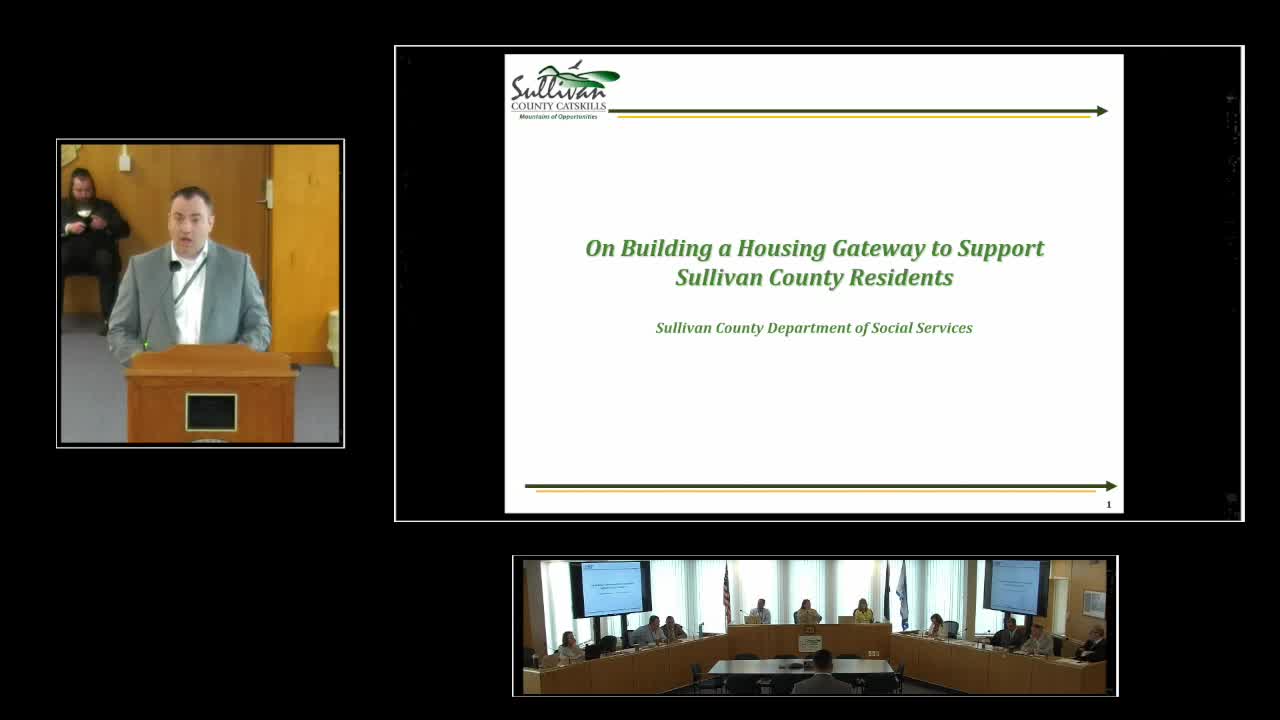
Sullivan County social‑services officials presented a proposed 20‑bed “housing gateway” to the Health & Human Services Committee as an alternative to expensive hotel placements for single adults, saying the facility would provide case management and services designed to move clients to permanent housing.
Sullivan County’s Department of Social Services presented a plan to create a 20‑bed “housing gateway” — a triage facility providing case management and on‑site services — that county officials say would reduce the county’s reliance on privately run hotels for emergency housing.
Commissioner (DSS) outlined the proposed facility and argued it would be a more cost‑effective, service‑oriented alternative to hotels. The draft architectural plan described a roughly 6,500‑square‑foot, single‑story building with a commercial kitchen, confidential meeting spaces, laundry, locked storage, public restroom/showers, and ten double‑occupancy rooms to provide 20 beds.
The commissioner described regulatory constraints and service requirements for shelters licensed under the New York State Office of Temporary and Disability Assistance (OTDA), referencing 18 NYCRR Part 491 (shelters for adults) and Part 900 (shelters for families with children). “When you operate a housing gateway under Part 491, there are services that have to be provided under those regulations,” the commissioner said, listing required health services, qualified staff, resident rights reviews and regular inspections.
Cost and funding: county staff said the architect and DPW currently estimate about $400,000 per unit (one bed), producing an approximate construction cost of $8 million for the 20‑bed center. The presenter cited Hudson Valley Pattern for Progress’s research on hotel conversion costs and said the county expects the project would be competitive for a New York State Homeless Housing Assistance Program (HHAP) grant that could cover construction. The commissioner said the conservative county estimate is that the center could “pay for itself in about 11 years,” driven by savings from avoided hotel bills and better exits to permanent housing.
County officials provided hotel cost context: negotiated emergency hotel rates now range roughly $80–$100 per night per room (reported); last year the county’s cash costs for emergency housing approached $3.5 million, with a local/state split officials described as roughly 71% local and 29% state. Officials said hotel payments do not include case management and other wraparound services the proposed center would provide, and they noted additional contract costs for outside case management.
Legislators pressed on site selection and grant timing. The commissioner said the drafted building is intentionally portable to fit a “shovel ready” slab on grade and that a HHAP application generally requires a specific site; the state will favor proposals able to begin construction quickly. A public hearing setting for one proposed parcel (Petaluca site) was scheduled as part of the legislature’s business (public hearing June 19). The commissioner said that without an identified site the county would likely be ineligible for the competitive HHAP grant because the state expects rapid timelines for shovel‑ready projects.
Public‑safety concerns and population focus: presenters and legislators discussed criminality and the public‑safety argument for a gateway facility. The commissioner said the gateway is intended to “enhance public safety” by providing supervised supports that reduce street risk and re‑entry into the hotel system. The plan focuses on single adults because county data show singles are most likely to return to hotels after initial placement; the county estimated a 20‑bed facility could serve 80–100 people per year.
Veterans and families: the presenter, a Navy veteran, said the county does not see enough veteran homelessness to justify a veteran‑only facility but indicated existing veteran resources (Vet2Vet, county programs) would be integrated. For families, the commissioner said the county already uses a hotel that provides a kitchenette for families and continues to expand family services case management to move families to permanency more quickly.
Next steps and grant conditions: officials said the county has been in multiyear discussions with the state and that HHAP requires a site and a realistic construction timetable. The county noted prior guidance from a 2016 state comptroller report and a 2024 grand jury review as context for moving away from hotels. Staff asked the legislature to consider identifying a site promptly to be competitive for HHAP funds.
Votes at a glance: during the same meeting the legislature moved and approved several routine committee resolutions pertaining to department agreements and public hearings. The committee set a public hearing for the Petaluca parcel (June 19) related to a proposed lease for a site under consideration for the project and approved memoranda of understanding and grant‑related administrative items that were on the meeting calendar.
The committee did not authorize construction funding during the meeting; officials said any capital spending depends on winning state grant awards and later legislative appropriation.