Get Full Government Meeting Transcripts, Videos, & Alerts Forever!
Get email alerts on the Aging And Disability Services topic
No spam. Unsubscribe anytime.
Richmond aging services office outlines needs assessment, seeks more staffing and outreach
Summary
The Office of Aging and Disability Services reported findings from a 2023 needs assessment and described steps the city is taking — and still needs — on outreach, home repairs, transportation, training and food access for older adults and people with disabilities.
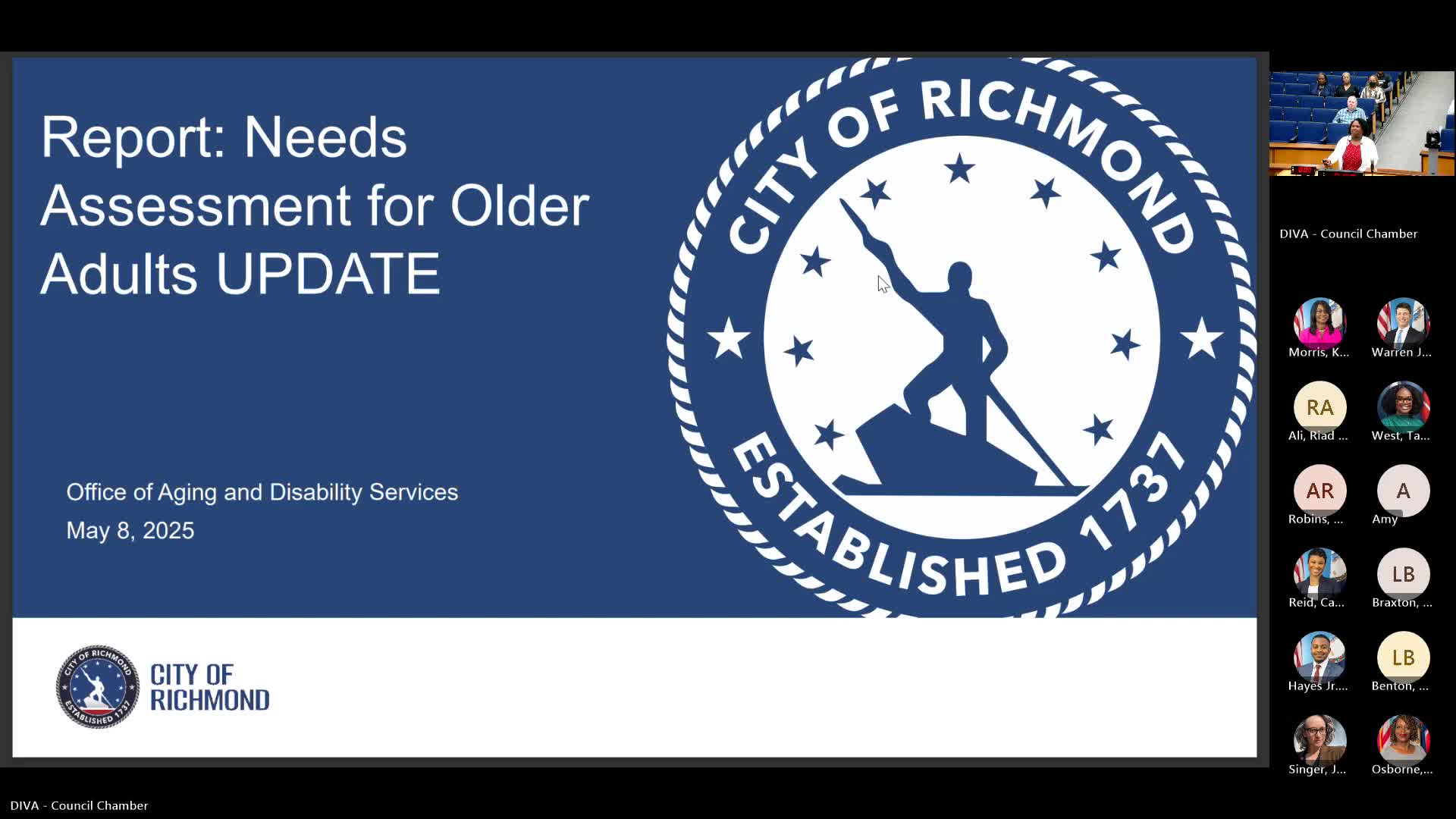
The Richmond Office of Aging and Disability Services reported to the Education and Human Services Standing Committee that a 2023 needs assessment identified gaps in housing repairs, transportation, built environment accessibility and awareness of services for older adults and people with disabilities.
The update, delivered by Natasha Haupt, program manager for the Office of Aging and Disability Services, summarized key findings, actions already under way and short-term priorities. Haupt said the office is focusing on improving outreach, expanding training for personal care workers, coordinating safety-check programs for residents who live alone and piloting pop-up food pantries in neighborhoods with high senior populations.
The report matters because Richmond’s population of older adults is growing and many residents who need help are not accessing city services. The presentation said the city counted about 57,000 older adults at the time of the survey and that the figure was approaching 70,000 as the city moved toward 2026; the assessment team interviewed about 495 older adults or key informants and produced an 80‑page report with 9 recommendations.
Haupt said the assessment’s recurring needs were improvements to the built environment (including sidewalks and ramps), more affordable and accessible housing options, better technology access and clearer communications. The office learned older residents prefer paper notices and is seeking funding to provide at least a twice‑yearly mailed direct mailer to reach seniors who do not use digital channels.
Haupt described work already under way: the Senior Navigator document — a compiled resource list with more than 900 entries — is being refined to show which organizations are active, what programs cost and what their capacities are. The office has detailed outreach plans that include regular visits to senior facilities and monthly learning sessions with partners in adult services.
On workforce, Haupt said the office partnered with the Office of Community Wealth Building, the SPAN Center (formerly Senior Connections) and VCU Gerontology to run a personal care aide training program. The course began with nine participants; all nine completed Personal Care Aide certification and first aid/CPR, and program staff reported those participants had been placed in jobs as of the week of the meeting.
The office is also working with the Richmond City Sheriff’s Office on its RU OK program, which currently supports roughly 32 people, to expand regular wellness check calls for isolated residents. To address food access in senior-concentrated neighborhoods, the office has piloted pop‑up pantries with partners including Humana (as a funder/partner) and Feeding More (food provider). These pantry events are being planned for the next fiscal year, the presentation said.
Committee members praised the work and repeatedly urged the administration to add staff. Councilwoman Jones said she relies on the aging office as a daily contact and called for more resources, especially for transportation solutions and protection of older adults from predatory behavior. Committee members asked for more detail about which built‑environment changes residents prioritize. Haupt said broken sidewalks, lack of curb ramps and other pedestrian barriers were recurring concerns and that residents sometimes travel in the street because sidewalks are not sufficiently accessible for wheelchairs or walkers.
Haupt also described housing and home‑repair backlogs. The report noted some home‑repair wait lists can extend for years; the office referenced a city program, Healthy Homes, and partnerships with Habitat for Humanity to address repairs but said demand outstrips current capacity.
The presentation concluded with the office’s near-term steps: (1) an annual interest survey to identify programming older adults want; (2) a refined Senior Navigator with capacity and cost information; (3) expansion of safety‑check enrollment with the sheriff’s office; (4) continuation and scaling of personal care aide training with placement assistance; and (5) outreach to find funding for regular mailed communications.
Amy Popovich, introduced earlier in the meeting as the city’s new deputy chief administrative officer for human services, attended and was introduced to the committee. Popovich said she was “very excited to be here” and bring her public‑health experience to the role.
Committee members directed staff to follow up on two items they requested during the meeting: an update on whether the direct‑mail funding request had been allocated in the budget and additional detail on parks and recreation programming targeted to older adults. The staff liaison said the committee would receive follow‑up on direct‑mail funding and would include regional coordination and homelessness case‑management briefings at a future meeting.
The presentation and committee discussion did not include a formal vote; committee members signaled support for more staffing and for continued coordination with Parks and Rec and other partners.