Get Full Government Meeting Transcripts, Videos, & Alerts Forever!
Get email alerts on the Aging Services topic
No spam. Unsubscribe anytime.
Clark County Commission on Aging briefs council on emergency preparedness, Aging Readiness Plan and bylaw changes
Summary
The Clark County Commission on Aging updated the County Council on the 2024 implementation of the Aging Readiness Plan, emphasized emergency-preparedness work, presented 2024 Silver Citizen awards, and said it has unanimously recommended bylaw changes that will be forwarded to the council for approval.
At a work session, the Clark County Commission on Aging reported to the Clark County Council on its 2024 activities, including a concentrated effort on emergency preparedness, outreach on housing and technology issues, recognition of two Silver Citizen award winners and a unanimous recommendation to forward proposed bylaw changes to the council for approval.
The presentation, led by Franklin Johnson, chair of the Clark County Commission on Aging, summarized the 10-year update to the Aging Readiness Plan (ARP), explained the commission’s 2024 focus on older-adult emergency preparedness and described proposed bylaw updates the commission plans to send to the council for consent or separate-business agenda review in May or early June.
Why it matters: Clark County is preparing for a growing older population. The commission cited estimates that by 2035 roughly one in four county residents will be age 60 or older, and said the ARP’s strategies aim to help the county adapt infrastructure, housing and services so older adults can remain safely in their communities.
The commission said the ARP update adopted in September 2023 contains 18 goals implemented through 67 strategies across chapters on healthy communities, housing, mobility, civic involvement and emergency preparedness. Johnson told the council the ARP’s housing chapter includes strategies to encourage housing that enables “aging in place” and to consider zoning or building-code changes to increase accessibility.
On emergency preparedness—the commission’s principal focus in 2024—members said they devoted eight monthly meetings to outreach and education. The commission invited staff from CRESA (Clark Regional Emergency Services Agency) to brief members on personal and neighborhood preparedness, assembling emergency “go bags,” and building communication networks. Commissioners said they were told that roughly 100 emergency-response personnel are on active duty each day countywide, and emphasized the need for individual and neighborhood plans in the event of a major incident.
Commission members described efforts to add older-adult–specific alerts and communication channels and to post resources for older adults on CRESA’s public site. They said CRESA staff highlighted challenges older adults may face in emergencies—mobility constraints, reliance on assisted transportation, and social isolation—and that individualized communication plans are an important mitigation strategy.
The commission also reviewed outreach work in 2024: presentations to city and community groups across the county, participation in the Public Health Advisory Council and the Area Agency on Aging and Disabilities of Southwest Washington (AAADSW) advisory council, and a county-council proclamation recognizing National Caregivers Month. The commission noted it received the Governor’s Smart Communities award from the Washington State Department of Commerce for effective local planning implementation tied to the ARP.
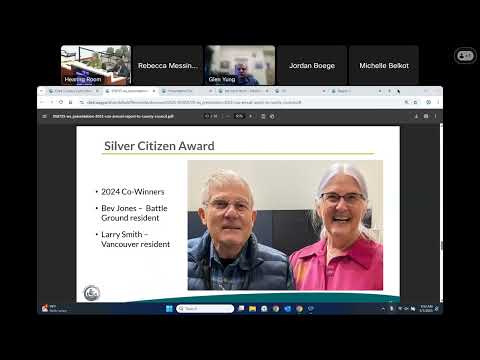
The commission announced two co-winners of the 2024 Silver Citizen award: Bev Jones, a nurse in Battle Ground who served the community professionally for 43 years and volunteers with organizations including the Lions Club and the North Clark County Community Food Bank; and Larry Smith, a Vancouver resident who served as a county councilor, mayor pro tem and as a commission on aging member and who co-founded a local military appreciation committee.
On bylaws, the commission said most proposed edits (clarifying language, adding references to the 2023 ARP, and more detail about nominations and nonvoting partners) can be approved internally under Article 13 of the commission bylaws. The presenters said, however, that one correction in the “powers and duties” language in Article 3 requires county council approval because those powers were originally granted by the council when the commission was established in 2012. The commission “unanimously voted to recommend approval of the proposed changes on 03/19/2025” and staff will submit the edits to the council consent or separate-business process, the presentation said.
Council members asked questions about whether the commission is addressing technology access for older adults, links between the ARP and the county comprehensive plan, and concrete housing measures. Susan Ellinger of Community Planning said the ARP is a supporting plan to the comprehensive plan and that planning staff will review comprehensive-plan chapters with ARP strategies in mind and can share links and crosswalks. Commissioners said they have begun outreach to developers and are exploring zoning and building-code incentives (for example, elevator requirements or incentives) to increase accessible units.
Councilors and commission members also discussed communications strategies—mailings, news outlets and distribution through services such as Meals on Wheels—and the commission said a 2017 “universal design” booklet about aging-in-place improvements is available on its website and can be shared with the council and the public.
The presentation closed with the commission saying it will follow up with the council on housing details and provide links to the ARP and related reports. The council thanked the commission for its work and acknowledged the award and outreach described in the presentation.