Get Full Government Meeting Transcripts, Videos, & Alerts Forever!
Get email alerts on the Wildfire Response topic
No spam. Unsubscribe anytime.
Bannock County fire officials urge clearer mutual-aid rules, warn aircraft costs strain small districts
Summary
Fire chiefs and county officials discussed gaps in mutual-aid coverage, a $30,000 local budget set-aside for a single aerial retardant drop, and the need for public outreach to create defensible space on the East Bench and foothill neighborhoods.
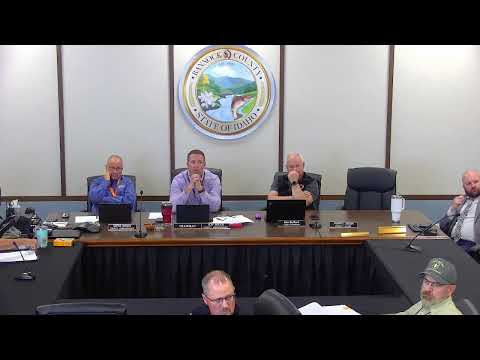
At a recent Bannock County meeting, local fire chiefs and county officials warned that gaps in mutual-aid arrangements and rising aircraft costs could leave communities vulnerable to large, wind-driven wildfires.
A fire official working with regional chiefs said maintaining cross-jurisdiction communication and partnerships is critical as personnel change, and noted limits on what agencies can say publicly. "There are certain things, you know, especially in the current atmosphere that we can or can't say," the official said, adding that some approvals must go "up the chain quite a ways to get approval to do certain things." The official also said agreements allow counties' small fire departments to use county/agency ground resources free for 24 hours but that aircraft are an exception: "That was well stated. So those agreements I was talking about allows the counties, little fire departments to use us for free for 24 hours. There is 1 exception to that, and it's the aircraft."
Ryan Curtis, North Bendrick Fire District fire chief, said his district has set aside $30,000 in the budget to pay for an aerial retardant drop but noted that will likely cover only a single drop. "We have set aside $30,000 in our budget for a fire drop," Curtis said. "30,000. 30 grand. Okay. Well Oh, you got you get 1 shot, then you get 1 Brad up." He described the risk to residential areas on the East Bench and foothills where private parcels meet U.S. Forest Service and Bureau of Land Management (BLM) lands and urged residents to create defensible space: "...it really comes back to, you know, public outreach and and so we're we're working through that."
Officials cited the Henry's Creek fire as an example of an incident that burned across jurisdictional lines into "no man's land," complicating response and cost allocation. The fire official said the state of Idaho is "looking at" ways to help with unprotected lands but cautioned unprotected tracts remain a major challenge: "But that's, that's a big alligator. If you have unprotected lands and you've got wildfires, because our bean counters are gonna step in at some point and tell us, you know, draw a line in the sand."
Speakers emphasized that federal partners typically provide aircraft and resources when incidents occur on or abutting federal lands, and that small districts rely on East Idaho dispatch to request those assets. "We call East Idaho dispatch, and we can request a full full run card from the forest service to BLM, and they'll show up with resources and and help us fight that," Curtis said. He also thanked federal partners: "hats off to the BLM and the Forest Service for for providing those resources."
Officials described operational limits in mutual-aid and reimbursement arrangements: ground resources may be provided for an initial period at no charge under existing agreements, but aircraft typically require explicit payment or interagency cost-sharing. One fire official summed the practical constraint bluntly while describing the standard for covering aircraft costs: "We can't do that. And as long as we can pass the red face test and say it's a threat to Indian border interest, then then we're gonna pay."
County representatives offered to assist with public information outreach. Officials also discussed simple contact logistics for small districts to share phone numbers and coordinate through the county public information officer. "If we can help out with the public awareness, let us know. Wes works with our PIO very well to get information out," a county official said.
The discussion did not include any formal motions or votes. No statutory citations or ordinance numbers were introduced during the exchange, and participants framed the remarks as operational concerns and requests for better coordination rather than policy actions.
Further follow-up discussed in the meeting included continuing interagency coordination, outreach to residents in at-risk areas such as Pocatello Creek Road and Buckskin Road, and clarifying which costs are covered under mutual-aid arrangements versus which require local or agency payment.