Get Full Government Meeting Transcripts, Videos, & Alerts Forever!
Get email alerts on the Residency Exemption topic
No spam. Unsubscribe anytime.
Village of Jackson denies residency exemption for applicant with juvenile sexual-assault conviction; board allows reapplication after six months
Summary
The Village of Jackson denied a request from an applicant identified as Mr. Carson to reside in the village. The police chief recommended denial citing public-safety concerns and untruthful statements in the application; the board voted to deny while preserving the applicant's right to reapply after six months.
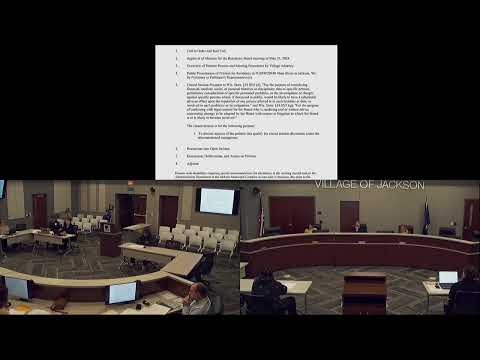
The Village of Jackson Residency Review Board denied an application from Mr. Carson for a residency exemption Tuesday, voting to deny the request while allowing him to reapply after six months.
Police Chief recommended denial, citing public-safety concern and credibility issues. "I believe he is a danger to our community, and I, I, suggest that you deny his application," the Police Chief told the board during the hearing, referencing a juvenile conviction for the sexual assault of a 7-year-old and subsequent law-enforcement contacts.
The board's decision followed a review of an application and a police investigative report. The board discussed statutory and ordinance-based criteria, including the nature of the offense (listed on the application as occurring on Nov. 21, 2007), the applicant's age at the time (about 16), the absence of current treating practitioners or probation/parole recommendations, and the applicant's recent criminal contacts. The Police Chief noted the applicant had been untruthful to officers and to the board about the length of sobriety and other matters, and said police records and the investigative report are on file.
Mr. Carson addressed the board at the hearing. Asked about the offense, he said, "It's horrible. Long it was like I was a kid. I didn't think I was young, and I I made a mistake," and said he had not had contact with the victim. The board questioned him about other police contacts and prior domestic-violence reports; Mr. Carson disputed some accounts and said he had recently been living with family and was employed.
Board members debated three primary options: deny the request outright; grant a conditional temporary exemption with monitoring and employer verification; or deny while allowing the applicant to reapply later. One board member said the police chief's recommendation and the record left "nothing in here that reassures me that it's going to be safe." Another member preferred allowing a time-limited conditional approval, such as a six-month probationary residency contingent on employment verification and no law-enforcement contacts.
A motion to approve with conditions (including monthly employer verification and no violations of law during a six-month period) failed for lack of a second. After further discussion, a motion to deny the application with the right to reapply after at least six months was made by a board member and seconded by another. The board then voted in favor of that motion. The presiding official called for a vote; the board recorded the motion as carried.
The board clarified what constitutes residency under the ordinance: residence is defined as sleeping, abiding, lodging or residing on a permanent or regular basis (a permanent basis is 14 or more consecutive days; a regular basis is 14 or more aggregate days during any calendar year, or four or more days in any one month). The board noted that because Mr. Carson's conviction was juvenile, he did not appear on the public version of the sex-offender registry and neighbors would not be notified by the registry.
The practical result of the board's action is denial of the exemption at this time. The board recorded that Mr. Carson may visit the home as a nonresident (visits that do not meet the ordinance's residency thresholds are permitted) and may reapply after a period of six months, at which point the board will consider new materials and any records of law-enforcement contact.
The board did not adopt a separate monitoring plan at this meeting; earlier conditional proposals (monthly employer verification from Mr. Carson's employer, Fleet Farm) were discussed but not approved. The board advised Mr. Carson on reapplying and closed the item before adjourning the meeting.