Get Full Government Meeting Transcripts, Videos, & Alerts Forever!
Get email alerts on the Public Safety Police topic
No spam. Unsubscribe anytime.
Howard County Police seek to sustain patrol, add school resource officer and tech funding in FY26 budget
Summary
Police Chief Gregory Durr presented a $162.8 million FY26 operating request that focuses on personnel, recruitment, expanded school resource officer coverage at a new high school and ongoing technology contracts — while asking the council for continued use of one‑time funds for equipment and retention/recruitment bonuses.
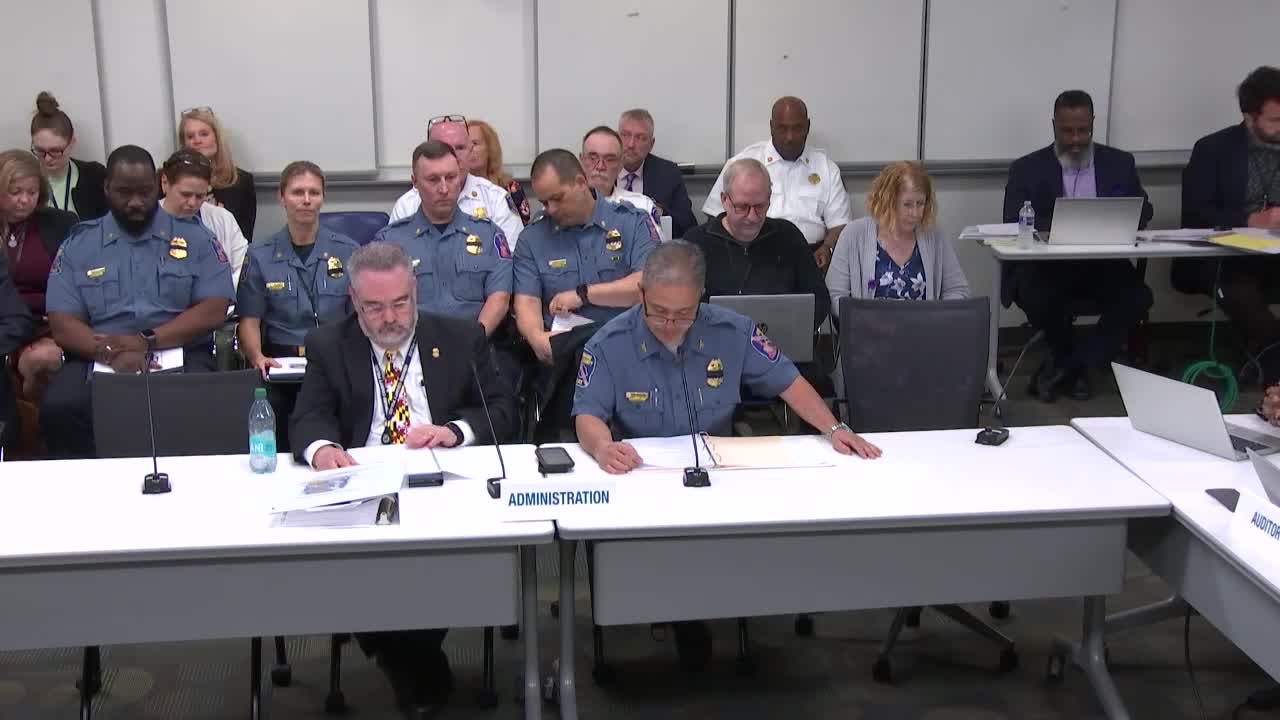
Howard County Police Chief Gregory Durr asked the County Council to approve a $162,820,809 operating budget proposed for fiscal 2026, telling members the department has prioritized maintaining service levels while managing rising costs.
The department’s personnel costs are its largest line item — “just over $135,000,000,” Durr said — representing roughly 84 percent of the request. Durr said the department continues to recruit and retain sworn and civilian staff with expanded outreach, targeted advertising and “fast track” hiring events.
The budget includes one additional school resource officer (SRO) to staff Guilford Park High School as it reaches full enrollment next year. “Per NASRO … one SRO per 1,000 students is the national standard,” Chief Durr said, and Guilford Park will be “close to 2,000 students” at full build-out. Durr said the new SRO will be dedicated to that high school and not shared across other schools; he said the Board of Education has been kept informed and is supportive.
Council members pressed on overtime and one‑time expenditures. Budget director Sean Hollywood told the council the FY26 request includes about $12.5 million for overtime. The chief said department overtime dropped from roughly 18,000 hours in 2024 to about 9,000 hours in 2025 after new hires arrived, but that unpredictable investigations and major cases continue to drive overtime costs.
The police request also reflects ongoing contract costs with Axon for body‑worn cameras and records management (about a $1,000,000 increase in services was cited), and a FY26 PAYGO request to buy firearms and equipment and to top up some one‑time items purchased last year — including ammunition stockpiles purchased to avoid supply‑chain shortages. Chief Durr said some purchases listed as ‘‘one‑time’’ (body and vehicle equipment, for example) were chosen because of supply and price volatility; Sean Hollywood said some items were classified as PAYGO to reflect that timing.
Council members asked about ballistic vests, a state matching grant, and PAYGO funding for upgrades; Hollywood said some state grant funding is intermittent, and county match funding was included in PAYGO to ensure timely outfitting and fitting for new officers. Chief Durr said the department will outfit new specialized units and the repeat‑offender division with fitted vests.
The council also discussed enforcement programs funded from special revenue — speed‑camera and school‑bus camera programs — and asked about trends and how revenue is handled. Major department staff said bus camera revenues are trending down (which officials said is the desired behavior change) while the speed‑camera revenue varies based on the number of cameras deployed and the locations; the county currently has seven speed cameras and is requesting authorization for an eighth under state limits. Hollywood noted the speed fund budgets conservatively to ensure spending authority if revenue increases.
The department said it continues to seek federal and state grants for programs such as violent‑crime prevention and technology upgrades, and officials said they monitor federal funding risks but have not yet received formal notice of cancellations affecting their FY26 expectations.
The chief and his command staff stayed to answer detailed questions from council members about ammunition procurement, the CAC relocation, paygo allocations, retention bonuses, vehicle and fleet choices, and the role of specialized units (drones, crime analytics, a Downtown Columbia crime‑reduction unit and partnership patrols with state parole/probation staff).