Get Full Government Meeting Transcripts, Videos, & Alerts Forever!
Get email alerts on the Veterans Budget topic
No spam. Unsubscribe anytime.
Conference committee reviews Minnesota veterans omnibus budget; defers decisions pending budget target
Summary
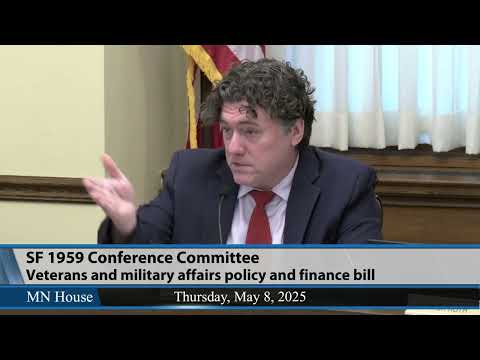
The Conference Committee on Senate File 1959 met May 8, 2025, to walk through House and Senate positions on the omnibus veterans and military affairs budget, review program funding and policy differences, and recessed without action pending a state budget target.
The Conference Committee on Senate File 1959, the omnibus veterans and military affairs budget, met Thursday, May 8, 2025, in Saint Paul to walk through the House and Senate positions; committee chairs took no formal action and recessed pending a state budget target.
Committee members and staff spent the session comparing line-by-line budget spreadsheets and identifying policy differences between the chambers. Helen Roberts, House fiscal staff, said the House bill was targeted at $5 million above the fiscal base for each biennium and that the bill’s total general fund spending for the agencies under the committee’s jurisdiction was $319,700,000. A Senate staff overview identified operating adjustments and change items in the Senate position, including a $600,000 biennial operating adjustment for the Department of Military Affairs and biennial increases for the Department of Veterans Affairs programs and for veterans homes.
The walkthrough highlighted several specific funding and policy differences the committee will need to reconcile. On funding, the Senate position included a $1,189,000 biennial increase for Department of Veterans Affairs programs and $39,170,000 for veterans homes (biennium), while the House included an $11,600,000 operating adjustment for veterans homes on its side of the document and a $2,200,000 increase targeted to suicide-prevention services within veterans health care. The House also identified a $112,000-per-year open general fund appropriation estimated to offset pensions for National Guard members ordered to state active duty.
On grants and one-time items, the House packet included a $60,000-per-year increase for County Veterans Service Officer (CVSO) grants (technical assistance coordinators) that mirrors the Senate position, a $500,000 increase for the CORE/Lutheran Social Services program, $500,000 for Metro Meals on Wheels, and several $1,000 one-time grants for local veteran organizations listed in the packet (Hometown Heroes, Camp Bliss, Veterans on the Lake, Veteran Mentorship for Black Youth, Fishing with Vets). The House packet also showed a $10,000,000 biennial reduction to homelessness-prevention programs under its veterans services program and omitted direct base grants to Camp Bliss and the Veterans Resilience Project that appeared in the other side’s documents.
Staff described multiple policy provisions included in both chambers’ versions and noted areas that will require reconciliation. Jeff Diebel of House Research summarized the policy article portions: agency language to grant the Department of Veterans Affairs access to the state’s MAXIS eligibility database, statutory updates to veterans burial rules, provisions to grant veterans status and benefits to people who served in the so-called “secret war” in Laos (with slightly different eligibility rules between the chambers), an advisory task force on those Laos veterans, and identical provisions to allow surviving spouses to retain certain veteran-related eligibility even after remarriage. A Senate-only draft section would require veterans service officers to assist nonresidents who have unsuccessfully sought services in their home county for 30 days.
Committee members did not take votes. The session concluded with the chairs saying the committee would recess to the call of the chair until a budget target is available; if a target appears, they said they would reconvene to negotiate outstanding differences.
The committee’s work will continue once a statewide budget target is set; until then, committee staff will hold the technical reconciliation and prepare a conference report that resolves funding and statutory differences between the two chamber positions.