Get Full Government Meeting Transcripts, Videos, & Alerts Forever!
Get email alerts on the Rent Stabilization topic
No spam. Unsubscribe anytime.
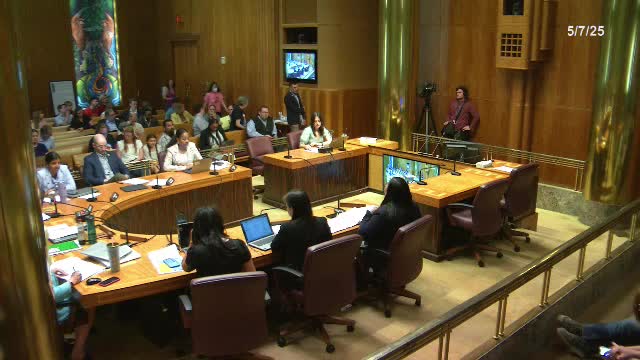
Council adopts rent-stabilization ordinance after close 4-3 vote; amendments fail
Summary
The council adopted the rent-stabilization ordinance (Ordinance 25-29) after heated public testimony and two failed amendment votes (a 30-year new-construction exemption and a prevailing-wage prerequisite). Final adoption passed 4-3.
After extended public hearings and debate, the St. Paul City Council adopted Ordinance 25-29, the city’s rent-stabilization measure. The final vote was 4 in favor, 3 opposed.
Council members heard hours of public testimony both for and against the ordinance and about proposed amendments. Two amendments proposed during the meeting failed: a motion to change the new-construction exemption from the ordinance’s baseline (20 years) to a 30-year rolling exemption failed on a 3–4 roll call; and a separate amendment that would have made prevailing-wage compliance a prerequisite for any project seeking an exemption likewise failed 3–4.
After the two amendment defeats, the council took a final vote to adopt the rent-stabilization ordinance in its published form. The roll call recorded four members voting in favor (Council members Pervatsky, Bowie, Jost and Council President Naker) and three voting against (Council members Yang, Johnson and Kim). The clerk announced the ordinance as adopted.
What was debated
Public testimony reflected sharp differences: tenant advocates and some community groups urged strong protections and objected to exemptions that would shrink the regulated housing stock. Labor representatives and unions testified in favor of a prevailing-wage requirement attached to any exemption for new construction; they framed prevailing wage as a tool to prevent wage theft on exempted projects. Developers, contractors and some business groups argued that exemptions were necessary to restart stalled projects and to entice private financing.
Council discussion focused on tradeoffs between encouraging new construction and preserving long-term regulated housing. Several council members said they supported tenant protections but sought compromise language to reduce the ordinance’s effects on development; others emphasized voter mandate and the need to protect renters.
Votes and next steps
Two amendments were voted down. The final adoption passed 4-3; sponsors and opponents said staff will now implement the ordinance according to its text and monitor impacts. The council also directed staff to produce data and a policy evaluation on rent stabilization, which council members said would inform future decisions.
Ending
Council members urged prompt administrative action to implement the ordinance and to track housing production, affordability metrics, and the effects of exemptions and enforcement going forward.