Get Full Government Meeting Transcripts, Videos, & Alerts Forever!
Get email alerts on the District Organization topic
No spam. Unsubscribe anytime.
Bay District superintendent unveils proposed reorganization to 'liberate resources' for schools
Summary
Superintendent presented a yearlong reorganization proposal that creates a four‑member cabinet, reorganizes teaching and learning divisions, and clarifies funding sources for positions (district, designated grants, self‑funded). Board members asked about titles, pay parity and the potential need for internal audit capacity as revenues grow.
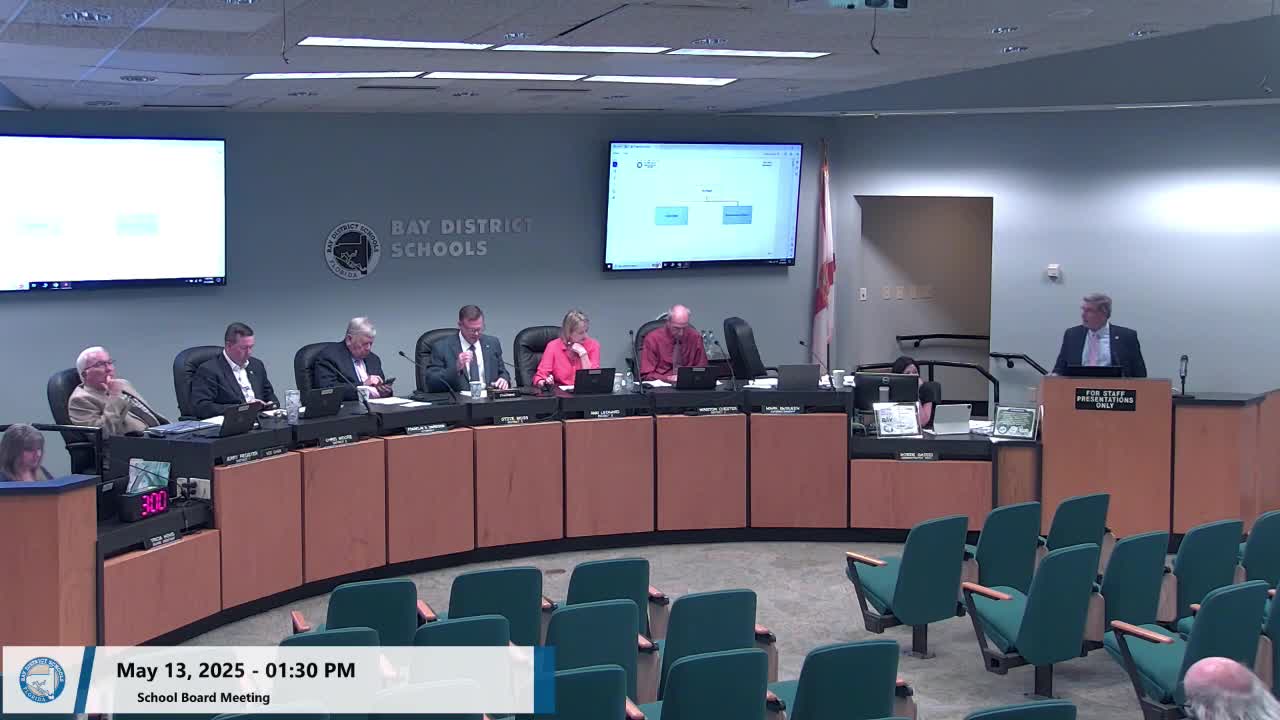
The superintendent presented a proposed reorganization of Bay District Schools during a board workshop, saying the plan is intended to streamline operations, improve accountability and redirect resources to schools and classrooms.
"This has been a work in progress for about a year trying to find out better ways to operate as your Bay District school system," the superintendent said. "The most important thing we can do is earn the trust and confidence of our citizens in their school district. It's their school district."
The proposal groups central operations under four cabinet‑level leaders: associate superintendent for business and finance (Jim), two deputy/associate superintendents (one for teaching and learning — Denise Kelly — and one for operations — Josh Balcom) and an associate superintendent for facilities and maintenance (Lee Walters). The presentation used a color legend to show funding sources: blue for Bay District funds, green for grant funds, yellow for designated grant funds or FTE‑allocated funds, and tan for self‑funded activities (for example, Bay Base after‑school programming).
Under teaching and learning, the district would organize elementary and secondary instructional services, ESE and student services, federal programs (Title I), virtual schools, instructional media and student wellness. The superintendent said many positions in student wellness and ESE are grant‑funded and that some positions were reclassified to match sustained workload (for example, moving an administrator on special assignment into a permanent coordinator role).
Board members raised specific questions about titles and parity — whether the deputy titles are perceived as above associate superintendents — and asked staff to confirm salary ranges to retain experienced leaders. The superintendent acknowledged statutory requirements that would trigger an operational audit once district revenue reaches $500 million and suggested internal audit capacity as a best practice even before reaching that threshold.
The presentation included staffing details for HR, transportation, food service (Chartwells), facilities, maintenance, procurement and payroll. Staff proposed moving the employee evaluation program into HR and discussed moving payroll/benefits positions closer to HR functions for administrative alignment.
Ending: Board members requested follow‑up information on salary ranges, the Evergreen study references, and the staffing impact of moving evaluation and payroll responsibilities. Staff said they would provide those clarifications and continue dialogue before final structural changes.