Get Full Government Meeting Transcripts, Videos, & Alerts Forever!
Get email alerts on the School Finance topic
No spam. Unsubscribe anytime.
Bay District officials warn state funding uncertainty could force local cuts or tax increases
Summary
District finance leaders told the school board that pending changes in state education funding and growth in scholarship (voucher) students could reduce revenue and force adjustments to the tentative budget, potentially requiring cuts to appropriations or local revenue changes.
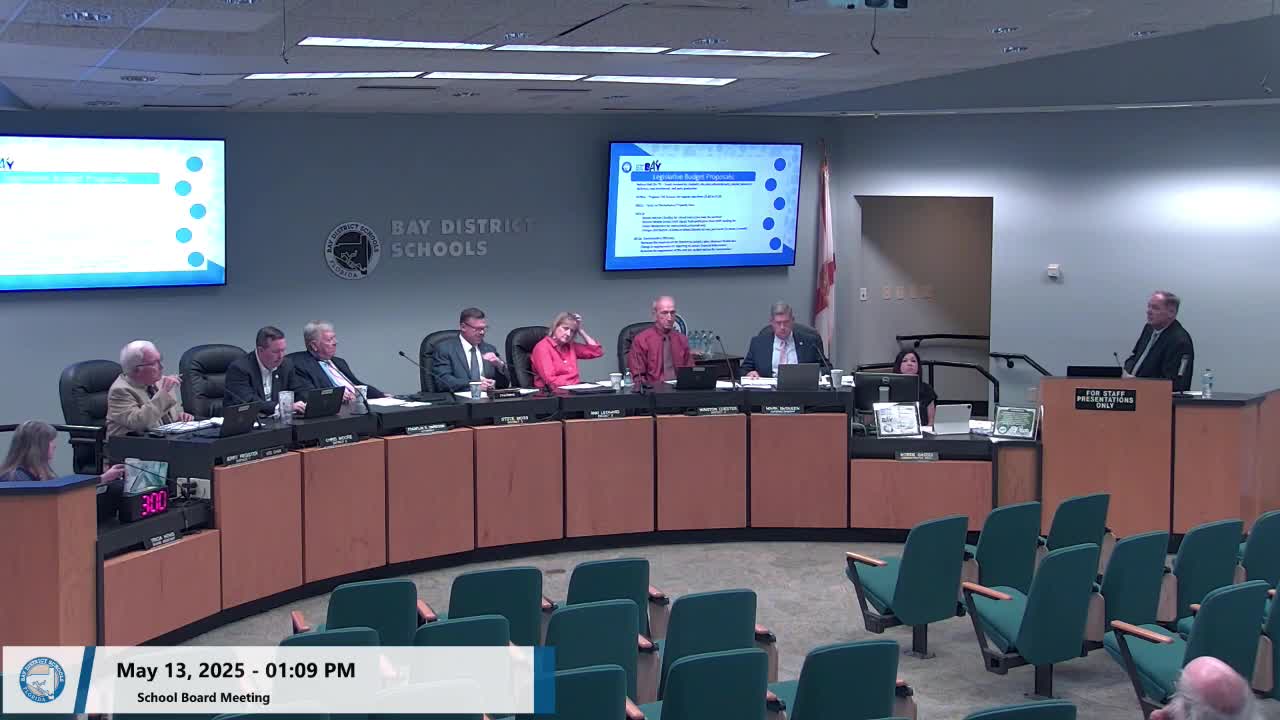
School district finance officials told the Bay District School Board on a budget-workshop panel that uncertain action in Tallahassee on the state education appropriation and expanding opportunity scholarship (voucher) enrollments may force the district to shift spending, reduce appropriations or seek more local revenue.
"If both of those happen, they're gonna have to flip over to the appropriation side and either move a lot of things around or cut a lot of things," a district finance presenter said during the workshop. He added that under the state funding formula the state effectively determines some per‑student allocations and that reducing one revenue source typically requires increasing another or cutting the appropriation.
The presentation included FTE (full‑time equivalent) counts and projections: the district reported roughly 22,000 FTE in traditional schools and projected only about 15 FTE growth next year in that sector. Officials said charter enrollment ticked down slightly, while opportunity scholarship participation (what district staff described as the state’s scholarship/homeschool funding) has risen sharply and previously cost the district about $2 million in a recent year.
The district noted the legislature’s proposed base student allocation changes were modest in both chambers at the time of the workshop: the House draft showed an increase of roughly $50 per student and the Senate draft about $66, though officials cautioned those figures frequently change before final action. Presenters said the net effect, after inflation and increased retirement or other mandated costs, could be negligible or even negative for district operations.
Board members asked whether the state might shift the timing of scholarship payments; staff said the state was considering distributing scholarship funds in increments (monthly or quarterly) rather than a single upfront payment. The district previously received large upfront scholarship payments that created budget timing challenges for some systems.
Officials reviewed the tentative budget calendar: a June 24 budget workshop, a July 24 board approval of the tentative budget for advertising, tentative budget advertising starting July 28, and a final budget hearing on Sept. 11. Staff said the district typically has about three weeks between final state numbers and the board’s adoption of a tentative budget, making the period for final adjustments short.
Board members pressed staff on potential local options to raise revenue, including millage adjustments, and staff responded that only a subset of counties levy a millage that significantly increases local revenue for schools. One board member noted many neighboring districts already levy that millage.
The presenters warned that additional legislative changes could place new mandates on the district without accompanying funds, and that the district is preparing departmental appropriation plans to be ready when state numbers settle. The board scheduled follow‑up budget workshops on June 24 and Aug. 26 to refine assumptions and consider appropriation adjustments.
Ending: District staff said they will return to the board with updated appropriation figures and scenarios once the Legislature and the governor finalize the state K‑12 budget, and that the June 24 workshop will be an early opportunity to adjust departmental plans in light of any new revenue or mandate changes.