Get Full Government Meeting Transcripts, Videos, & Alerts Forever!
Get email alerts on the Infrastructure Planning topic
No spam. Unsubscribe anytime.
Candlestick Point Phase 2 infrastructure update: outfall, Harney Way extension and workforce opportunities outlined
Summary
5Point and OCII presented infrastructure planning next steps for Candlestick Point Phase 2, highlighting outfall design, separated sewer benefits, a Harney Way extension and a breakdown of near-term construction job classifications and small-business opportunities.
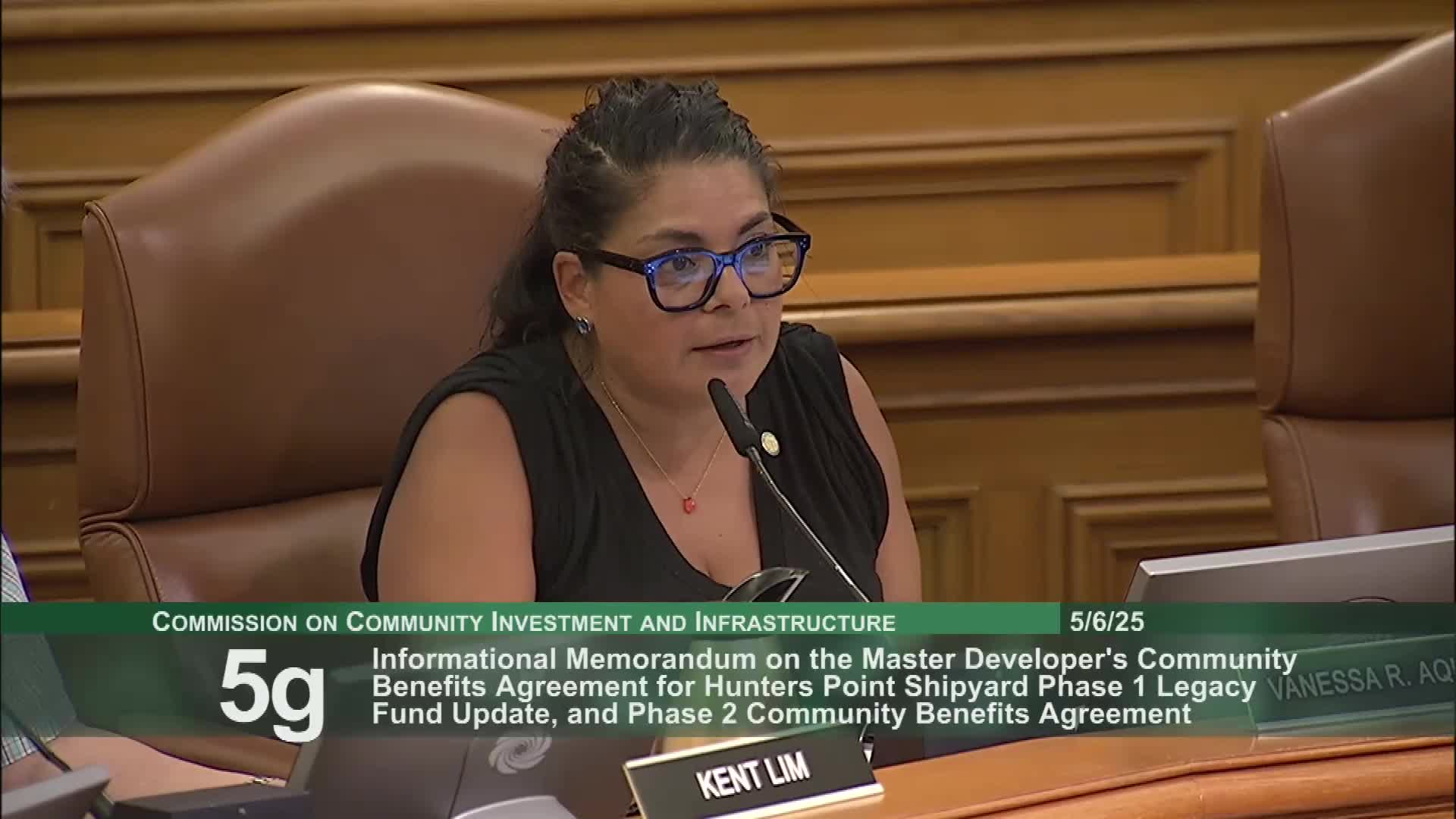
Representatives for the Candlestick Point Phase 2 effort briefed the commission on infrastructure planning and next steps on May 6, emphasizing permitting and design work ahead of construction and detailing the kinds of trades and small-business roles that will be in demand.
LaShawn Walker of 5Point said 2024 involved extensive public outreach (about 25 public meetings) and that 2025 is focused on permitting and design approvals required to start infrastructure construction. OCII27s Katarina Kidd described the scope of infrastructure work, which includes underground utilities, stormwater and outfall systems, power and communications, and above-ground elements such as complete streets, sidewalks, tree canopy, transit-priority lanes and landscaped public spaces.
A key technical element staff highlighted is construction of an outfall (stormwater discharge) to the bay and related permitting with the California State Lands Commission and other agencies. Director Kozlowski and staff said one long-term benefit of the Candlestick program is creating a separated sewer system (separate stormwater and sanitary sewer), which reduces combined-sewer flows to treatment facilities and improves water-quality management.
Walker and Kidd outlined the Harney Way extension as a first-phase public-street project. Design and permitting work is underway in 2025 with final construction filing and review; staff said that the street design is approximately 90% complete and that shovels-in-ground for Harney Way are anticipated to begin in 2026, with broader street and infrastructure work phased through 2028.
Because infrastructure work requires many types of trades, 5Point provided a detailed table of construction job classifications and small-business opportunities tied to each work category (demolition, earthwork, utilities, streetscapes, landscape, stormwater, structural work, etc.). OCII and 5Point said the purpose of breaking the job categories down now is to give workforce and small-business partners (CityBuild, contractors, training programs) clearer lead time to prepare workers, apprentices and local firms for upcoming bid opportunities.
Commissioners lauded the level of detail and asked for regular updates; staff said they intend to return periodically during the permitting and design phase and will coordinate with workforce partners so training programs can be timed to hiring needs.
No formal action was required; the presentation was informational.